Manufacturing of Authorized Generics: Who Actually Makes Them
 Jul, 27 2026
When you pick up a prescription at the pharmacy, you might notice two versions of the same medication on the shelf: the familiar brand-name box and a cheaper alternative with different packaging. If that cheaper option is an authorized generic, it isn't made by a random third-party factory trying to copy the formula. It is made by the very same company that created the brand-name drug-or by a subsidiary they completely own. This distinction matters because it changes who controls the quality, how the price is set, and why these drugs exist in the first place.
The question "who actually makes them" has a straightforward answer but complex implications. Authorized generics are not traditional generics approved through the standard Abbreviated New Drug Application (ANDA) process. Instead, they are marketed under the original brand's New Drug Application (NDA). This means the manufacturer doesn't have to prove bioequivalence from scratch; they just change the label. But who holds that label? And where does the pill actually get pressed?
Defining the Manufacturer: The NDA Holder
To understand who makes authorized generics, we first need to define the entity responsible for them. In regulatory terms, the manufacturer is the New Drug Application (NDA) holder. This is typically the pharmaceutical company that originally developed the drug and received FDA approval for its safety and efficacy. Under the Hatch-Waxman Act of 1984, this framework allows brand companies to maintain market presence while introducing lower-priced versions of their own products.
An authorized generic is defined by the FDA as a listed drug approved under subsection 505(c) of the Federal Food, Drug, and Cosmetic Act that is marketed with labeling, packaging, or trade names differing from the listed brand drug. Crucially, the active ingredient, strength, dosage form, and route of administration remain identical to the brand-name product. The only difference is the marketing strategy. The NDA holder retains full regulatory responsibility for the product, regardless of whether the pills are physically produced in their main facility or outsourced.
This structure creates a unique dynamic. Unlike traditional generic manufacturers who compete against the brand, the authorized generic manufacturer *is* the brand. They capture the generic market share without losing control over product quality or manufacturing processes. As of Q3 2023, the FDA reported 217 active authorized generic products in the U.S. market, representing approximately 7.3% of all generic drug entries. These aren't niche experiments; they are a significant part of the pharmaceutical landscape.
Two Pathways for Production
While the NDA holder is legally the manufacturer, the physical production can happen in two distinct ways. Understanding these pathways clarifies the "who" in your question.
- In-House Manufacturing (Same Facility): The NDA holder produces the exact same drug product as stated in their original NDA. This means the formulation, manufacturing process, and site are identical to the brand-name version. The only change is the label. To do this, the company files an annual report with the FDA, allowing immediate marketing upon label approval. According to US Pharmacist's 2022 analysis, approximately 68% of authorized generics follow this path. They come out of the same factory lines as the expensive brand-name pills.
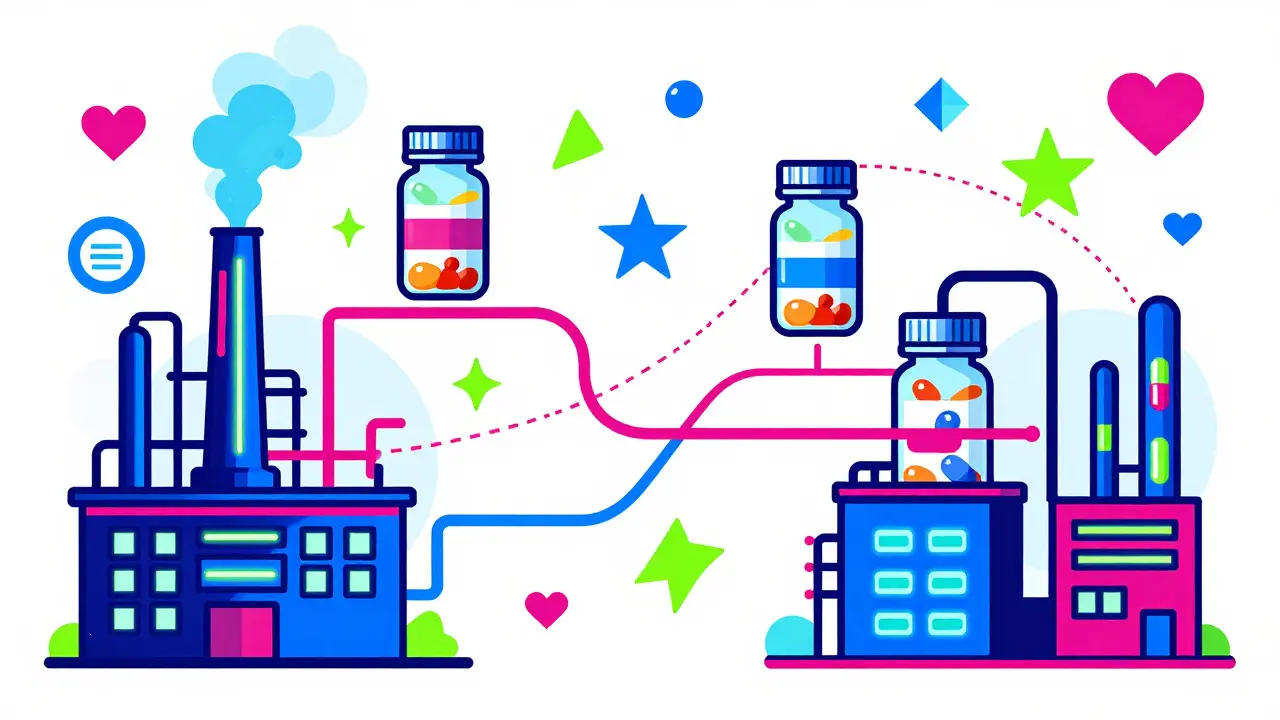
- Contract Manufacturing (Third-Party): The NDA holder contracts another company to produce the generic version. Ideally, this contract manufacturer uses the same formulation, process, and testing protocols as the brand. However, this requires adding the new manufacturing site to the NDA. This involves either a Prior Approval Supplement (PAS), which averages 22 months for FDA approval as of 2023, or a Change Being Effected in 30 days (CBE30) submission if circumstances permit. Only about 17% of authorized generics use this third-party model.
The critical distinction here is regulatory oversight. Even if a third party makes the pills, the NDA holder must notify the FDA when marketing the authorized generic and remains liable for any quality issues. This differs sharply from traditional generics, where the ANDA holder bears sole responsibility.
Case Studies: Pfizer’s Greenstone and Novartis’ Strategy
Abstract definitions help, but real-world examples show how this works in practice. Consider Greenstone LLC, a U.S.-based company wholly owned by Pfizer Inc.. Since 1998, Greenstone has provided authorized generic versions of Pfizer’s brand-name medications. Today, it manufactures over 70 authorized generics across various therapeutic areas. All of these are produced using the same manufacturing processes and facilities as their branded counterparts. For consumers, the drug inside the bottle is chemically identical to the brand-name version; only the outer box and the price tag differ.
Another notable example involves Novartis and its drug Comtan (entacapone). In January 2023, Drug Patent Watch highlighted how Novartis launched an authorized generic version of Comtan through a third-party manufacturer. Despite using an external partner, Novartis maintained identical active pharmaceutical ingredient sourcing and manufacturing protocols. The only changes were the labeling and packaging. This case demonstrates that even when production is outsourced, the brand company exerts tight control to ensure the authorized generic mirrors the brand exactly.
| Feature | Authorized Generic | Traditional Generic |
|---|---|---|
| Regulatory Pathway | New Drug Application (NDA) | Abbreviated New Drug Application (ANDA) |
| Manufacturer Identity | NDA Holder or Subsidiary | Independent Third Party |
| Facility Overlap | 68% same facility as brand | 12% same process as brand |
| Bioequivalence Study | Not required (uses brand data) | Required |
| Market Share Goal | Capture generic revenue for brand owner | Displace brand sales |
Why Brands Choose This Model
You might wonder why a profitable brand company would undercut itself. The answer lies in market strategy. Expert analysis from Avalere Health’s 2019 report indicates that brand manufacturers use authorized generics to maintain market control during patent challenges. By entering the generic market themselves, they prevent independent competitors from capturing the entire low-price segment.
Dr. Dan Leonard, President of the FDA’s Generic Drug User Fee Amendments (GDUFA) committee, noted in a 2022 advisory meeting that authorized generics represent a sophisticated strategy where brand companies compete against traditional generics while maintaining quality control. From a financial perspective, IQVIA’s 2022 Generic Drug Market Analysis shows that authorized generics now account for approximately $4.7 billion in annual U.S. pharmaceutical sales, up from 6.1% of the total generic market in 2018.
The most successful example is the generic version of AstraZeneca’s Nexium, manufactured by AstraZeneca’s subsidiary Az generici. It achieved $1.2 billion in annual sales in 2022. By controlling the supply, AstraZeneca ensured that even after patent expiration, a significant portion of the savings went back to them rather than to unrelated generic competitors.
Quality Control and Regulatory Oversight
A common concern among patients is whether authorized generics are "just as good." The data suggests they are. The FDA requires all manufacturing facilities to comply with Current Good Manufacturing Practices (cGMP) outlined in 21 CFR Parts 210 and 211. There are no exceptions for authorized generics.
In fact, the inspection data favors them. The FDA’s 2022 inspection data showed that facilities producing authorized generics had a 98.7% cGMP compliance rate, compared to 96.2% for traditional generic manufacturers. This higher rate likely stems from the fact that many authorized generics are made in the same high-standard facilities as the brand-name drugs.
However, operational challenges exist. Premier Consulting’s 2023 case studies highlight the difficulty of maintaining identical product performance while changing only the labeling. When Teva launched an authorized generic version of its own Copaxone in 2021, it had to maintain identical glass vial specifications and lyophilization processes while changing only the label design. This required significant investment in dedicated packaging lines to avoid cross-contamination of branding materials.
Future Trends and Transparency
The landscape is shifting toward greater transparency. In response to concerns raised by the Government Accountability Office in 2022, the FDA announced in July 2023 that NDA holders must disclose whether authorized generics are manufactured in the same facility as the brand-name product. This implementation began on January 1, 2024.
Industry analysts at Clarivate anticipate a 15-20% increase in authorized generic manufacturing through wholly-owned subsidiaries by 2025. This trend is driven by the impending expiration of patents on major drugs, including the $127 billion in brand-name drugs expected to lose exclusivity over the next five years. A key upcoming shift involves the 2025 patent expiration of Humira, where AbbVie has established a manufacturing arrangement with its subsidiary Soliris Generics to produce an authorized generic version.
Despite debates about pricing impact, the FDA’s GDUFA III provisions aim to streamline the notification process while maintaining rigorous quality oversight. For consumers and healthcare providers, understanding that the maker of an authorized generic is essentially the brand company itself provides clarity on both quality expectations and market dynamics.
Who owns the rights to manufacture an authorized generic?
The rights belong to the New Drug Application (NDA) holder, which is typically the original brand-name pharmaceutical company. They can choose to manufacture it themselves, through a wholly-owned subsidiary, or via a contract manufacturer under strict oversight.
Are authorized generics made in the same factory as the brand-name drug?
In about 68% of cases, yes. They are produced in the exact same facilities using the same processes and formulations. The remaining 32% are made by third-party contractors or subsidiaries, often requiring additional regulatory approvals for the new site.
Is an authorized generic the same as a regular generic?
Chemically and therapeutically, yes. Both contain the same active ingredients. However, regulated differently: authorized generics are marketed under the brand's NDA, while regular generics go through the ANDA process. Authorized generics are also directly controlled by the brand company.
Why do pharmaceutical companies create authorized generics?
Companies use them to capture market share in the generic space before independent competitors enter. It allows them to offer a lower price point while retaining control over quality and keeping profits within their corporate family, especially during patent litigation periods.
Does the FDA regulate authorized generics differently?
They meet the same quality standards (cGMP) as brand-name drugs. However, the approval pathway is different because they rely on the existing NDA rather than filing a new ANDA. Recent FDA rules require more transparency about the manufacturing source starting in 2024.
MiMi Stanley
July 29, 2026 AT 01:47I never really thought about who was actually making the generic version of my meds. I just assumed it was some random factory somewhere. This explains a lot about why some generics feel exactly the same as the brand name while others don't. It makes sense that if Pfizer is making both, the quality control would be tighter. I guess I should check the packaging next time I pick up a prescription to see if it's an authorized generic or not.
Najmunisa Govender
July 31, 2026 AT 00:18This is such an important distinction!; and honestly; it makes me feel a little better about taking cheaper options.; knowing that the original company is still responsible for the quality gives me peace of mind.; I used to worry that 'generic' meant 'cheaply made'; but this article clarifies that at least for authorized generics; the standards remain high.; thank you for sharing this information!
Crystal Tadlock
August 1, 2026 AT 23:55It's all a big scam. They just want your money. The big pharma companies are evil and they control everything. They make the drug then sell it to themselves under a different name so they can keep the profits. Don't trust them. They lie about everything. The FDA is in their pocket too. Wake up people.
Tad Cronn
August 3, 2026 AT 04:43You're missing the bigger picture here. The real issue isn't who makes the pill, it's the patent system itself. Big Pharma creates artificial scarcity to jack up prices. Authorized generics are just a way for them to bleed off excess demand without losing their monopoly grip on the market. It's predatory pricing disguised as consumer benefit. You think you're saving money, but you're just keeping the corporation alive longer. The whole NDA vs ANDA thing is legal jargon designed to confuse the public into accepting higher costs for healthcare.
Vineet Hawelia
August 4, 2026 AT 00:47That is an interesting perspective, though perhaps slightly cynical. From a regulatory standpoint, the transparency required by the FDA does offer some assurance. The fact that 68% of these are produced in the same facilities as the brand-name drugs suggests a logistical efficiency rather than purely malicious intent. It allows for consistent supply chains during patent expiration periods. While the profit motive is undeniable, the mechanism itself ensures that patients have access to lower-cost alternatives without compromising on the established safety profile of the original medication.
Laura Odom
August 4, 2026 AT 07:52nah i think its just capitalism doing what it does best. they find a loophole and exploit it. why fight the generic makers when you can BE the generic maker? its clever in a dark way. like watching a spider eat its own web to build a new one. we are just the flies getting stuck in the process. its sad really but also kinda funny how they outsmarted the whole system.
Katie Caruthers
August 6, 2026 AT 03:16It feels so manipulative doesn't it? Like they are playing us for fools. We think we are getting a deal but really they are just protecting their empire. It makes me so angry that they have to do this instead of just lowering the price of the brand name drug. It shows how greedy they are. They don't care about us they only care about the bottom line. It's disgusting really.
Megan Crossland
August 7, 2026 AT 10:38just take the pills and move on