Renal Nutrition: Protein Targets for CKD Stages Explained
 Mar, 20 2026
When your kidneys aren’t working well, what you eat matters more than you might think. Not all protein is equal when it comes to kidney health-and cutting too much, or too little, can make a big difference in how fast your disease progresses. For people with chronic kidney disease (CKD), getting protein right isn’t about going low-carb or high-protein. It’s about finding the protein target that matches your stage of disease, your body size, and your overall health.
Why Protein Matters in CKD
Your kidneys filter waste from your blood, and one of the biggest waste products comes from protein. When you eat protein, your body breaks it down into nitrogen-containing compounds like urea. Healthy kidneys handle this easily. But when kidney function drops, these wastes build up. That’s what causes fatigue, nausea, and the feeling of being constantly “off.”
For decades, doctors have known that lowering protein intake can slow this buildup. The goal? Reduce strain on the kidneys, delay the need for dialysis, and help you feel better longer. Studies show that sticking to the right protein level can push off dialysis by 6 to 12 months. But here’s the catch: too little protein can lead to muscle loss, weakness, and malnutrition-which is just as dangerous.
Protein Targets by CKD Stage
There’s no one-size-fits-all number. Protein needs change as kidney function declines. Here’s what the latest guidelines say, based on your estimated glomerular filtration rate (eGFR):
- CKD Stage 1-2 (eGFR ≥60): Aim for 0.8 grams of protein per kilogram of body weight per day. For a 150-pound person (68 kg), that’s about 54 grams daily. This isn’t a restriction-it’s just avoiding excess. Most people eat more than this already.
- CKD Stage 3a (eGFR 45-59): Stay around 0.6-0.8 g/kg/day. Some newer research suggests higher intake (up to 0.8) may be safer for older adults, especially if they’re losing weight or muscle.
- CKD Stage 3b-4 (eGFR 15-44): Target 0.55-0.60 g/kg/day. That’s roughly 40-54 grams for a 150-pound person. At this stage, protein restriction has the strongest evidence for slowing kidney decline.
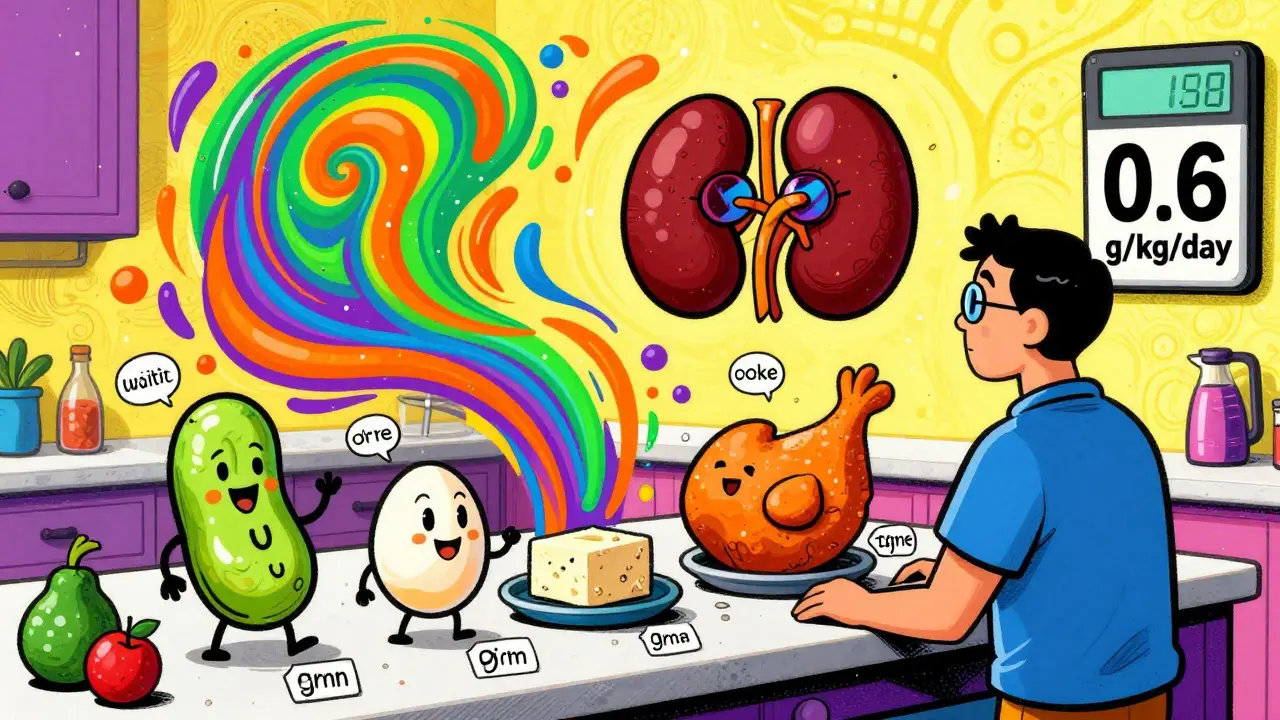
- CKD Stage 5 (eGFR <15, not on dialysis): Stick to 0.6 g/kg/day. If you’re on dialysis, your needs jump back up-this guide doesn’t cover dialysis patients.
These numbers aren’t guesses. They’re based on large studies like the MDRD trial and the 2024 JAMA Network Open analysis, which looked at over 12,000 adults with CKD. The key takeaway? Don’t go below 0.55 g/kg unless your dietitian says so. Going too low increases your risk of wasting.
Animal vs. Plant Protein: Which Is Better?
Not all protein sources are created equal for your kidneys.
Animal proteins-like meat, eggs, and dairy-have all the essential amino acids your body needs. But they also produce more urea and phosphate per gram. Red meat, in particular, generates higher levels of advanced glycation end products (AGEs), which fuel inflammation and may speed up kidney damage.
Plant proteins-beans, lentils, tofu, nuts, and whole grains-create less waste. Studies show swapping just 30% of animal protein for plant protein can lower your risk of CKD worsening by 14% and cut death risk by 11%. That’s huge.
But plant proteins have a downside: they’re often low in lysine and methionine. If you’re eating mostly plants, you need to combine sources-like rice and beans-to get all the amino acids. And don’t forget potassium. Many plant foods (potatoes, spinach, bananas) are high in potassium, which can be dangerous if your kidneys can’t clear it. Stage 4-5 patients especially need to watch this.
Special Cases: Diabetes and Older Adults
If you have both diabetes and CKD, protein targets get trickier. The American Diabetes Association recommends 0.8-0.9 g/kg/day. Why? Because too little protein can hurt muscle and healing, and muscle loss makes blood sugar harder to control.
For older adults (over 65), the rules shift again. A 2024 study found that higher protein intake (0.8-1.0 g/kg) was linked to lower death rates-even in CKD stages 1-2. Why? Because many older people with CKD die from heart disease before their kidneys fail. Muscle loss increases fall risk, infections, and hospital stays. For them, preserving strength may matter more than slowing kidney decline.
What Works in Real Life?
Knowing the numbers is one thing. Eating by them is another.
On patient forums, 74% of people say they feel hungry all the time on a low-protein diet. 62% report muscle weakness. Many stop following the plan because it feels isolating-dining out, family dinners, holidays become stressful.
But here’s what helps:
- Use a protein calculator. The National Kidney Foundation’s free app lets you scan foods and see how much protein you’ve eaten. Over 47,000 people have downloaded it since 2023.
- Focus on quality. Half your protein should come from high-biological-value sources: eggs, milk, poultry, fish, lean beef, soy. These give you the most bang for your protein buck.
- Meal prep. The Kidney Kitchen website gets 1.2 million visits a month. Their recipes are designed to keep protein low while keeping meals satisfying.
- Work with a dietitian. Patients who see a renal dietitian are 82% more likely to stick with the plan and report better quality of life. And yes-Medicare now covers 3 hours of initial nutrition counseling and 2 hours of follow-up each year.
Most people struggle to track protein in mixed dishes. A chicken stir-fry with rice and veggies? That’s hard to guess. Apps like MyFitnessPal now have renal-specific databases that help. Some patients also use keto acid analogues like Ketosteril, which provide essential amino acids without the nitrogen waste. These are prescribed to about 15% of stage 4-5 patients in Europe.
The Bigger Picture
The global market for renal nutrition products hit $1.7 billion in 2023. Companies like DaVita and Fresenius are investing heavily in meal plans, supplements, and education tools. But here’s the gap: only 35% of nephrologists refer patients to dietitians, even though guidelines say they should.
New research is changing how we think. The NIH-funded PRECISE-CKD trial is testing whether protein targets should be personalized-not just based on weight, but on your body’s actual urea production. Imagine a future where your protein goal is set by a scan, not a chart.
One thing is clear: protein restriction works-but only if it’s sustainable. The goal isn’t to eat less protein. It’s to eat the right kind, in the right amount, for your life. For many, that means eating more plants, fewer processed meats, and getting help from a professional who understands the balance between kidney protection and quality of life.
By 2030, experts agree: individualized protein management will still be at the heart of CKD care. But the focus is shifting-from just counting grams-to choosing smart, sustainable, and nourishing foods that help you live well, not just survive.
How much protein should I eat if I have CKD stage 3?
For CKD stage 3 (eGFR 30-59), aim for 0.6 to 0.8 grams of protein per kilogram of body weight daily. For example, a 150-pound person (68 kg) should eat about 41 to 54 grams of protein per day. If you’re older, active, or losing weight, your dietitian may recommend the higher end of this range to protect muscle mass.
Can I eat beans and lentils with CKD?
Yes-but with caution. Beans and lentils are excellent plant-based proteins and produce less kidney waste than meat. However, they’re high in potassium and phosphorus. If you’re in stage 4 or 5, you may need to limit portions or soak and rinse them thoroughly to reduce these minerals. Pair them with low-potassium foods like rice or pasta to balance your meal.
Is a vegetarian diet safe for CKD?
A well-planned vegetarian diet can be safe and even beneficial for CKD. Plant proteins reduce urea and phosphate load, which helps slow kidney damage. But you must combine different plant sources-like beans with rice or tofu with whole grains-to get all essential amino acids. Work with a renal dietitian to avoid low protein intake and manage potassium levels.
What happens if I eat too much protein with CKD?
Eating more than 1.2 grams of protein per kilogram of body weight can increase the workload on your kidneys. This may speed up the decline in kidney function and worsen symptoms like fatigue, nausea, and swelling. Studies show that high protein intake in CKD stages 3-5 is linked to faster progression to dialysis. It’s not about being “bad”-it’s about protecting your kidneys long-term.
Do I need protein supplements for CKD?
Most people don’t need supplements. Real food is better. But if you’re struggling to meet your protein goal without exceeding phosphorus or potassium limits, your dietitian might recommend keto acid analogues (like Ketosteril). These provide essential amino acids without the nitrogen waste. They’re not over-the-counter-they require a prescription and monitoring.
Desiree LaPointe
March 20, 2026 AT 15:46And for the love of all that is holy, stop pretending 0.55 g/kg is some magical number. My aunt’s eGFR is 22 and she eats two eggs for breakfast, a turkey sandwich for lunch, and a steak for dinner. She’s got more muscle than half the gym bros in Ohio. Maybe the real problem isn’t protein-it’s that doctors are scared to say ‘you’re fine, just don’t eat 3lbs of tofu a day.’
Paul Cuccurullo
March 20, 2026 AT 18:44It is important to remember that each individual’s journey is unique, and while guidelines provide a framework, personalized care remains paramount. I hope this resource reaches those who need it most-those silently navigating the complexities of renal health without adequate support.
Nishan Basnet
March 22, 2026 AT 17:30What no one talks about is how hard it is to track protein without obsessing over food scales. I use an app now, and it’s changed everything. Also, don’t forget hydration. Water isn’t just for flushing toxins-it helps your body use protein more efficiently. And yes, I’ve stopped eating processed meats. Not because of some dogma, but because I feel better. Simple stuff.
Chris Dwyer
March 23, 2026 AT 15:32Turns out, I was in stage 3a and needed closer to 0.7g/kg. I started adding a scoop of whey isolate (low phosphorus!) and a few more eggs. My strength’s coming back. You don’t have to suffer to protect your kidneys. Small, smart changes = big wins. You got this.
trudale hampton
March 24, 2026 AT 21:41Also, I don’t care what the numbers say-I eat what I can tolerate. If I feel good after a meal, that’s my target. Science is great, but so is listening to your own body.
Solomon Kindie
March 26, 2026 AT 14:14also who the hell measures protein in grams per kg of body weight like are we all bodybuilders now
also why is there no mention of potassium or phosphorus like are we just pretending protein is the only thing that matters
also i think the whole system is rigged and we should all just eat pizza and chill
Natali Shevchenko
March 27, 2026 AT 18:55It’s about listening. To the fatigue. To the cravings. To the quiet voice that says, ‘I need something warm and salty today.’ That’s not weakness. That’s wisdom. The guidelines are a map, not a cage. You’re not failing if you eat a burger once a month. You’re surviving. And survival, in its quiet, imperfect form, is the most radical act of care we have.
Bryan Woody
March 29, 2026 AT 14:30Real talk: if you’re in stage 3b, you need 0.55–0.6g/kg, yes-but you also need to avoid hidden phosphorus additives. Read labels. Skip deli meat. Skip flavored yogurt. Stop pretending ‘low-protein’ means ‘eat tofu and sad salads.’ Eat real food. Eggs. Lean chicken. Cottage cheese. Drink water. Sleep. Move. That’s the protocol. The rest is noise.
Timothy Olcott
March 31, 2026 AT 01:32My cousin with CKD eats 3 steaks a day and still hikes mountains. Science is just woke propaganda anyway. #RealFood #NoDialysis
shannon kozee
April 2, 2026 AT 01:00