QD vs. QID: How Prescription Abbreviation Confusion Causes Dosing Errors
 Jul, 17 2026
Imagine taking a blood pressure pill four times a day when your doctor meant for you to take it just once. For one construction inspector, this wasn't a hypothetical nightmare-it was his reality for an entire week. He drove with his seven-year-old daughter in the car, feeling excessively drowsy and sedated, only realizing the mistake when he went to refill his prescription. This is the dangerous reality of QD vs QID confusion, a critical medication safety issue that continues to threaten patients worldwide despite decades of warnings.
The abbreviations QD (meaning 'once daily') and QID (meaning 'four times daily') look nearly identical on paper. A simple smudge, a hurried scribble, or a misread letter can turn a safe dose into a potentially life-threatening overdose. While electronic health records have helped, these Latin-based shortcuts remain a leading cause of preventable harm. Understanding why this error persists and how to stop it is essential for anyone managing their own medications or caring for others.
The Roots of the Confusion: Why QD and QID Look So Similar
To understand the risk, we first need to look at where these terms come from. Both QD and QID are derived from Latin medical terminology used by doctors for centuries. QD stands for quaque die, which translates to "every day" or "once daily." QID stands for quater in die, meaning "four times a day." The visual similarity between the two strings of letters-especially when handwritten-is striking. The difference is essentially just the addition of the letters 'i' and another 'd'.
Institute for Safe Medication Practices (ISMP) is a nonprofit organization dedicated to reducing medication errors through education, research, and advocacy. They identified QD as high-risk early on.
The Institute for Safe Medication Practices (ISMP) flagged these abbreviations as high-risk back in 2001. Recognizing the danger, The Joint Commission added them to their official "Do Not Use" list in 2004. Yet, the habit persists. According to the American Medical Association's 2015 prescribing guidelines, about 30% of handwritten prescriptions still use these ambiguous abbreviations. Even in digital systems, providers sometimes override standard options, keeping the old habits alive.
What QD and QID Actually Mean for Your Schedule
Beyond the spelling confusion, there is also a misunderstanding of what these frequencies actually require in practice. Many people assume that QID means taking medication every six hours, like clockwork. However, clinical guidelines clarify that QID typically refers to administration during waking hours.
According to the Montana Department of Public Health and Human Services, QID does not mean strict six-hour intervals. Instead, it means dividing doses approximately equally throughout the time you are awake-usually from around 6-7 AM until bedtime (8-10 PM). Similarly, BID (twice daily) generally means morning and evening, not exactly 12 hours apart. TID (three times daily) implies morning, mid-day, and evening. When a patient interprets QD as QID, they aren't just taking extra pills; they are disrupting their body's rhythm with unnecessary doses, often leading to toxicity.
| Abbreviation | Latin Origin | Intended Meaning | Common Misinterpretation |
|---|---|---|---|
| QD / q.d. | Quaque die | Once daily | Four times daily (QID) |
| QID / q.i.d. | Quater in die | Four times daily (waking hours) | Every 6 hours strictly |
| BID / b.i.d. | Bis in die | Twice daily | Every 12 hours strictly |
| TID / t.i.d. | Ter in die | Three times daily | Every 8 hours strictly |
The Real-World Impact: Who Gets Hurt?
The statistics behind this confusion are alarming. The U.S. Food and Drug Administration (FDA) reports that abbreviation-related errors account for roughly 5% of all medication errors reported to their MedWatch system. Within that category, QD/QID confusion is a major contributor. A 2018 study published in the Journal of Patient Safety found that QD was misinterpreted as QID in 12.7% of simulated prescription reviews. That rate jumps to 18.2% among healthcare professionals with less than five years of experience.
Elderly patients bear the brunt of this risk. The American Geriatrics Society noted in 2019 that adults aged 65 and older accounted for 68% of documented QD/QID confusion cases. This makes sense: older adults often manage complex regimens with multiple medications. If one drug is taken four times instead of once, it can interact dangerously with others. In one case shared on Reddit’s r/medicine forum, a nurse described a patient who took warfarin (a blood thinner) four times daily instead of once. The result was an INR level of 12.3-a dangerously high number indicating severe bleeding risk-requiring immediate hospitalization.
The economic toll is also significant. The Medicare Payment Advisory Commission estimates that medication errors related to prescription misinterpretation cost $2.1 billion annually. Of that, $780 million is specifically tied to frequency errors like this one. These costs include emergency room visits, hospitalizations, and lost productivity.
Why Electronic Systems Haven't Solved It Completely
You might wonder why modern technology hasn't fixed this problem yet. Electronic Health Records (EHRs) have certainly helped. The American Medical Informatics Association reported in 2022 that 87% of EHR systems now include built-in checks to prevent QD/QID confusion, up from just 42% in 2015. Major vendors like Epic and Cerner have implemented "hard stops" in their 2023 software updates, preventing providers from saving prescriptions if they type these forbidden abbreviations.
However, the problem isn't dead. An analysis by the Agency for Healthcare Research and Quality (AHRQ) in 2021 showed residual error rates of 3.8% in EHR systems where providers manually override standard dosing frequencies. Furthermore, 31% of community pharmacies still encounter handwritten prescriptions using these dangerous abbreviations, according to a 2023 survey by the American Society of Health-System Pharmacists. Independent practitioners who don't use integrated EHR systems are often the source of these lingering risks.
How to Prevent QD vs QID Errors Today
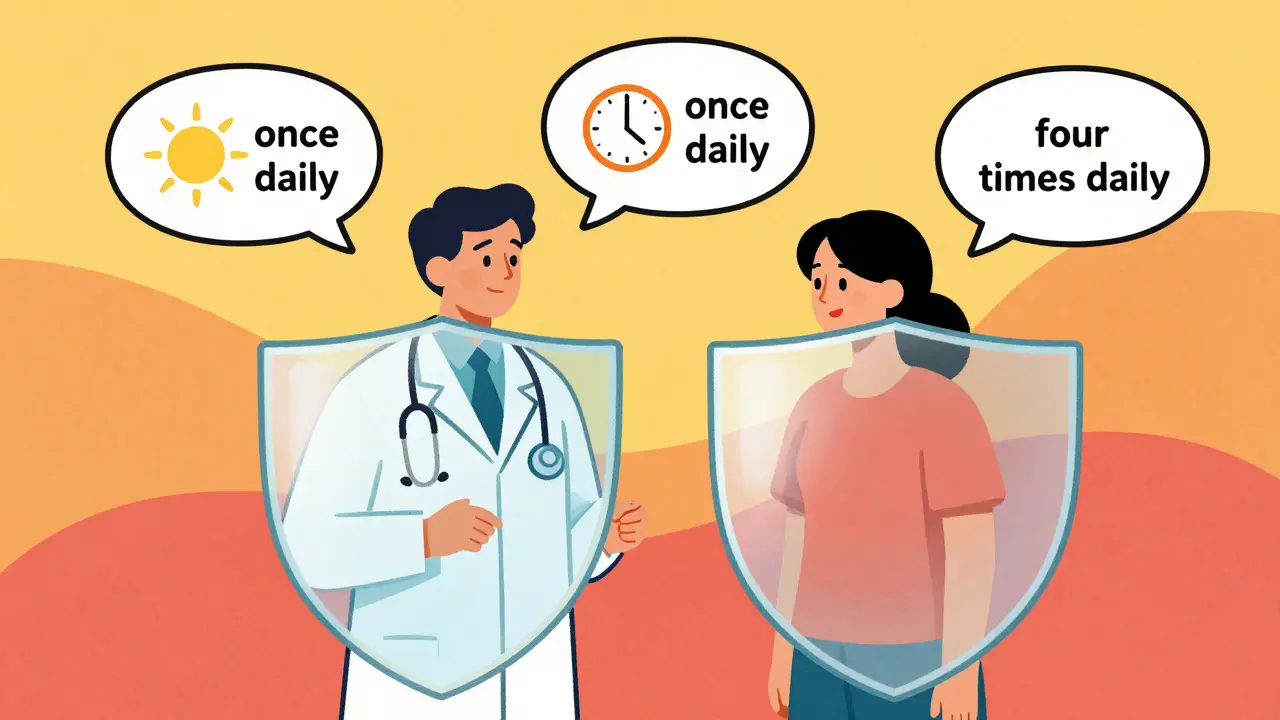
Preventing these errors requires action from both healthcare providers and patients. Experts unanimously agree: stop using the abbreviations entirely. Dr. Michael Cohen, President of the ISMP, called these abbreviations "relics of a pre-digital era." Writing out "daily" instead of "QD" adds only three to five characters but eliminates ambiguity.
For patients and caregivers, here are practical steps to protect yourself:
- Ask for Plain Language: When picking up a new prescription, ask the pharmacist, "Can you write out the instructions in plain English?" Avoid accepting labels that only use codes.
- Use Open-Ended Questions: The AHRQ recommends asking, "How often am I supposed to take this medication?" rather than yes/no questions like "Is this once a day?" This forces the provider to state the frequency clearly.
- Verify Visually: Look at the label carefully. If you see "QD" or "QID," double-check with your pharmacist immediately. Newer labels increasingly use icons or clear text like "Take 1 tablet every morning."">
- Conduct Verbal Verification: Studies from the University of Michigan Health System show that requiring pharmacists to verbally verify dosing frequency with every new prescription reduced errors by 67%.
Hospitals that have implemented systematic changes-such as eliminating abbreviations, adding computer alerts, and conducting quarterly audits-have seen a 35-50% reduction in frequency-related errors within six to nine months. The return on investment is strong, with the American Pharmacists Association noting an $8.70 return for every $1 invested in these safety measures.
The Future of Prescription Clarity
The momentum is shifting toward complete elimination of dangerous abbreviations. In June 2023, the American Medical Association updated its guidelines to mandate writing out "daily" in all circumstances. The FDA’s 2023 draft guidance explicitly recommends against using Latin abbreviations entirely. Additionally, the National Action Alliance for Patient Safety launched the "Clear Communication Campaign" in April 2023, aiming to reduce abbreviation-related errors by 90% by 2026.
Research continues to support this direction. A Johns Hopkins University study published in JAMA Internal Medicine in October 2023 demonstrated that adding visual aids to prescription instructions reduced QD/QID confusion by 82% in a randomized controlled trial. As CMS implements new Conditions of Participation effective January 1, 2024, healthcare facilities face penalties for preventable errors, further incentivizing clean communication.
The goal is simple: ensure that when a doctor writes "once daily," the patient takes it once daily. No guesswork, no Latin, no risk. By demanding clarity and supporting systemic changes, we can close this gap in patient safety.
What does QD mean on a prescription?
QD stands for the Latin phrase quaque die, which means "once daily" or "every day." It indicates that the medication should be taken one time per 24-hour period. However, because it looks similar to QID, many safety organizations recommend writing out "daily" instead to avoid confusion.
What does QID mean on a prescription?
QID stands for the Latin phrase quater in die, which means "four times daily." Contrary to popular belief, this usually does not mean taking the medication every six hours around the clock. Instead, it typically refers to taking the dose four times during normal waking hours, spaced out as evenly as possible.
Why are QD and QID considered dangerous abbreviations?
They are considered dangerous because they look visually similar, especially when handwritten. If a prescriber writes QD (once daily) but a pharmacist or patient misreads it as QID (four times daily), the patient may receive four times the intended dose. This can lead to severe side effects, toxicity, hospitalization, or even death. Both the ISMP and The Joint Commission list them on their "Do Not Use" lists.
Who is most at risk for QD/QID confusion errors?
Elderly patients (aged 65 and older) are at the highest risk, accounting for 68% of documented cases. They often manage multiple medications with complex schedules. Additionally, healthcare professionals with less than five years of experience are more likely to misinterpret these abbreviations, with error rates reaching 18.2% in some studies.
How can I prevent medication errors due to abbreviation confusion?
You can prevent errors by asking your doctor and pharmacist to use plain language instead of abbreviations. Ask open-ended questions like "How often should I take this?" Verify the instructions on the bottle match what you were told verbally. If you see QD or QID on a label, ask for clarification immediately. Supporting hospitals and clinics that implement electronic checks and verbal verification protocols also helps reduce risk.