Probiotics with Antibiotics: Best Timing to Reduce Side Effects
 Mar, 2 2026
Probiotic-Antibiotic Timing Calculator
How to Use This Calculator
Enter the time you take your antibiotic. The calculator will show the safe window for probiotics based on the 2-hour rule recommended by Harvard Medical School and the American Gastroenterological Association.
Enter your antibiotic time to see the recommended probiotic window
Why Timing Matters
Antibiotics can kill probiotic bacteria if they meet in your stomach or intestines too soon. The 2-hour rule ensures probiotics reach your intestines before the antibiotic hits. Studies show this spacing significantly reduces diarrhea risk and supports gut recovery.
Take probiotics at least 2 hours before or after your antibiotic dose for best results.
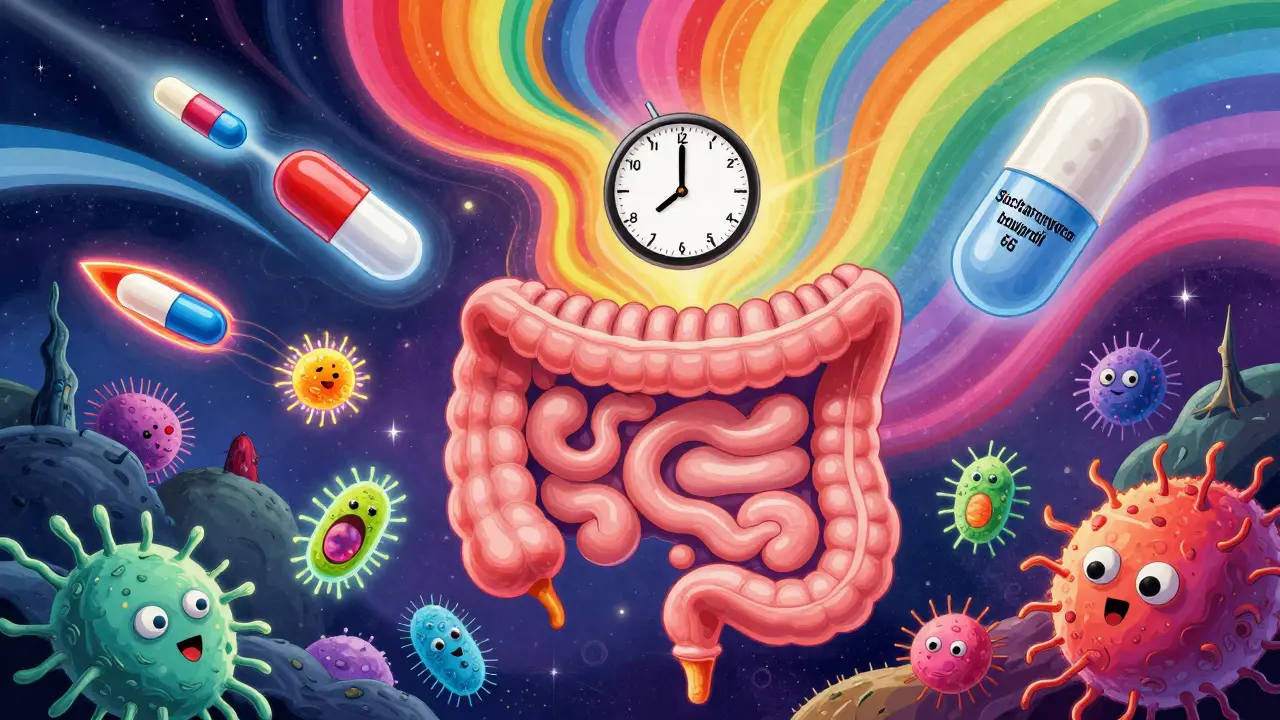
When you're on antibiotics, your gut takes a hit. The drugs kill off the bad bacteria causing your infection-but they don’t stop there. They also wipe out good bacteria that help with digestion, immunity, and even mood. This is why so many people end up with diarrhea, bloating, or stomach cramps during or after treatment. The solution? Probiotics. But not just any probiotics, and not just any time. Timing matters more than you think.
Why Antibiotics Mess Up Your Gut
Antibiotics don’t pick and choose. They’re like a sledgehammer to your gut microbiome. A 2018 study in Nature Microbiology found that even after just a week of antibiotics, it can take up to two years for your gut bacteria to fully bounce back. That’s not just a theory-it’s what real data shows. And during that time, you’re more likely to get sick again, develop food intolerances, or even feel more anxious. The reason? Your gut has thousands of bacterial species working together. When antibiotics knock out key players, the whole system gets unbalanced.Probiotics Can Help-But Not Always
Probiotics are live microbes that can help refill the gaps left by antibiotics. Strains like Lactobacillus rhamnosus GG and a yeast-based probiotic called Saccharomyces boulardii have the strongest evidence for preventing antibiotic-associated diarrhea (AAD). In fact, meta-analyses show they cut the risk of diarrhea by nearly half. That’s huge. But here’s the twist: not every study agrees. Some research, including a 2023 article from UCLA Health, found that taking probiotics during antibiotics might actually slow down your gut’s natural recovery. How? Because the introduced microbes might outcompete your own bacteria from coming back.This isn’t a simple yes-or-no question. It’s a balancing act. The Microbiology Society’s 2022 review and the 2024 Frontiers in Microbiomes study by D. John et al. both found benefits: less diarrhea, fewer antibiotic resistance genes, and better overall microbial stability. But the same 2024 review by J. Łukasik et al. looked at seven studies and found mixed results-some helped, some hurt, some did nothing. So what gives?
When to Take Probiotics: The 2-Hour Rule
The safest and most widely recommended approach? Space them out. Take your probiotic at least 2 hours before or after your antibiotic dose. Why? Because antibiotics can kill probiotic bacteria if they meet in your stomach or intestines too soon. Think of it like this: if you’re trying to plant seeds in a field that’s been sprayed with weed killer, you don’t plant them right after spraying. You wait.Harvard Medical School and the American Gastroenterological Association both back this timing. A 2023 Drugs.com poll of 1,875 people showed 42% took probiotics 2 hours after their antibiotic, and 38% took them 2 hours before. Both worked. What didn’t work as well? Taking them at the same time. Those users reported more stomach upset and less benefit.
Also, don’t just take probiotics during your antibiotic course. Keep going for 1-2 weeks after. Some experts, including the 2024 John study, suggest extending it to 4 weeks for broad-spectrum antibiotics like clindamycin or ciprofloxacin. Why? Because your gut doesn’t recover overnight. You need time to rebuild.
Which Probiotic Strains Actually Work?
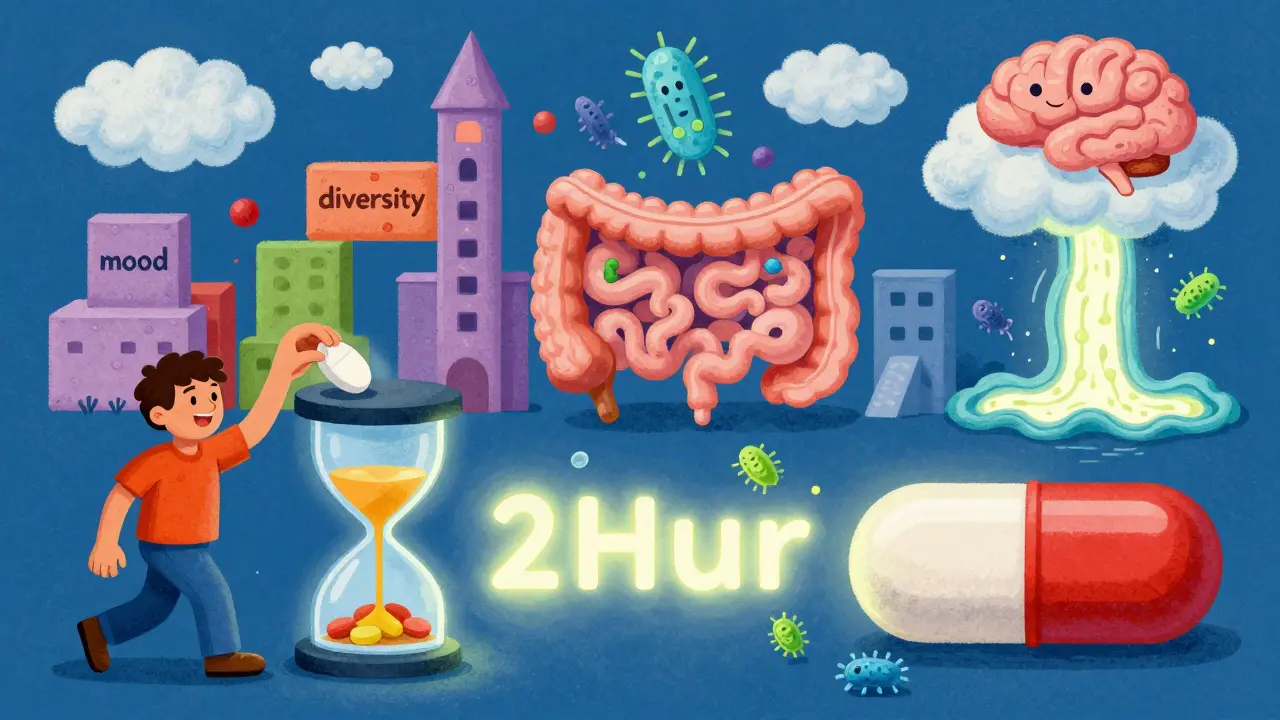
Not all probiotics are created equal. Out of over 500 commercial strains, only about five have solid evidence for reducing antibiotic side effects. Here’s what the data says:| Strain | Effectiveness for AAD | Dosage (CFU/day) | Storage Requirement |
|---|---|---|---|
| Lactobacillus rhamnosus GG | 26% more effective than multi-strain blends (Cochrane, 2022) | 10-20 billion | Refrigerated |
| Saccharomyces boulardii | Reduces diarrhea risk by 50% in multiple trials | 5-10 billion | Shelf-stable |
| Lactobacillus plantarum 299v | 37% better at preserving microbiome diversity (ISAPP, 2023) | 10-20 billion | Refrigerated |
| Bifidobacterium lactis BB-12 | Good for bloating and gas relief | 10-20 billion | Refrigerated |
| Lactobacillus acidophilus NCFM | Moderate benefit, best in combination | 5-10 billion | Shelf-stable |
Stick to these. Multi-strain blends sound impressive, but they’re not always better. In fact, a 2022 Cochrane review found single-strain products like L. rhamnosus GG outperformed complex mixes. Also, check the label. If it says “shelf-stable,” that’s fine-but refrigerated strains often have higher survival rates. A 2023 study in the Journal of Probiotics and Health showed refrigerated probiotics kept 85-90% of their live bacteria after 30 days. Shelf-stable? Only 65-70%.
What About Food-Based Probiotics?
Yogurt, kefir, sauerkraut, kimchi-these are great. But they’re not a replacement for supplements when you’re on antibiotics. Why? Because they contain far fewer live cultures. A typical yogurt has 1-2 billion CFU. A clinical dose? 10-40 billion. You’d need to eat 5-10 servings a day to match that. Plus, many store-bought yogurts are loaded with sugar, which can feed bad bacteria. If you’re eating fermented foods, fine. But don’t rely on them alone.Who Should Avoid Probiotics?
Probiotics are safe for most people. But not everyone. If you’re immunocompromised-due to chemotherapy, organ transplants, HIV, or long-term steroid use-you’re at risk for rare but serious infections from probiotic strains. The PMC article by Kopacz (2022) documented cases of bloodstream infections from Lactobacillus in vulnerable patients. If you’re unsure, talk to your doctor. Also, if you’ve had recent surgery, a central line, or a severe gut infection, proceed with caution.Another group: people with small intestinal bacterial overgrowth (SIBO). Probiotics can make bloating and gas worse. If you’ve been told you have SIBO, skip probiotics until you’ve treated it.

Real-World Results: What Users Say
On Reddit’s r/Probiotics community, over 60% of 1,450 users said probiotics helped them avoid diarrhea during antibiotics. One user wrote: “I took Saccharomyces boulardii during my 14-day amoxicillin course. Zero stomach issues. My friend skipped it and was in the bathroom every 2 hours.”But not everyone had luck. Healthline’s 2023 survey of 2,300 people found 17% got more bloating or gas from probiotics. That’s not a dealbreaker-it’s usually temporary. But it’s a sign your gut is adjusting. Start low: 5 billion CFU instead of 20. See how you feel. Then increase if needed.
The Bigger Picture: Resistance and Recovery
There’s more at stake than just diarrhea. Antibiotic resistance is a global crisis. And here’s something surprising: the 2024 John et al. study found that people taking probiotics had fewer antibiotic resistance genes in their gut over time. The placebo group? Their resistance genes bounced back to pre-treatment levels. The probiotic group? They kept declining. That’s not just good for you-it’s good for everyone. Fewer resistant bacteria mean fewer superinfections down the line.And now, new research from January 2025 in Nature suggests probiotics might even help with mood. After two weeks of use, participants reported less anxiety and irritability. That’s likely tied to the gut-brain connection. Your gut makes 90% of your serotonin. If antibiotics wreck your microbiome, your mood can crash too.
Final Advice: What to Do Right Now
If you’re about to start antibiotics:- Choose one proven strain: L. rhamnosus GG or Saccharomyces boulardii.
- Take 10-20 billion CFU daily.
- Take it at least 2 hours before or after your antibiotic.
- Keep taking it for 1-2 weeks after your antibiotics end.
- Store refrigerated strains in the fridge. Don’t leave them in your purse or car.
- If you feel bloated or gassy, lower the dose. Your gut is adapting.
- If you’re immunocompromised, ask your doctor first.
Don’t wait until you’re already sick. Start on day one of your antibiotic course. Probiotics aren’t magic. But when timed right, they’re one of the few things that actually help your gut survive the storm.
Can I take probiotics at the same time as antibiotics?
It’s not recommended. Antibiotics can kill the live bacteria in probiotics if they’re taken together. Spacing them 2 hours apart gives the probiotics time to reach your intestines before the antibiotic hits. Studies show better results when they’re separated.
Which probiotic strain is best for antibiotic side effects?
Lactobacillus rhamnosus GG and Saccharomyces boulardii have the strongest evidence for reducing antibiotic-associated diarrhea. L. rhamnosus GG is especially effective-26% more so than many multi-strain blends. Stick to these two unless your doctor recommends another.
Do I need to keep taking probiotics after antibiotics?
Yes. Your gut microbiome doesn’t recover overnight. Experts recommend continuing probiotics for at least 1-2 weeks after finishing your antibiotic course. For broad-spectrum antibiotics like clindamycin or ciprofloxacin, extend it to 4 weeks. This helps your native bacteria come back stronger.
Are probiotics from yogurt enough?
No. Most yogurts contain only 1-2 billion CFU per serving. Clinical doses for antibiotic support are 10-40 billion CFU. You’d need to eat 5-10 servings daily to match that. Plus, many yogurts are high in sugar, which can feed harmful bacteria. Supplements are more reliable.
Can probiotics make me feel worse?
Some people get bloating, gas, or temporary diarrhea when starting probiotics. This usually lasts a few days as your gut adjusts. If symptoms persist, lower the dose or switch strains. Avoid probiotics if you’re immunocompromised or have SIBO-talk to your doctor first.
Do probiotics reduce antibiotic resistance?
Yes. A 2024 study in Frontiers in Microbiomes found that people taking probiotics alongside antibiotics had fewer antibiotic resistance genes in their gut over time. The placebo group’s resistance genes returned to normal levels. Probiotics may help slow the spread of drug-resistant bacteria.
Darren Torpey
March 3, 2026 AT 07:14Yo, I took L. rhamnosus GG during my last round of amoxicillin and it was a game-changer. Zero stomach drama. My buddy skipped it and spent half his vacation in the bathroom. Seriously, if you're gonna do this, do it right. Don't just grab some random probiotic off the shelf - go for the ones with the data. And yeah, spacing it 2 hours apart? Non-negotiable. I set an alarm. Felt like a scientist with a schedule.
Lebogang kekana
March 4, 2026 AT 12:40LET ME TELL YOU SOMETHING - PROBIOTICS AREN'T JUST A SUPPLEMENT, THEY'RE A REBELLION AGAINST THE MODERN WORLD'S GUT-WRECKING MACHINE! 🚨
Antibiotics? They're not medicine - they're a nuclear strike on your inner ecosystem. And if you think yogurt is enough? Honey, that's like trying to refill a swimming pool with a teaspoon. I started taking Saccharomyces boulardii on day one. Two weeks later? My gut felt like a tropical rainforest after the monsoon. No bloating. No panic. Just peace. And yes, I'm still taking it. Because recovery isn't a checkbox. It's a revolution.
Jessica Chaloux
March 4, 2026 AT 20:57OMG I SO RELATE 😭
I took probiotics with my antibiotics and I felt like my body was finally listening to me again. Before, I was just a walking stomachache with legs. Now? I’m vibing. I even started eating kimchi again. My partner said I’m less moody. I’m crying. I’m so proud of my gut. 💕
Mariah Carle
March 4, 2026 AT 21:49It’s fascinating how we’ve reduced the complexity of the human microbiome to a binary: good bacteria vs. bad. But what if the real issue isn’t the absence of probiotics - but the presence of systemic inflammation, poor diet, and chronic stress? Probiotics are a band-aid on a hemorrhage. We treat symptoms, not causes. The fact that we need to supplement our gut after antibiotics is a symptom of a broken medical paradigm. We don’t fix ecosystems - we weaponize them.
Raman Kapri
March 6, 2026 AT 09:41The claim that probiotics reduce antibiotic resistance genes lacks robust longitudinal data. The 2024 Frontiers study cited has a sample size of 47 participants. Moreover, the mechanism by which probiotics suppress resistance genes is not clearly elucidated. It is also noteworthy that many probiotic strains are derived from non-human sources and may not colonize effectively in the human gut. The evidence base remains preliminary, and clinical guidelines should reflect this uncertainty.
Megan Nayak
March 7, 2026 AT 02:22Let’s be real - the whole probiotic industry is a $50 billion marketing scam wrapped in pseudoscience.
People think popping a capsule is the same as healing their gut? Please. You’re not ‘rebuilding’ your microbiome. You’re throwing a handful of foreign microbes into a war zone and hoping they don’t get shot. And don’t even get me started on refrigerated vs. shelf-stable - it’s all about profit margins, not survival rates.
Meanwhile, the real solution? Stop taking antibiotics unless absolutely necessary. Stop eating processed sugar. Stop pretending your gut is a petri dish you can fix with a supplement.
Probiotics? They’re the placebo of modern wellness. And we’re all buying it.
Tildi Fletes
March 8, 2026 AT 23:50While the majority of evidence supports the use of specific strains such as Lactobacillus rhamnosus GG and Saccharomyces boulardii for the prevention of antibiotic-associated diarrhea, it is imperative to emphasize that probiotic efficacy is strain-specific, dose-dependent, and temporally sensitive. The recommendation to space administration by two hours is supported by pharmacokinetic studies demonstrating reduced viability of probiotic organisms when co-administered with antibiotics. Furthermore, the persistence of probiotic colonization post-antibiotic therapy remains transient in most individuals, suggesting that long-term dietary and lifestyle modifications are necessary for sustained microbiome resilience. Clinically, we recommend patient-specific protocols based on antibiotic class, duration, and baseline microbiome status where available.
Siri Elena
March 9, 2026 AT 16:55Oh wow, a 2024 study says probiotics help? How revolutionary. Next you’ll tell me water is hydrating and sunlight is good for vitamin D.
Also, ‘shelf-stable’ probiotics? Honey, if it doesn’t need refrigeration, it’s probably dead. I’d rather eat a spoonful of yogurt than trust a capsule labeled ‘live cultures’ that’s been sitting in a warehouse in Arizona for six months.
And don’t get me started on ‘multi-strain blends.’ Sounds like a probiotic rave - everyone’s there, nobody’s dancing.
Divya Mallick
March 11, 2026 AT 01:24Western medicine has turned the human microbiome into a commodity - packaged, patented, and sold back to us like a corporate wellness product. Meanwhile, traditional Indian systems like Ayurveda have understood gut balance for millennia through fermented foods, herbal carminatives, and dinacharya. We didn’t need a Cochrane review to tell us that curd, asafoetida, and ginger tea heal the gut. Why are we outsourcing our biology to American supplement companies? This isn’t science - it’s cultural colonization disguised as health advice.
Pankaj Gupta
March 12, 2026 AT 16:37The evidence presented is largely consistent with current clinical guidelines, and the emphasis on strain specificity, timing, and post-therapy duration is well-founded. However, one nuance often overlooked is individual variability in microbiome composition. A 2023 study in Cell Host & Microbe demonstrated that baseline microbiota diversity significantly influences probiotic response. Thus, while L. rhamnosus GG is broadly effective, personalized approaches - perhaps via microbiome sequencing - may yield superior outcomes in the future. For now, the 2-hour rule and 10–20 billion CFU dosing remain the most practical, evidence-based recommendations for the general population.