Printing Medication Guides at Pharmacies: Your Rights and Requests
 Mar, 23 2026
Medication Guide Request Assistant
Did you pick up a prescription but didn't receive your required Medication Guide? This tool will guide you through your rights and next steps to ensure you get the safety information you're entitled to by law.
Step 1: Verify Requirements
First, confirm if your medication requires a Medication Guide. According to FDA regulations (21 CFR §208.24), approximately 5% of prescriptions (about 150 drugs) come with required guides. These cover:
- Drugs with life-threatening side effects
- Drugs where the risks are high enough to need patient awareness
- Drugs where health depends on taking it exactly as directed
Step 2: Request Your Guide
If you didn't receive a guide, use these exact phrases with your pharmacist:
"Can you please give me the required Medication Guide for my prescription? I'm entitled to receive it by law."
If they say they don't have it, say:
"I can request it in digital format. Please email or text it to me, or print it on demand."
Step 3: Know Your Options
You have the right to:
- Receive a printed copy
- Receive an electronic version via email, text, or patient portal
- Ask for clarification from your pharmacist
Pharmacists cannot refuse your request for digital delivery. This is a federal requirement.
Step 4: If They Refuse
If the pharmacy still refuses:
- Ask to speak with the pharmacy manager
- Request the manufacturer's name and call them directly (they must provide guides to pharmacies)
- File a complaint with FDA's MedWatch program (no proof required)
Remember: According to 2022 data, 43% of patients never receive their required Medication Guide. You're not being difficult—you're protecting your health.
Step 5: Keep Your Information
Once you receive your guide:
- Keep it accessible (in your wallet, phone, or health app)
- Share it with family members who might assist with your care
- Use it to discuss side effects with your doctor
Important Update
Starting in 2027, the FDA is replacing Medication Guides with standardized Patient Medication Information (PMI). This new format will be easier to read, with 37% better comprehension according to FDA testing. Your current Medication Guide will still be valid until the transition is complete.
What Exactly Is a Medication Guide?
You pick up your prescription, and the pharmacist hands you a small paper. It says Medication Guide at the top. You glance at it, maybe tuck it in your bag, and forget about it. But this isn’t just any leaflet. It’s a legally required document approved by the U.S. Food and Drug Administration (FDA), designed to warn you about serious risks tied to your drug. As of 2023, about 150 prescription medications - roughly 5% of all prescriptions - come with one. These aren’t the same as the general info sheets pharmacies print. Medication Guides are created by drug makers, reviewed and approved by the FDA, and must follow strict rules on language, font size, and layout.
The FDA only requires these guides when a drug has serious safety concerns. That could mean: the drug could cause life-threatening side effects; the risks are high enough that patients need to know before taking it; or your health depends on taking it exactly as directed. Think drugs for epilepsy, blood thinners, certain antidepressants, or treatments for autoimmune diseases. The guide exists to make sure you don’t just get the pills - you understand what they can do.
Your Legal Right to a Printed Copy
If your prescription requires a Medication Guide, the law says you must receive it - in paper form - when you pick up your medicine. That’s not a suggestion. It’s written into federal regulations (21 CFR §208.24). Pharmacists can’t skip this step just because they’re busy or assume you already know the risks. The guide must be handed to you or your authorized agent at the time of dispensing. Not left on the counter. Not offered as an option you might notice later. It’s part of the dispensing process.
But here’s where things get tricky. A 2022 survey by the National Consumers League found that 43% of patients never received their required Medication Guide. Why? Overworked staff, poor tracking systems, or pharmacies running out of printed copies. Independent pharmacies sometimes struggle to keep up with manufacturer shipments. Chain pharmacies usually have electronic systems to print them on demand, but even those can glitch. If you don’t get it, you’re within your rights to ask for it again. And if they say they don’t have it, ask if they can print it right then.
You Can Request It Electronically - No Paper Needed
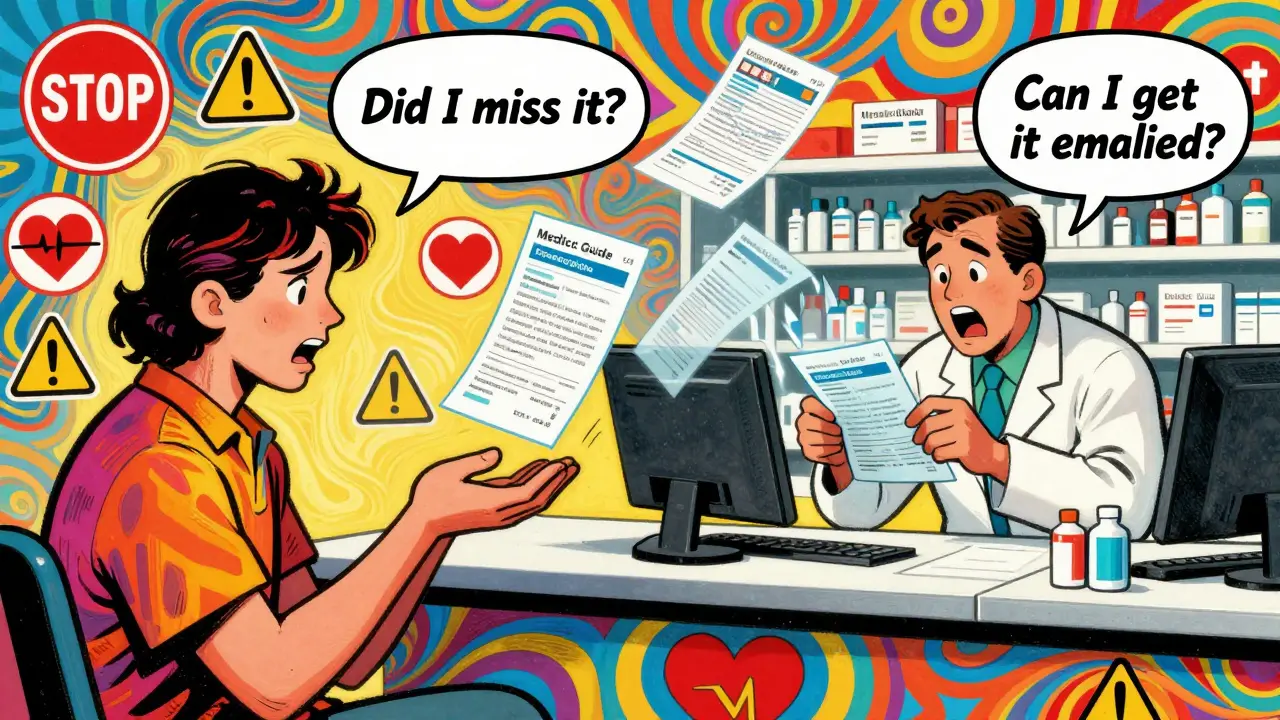
Here’s something many people don’t know: you don’t have to accept a paper copy. In May 2023, the FDA officially clarified that patients can request an electronic version instead. That means your pharmacist can send the guide to your email, text, or patient portal app. They can’t force you to take paper. They also can’t refuse your request for digital delivery just because they’re used to handing out printed copies.
This change was made because many patients find paper guides hard to keep, lose them, or don’t read them. Digital versions can be saved, searched, or even read aloud by phone apps. If you’re tech-savvy or prefer to keep all your health info in one place, just say: "Can I get this Medication Guide emailed to me?" The pharmacy must comply. This is especially useful if you refill prescriptions at different locations - you won’t get five different paper copies.
What’s Actually in a Medication Guide?
Not all guides are created equal. The FDA has strict rules about what must be included. Every guide must have:
- The words "Medication Guide" at the top of the first page
- The brand name and generic name of the drug (the generic name must be at least half the size of the brand name)
- Clear, plain language - no medical jargon
- A warning section highlighting serious risks
- Instructions on how to use the drug correctly
- A statement at the bottom: "This Medication Guide has been approved by the U.S. Food and Drug Administration"
The font size can’t be smaller than 10 points. That’s about the size of text on a standard newspaper. Yet, a 2023 analysis by the American Society of Health-System Pharmacists found that 68% of guides still exceed an 11th-grade reading level. That means they’re written for someone with more than a high school education. If you’re struggling to understand it, ask your pharmacist to explain it. You’re not expected to decode dense medical language on your own.
Why Do Pharmacists Sometimes Forget to Give Them?
It’s not laziness - it’s systems. A 2021 study in the Journal of the American Pharmacists Association found that pharmacists spend 15 to 20 seconds per prescription just verifying and handing out Medication Guides. During busy hours, that adds up. Some pharmacies don’t track which drugs require guides. Others rely on outdated printer cartridges or don’t have enough stock. Independent pharmacies might not get shipments on time. Chain pharmacies usually have digital systems, but even those can fail if the software doesn’t auto-pull the right guide.
And here’s the catch: if a pharmacist doesn’t give you the guide, they’re breaking federal law. But enforcement is rare. The FDA doesn’t send inspectors to every pharmacy. The Department of Health and Human Services’ Office of Inspector General found in a 2022 audit that community pharmacies averaged nearly three compliance issues per site - and Medication Guide distribution was one of the top three complaints from patients.
What If You Don’t Get It? What Can You Do?
If you’re supposed to get a Medication Guide and you don’t, here’s what to do:
- Ask: "Was I supposed to get a Medication Guide with this prescription?"
- If they say no, ask: "Is this one of the drugs that requires one?"
- If they still say no, ask to speak with the pharmacist in charge.
- If you’re still not given one, ask if they can print it on the spot or email it to you.
- If they refuse or say they don’t have it, ask for the name of the drug’s manufacturer and call them directly. They’re required to provide guides to pharmacies.
You can also file a complaint with the FDA’s MedWatch program. You don’t need to prove anything - just report that you didn’t receive a required Medication Guide. The FDA tracks these reports and uses them to monitor pharmacy compliance.
The Big Change Coming: Patient Medication Information (PMI)
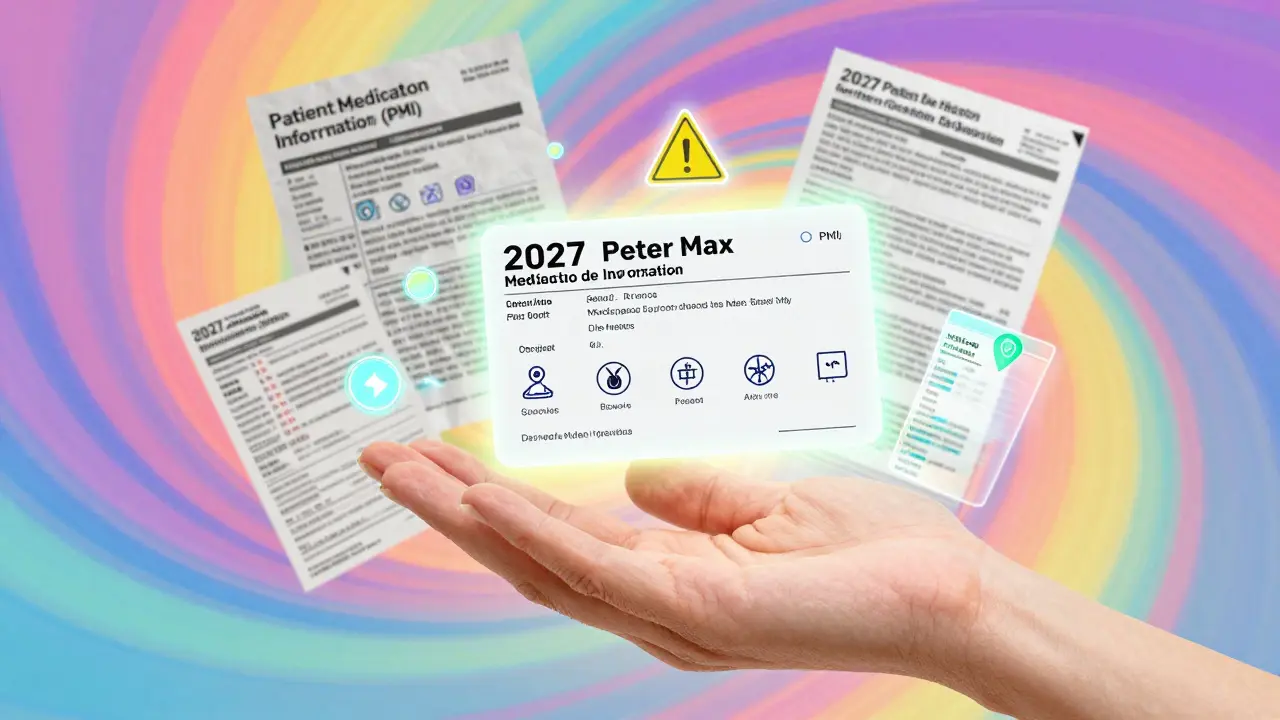
The FDA isn’t done fixing this system. In 2023, they announced they’re replacing Medication Guides with something called Patient Medication Information (PMI). This will be a single-page, standardized document for every drug - no more weird layouts, inconsistent fonts, or confusing formats. Think of it like a nutrition label for your prescription.
The goal? Make it easier to read, understand, and use. FDA testing showed patients understood PMI prototypes 37% better than current Medication Guides. By 2027, the old system will be gone. Pharmacies will need to update their printers and software. Independent pharmacies might pay $2,500 to upgrade. Chains could spend over $10 million. But the payoff? Clearer information for patients. Fewer dangerous mistakes.
Real Stories: When a Guide Made a Difference
Not everyone ignores these guides. Patients for Safer Drugs collected 347 stories from people who say their Medication Guide saved them. One woman taking a blood thinner read the guide and realized her new allergy pill could cause dangerous bleeding. She called her doctor - and avoided a hospital trip. Another man saw a warning about alcohol interactions and stopped drinking, preventing liver damage. In 22.5% of the cases collected, patients credited the guide with preventing a serious health event.
But many others say the guides are useless. A 2022 Pharmacy Times survey found 28% of patients thought the guides were "not helpful at all." Why? Because they repeat what’s on the prescription label. Or the font is too small. Or they’re written like a textbook. That’s why the shift to PMI matters. It’s not just about printing more papers - it’s about making the information actually useful.
Final Takeaway: Know Your Rights
You have a right to clear, accurate, and accessible information about your prescription. If your drug needs a Medication Guide, you’re entitled to it - whether in print or digital form. Don’t assume the pharmacist knows the rules. Don’t assume you’ll get it automatically. Ask. If they say no, ask again. And if they still refuse, you’re not being difficult - you’re protecting your health. The system isn’t perfect. But your voice can help make it better.
Do all pharmacies have to give out Medication Guides?
Yes. All pharmacies that dispense prescription drugs requiring a Medication Guide must provide one to the patient at the time of dispensing. This applies to chain pharmacies like CVS and Walgreens, independent pharmacies, and even mail-order services. The FDA requires it under 21 CFR §208.24. Pharmacies can’t opt out just because they’re busy or don’t have enough printed copies - they must have a system in place to deliver them, either through printing on demand or electronic delivery.
Can I refuse to take a paper Medication Guide?
Yes. Since May 2023, the FDA has confirmed that patients can request an electronic version instead. Pharmacists cannot require you to accept a printed copy. You can ask for it to be emailed, sent via text, or made available through your pharmacy’s patient portal. The law requires them to honor your preference.
What if I don’t understand what’s written in the Medication Guide?
Ask your pharmacist to explain it. While the FDA requires Medication Guides to use plain language, many still use complex wording. Pharmacists are trained to translate medical information into everyday terms. You have the right to ask for clarification - no judgment, no rush. If you’re still confused, ask your doctor for a simpler explanation. Your safety depends on understanding the risks, not just reading the paper.
Are Medication Guides the same as drug package inserts?
No. Medication Guides are written for patients - in plain language - and are required by the FDA for certain high-risk drugs. Package inserts are detailed, technical documents meant for healthcare professionals. They’re often hundreds of pages long and full of medical jargon. The Medication Guide is the simplified version meant for you. You should never rely on the insert for personal use.
Will the new Patient Medication Information (PMI) replace all Medication Guides?
Yes. The FDA plans to fully replace the current Medication Guide system with standardized Patient Medication Information (PMI) by 2027. PMI will be a single-page, consistent format for every drug, designed to be easier to read and understand. It will include clear warnings, usage instructions, and side effects - all in the same layout. This change is meant to fix the current system’s inconsistencies and improve patient comprehension.
peter vencken
March 24, 2026 AT 12:00Aaron Sims
March 26, 2026 AT 07:16Katie Putbrese
March 27, 2026 AT 11:27Linda Foster
March 27, 2026 AT 13:02Rama Rish
March 27, 2026 AT 17:11Kevin Siewe
March 28, 2026 AT 04:28Chris Farley
March 28, 2026 AT 08:06Darlene Gomez
March 28, 2026 AT 20:46Jacob Hessler
March 30, 2026 AT 20:26Amber Gray
March 31, 2026 AT 10:51Danielle Arnold
April 1, 2026 AT 22:26Kevin Y.
April 2, 2026 AT 09:27