Post-Transplant Life: Recognizing Rejection Signs and Sticking to Your Medication
 Mar, 9 2026
After a liver transplant, the real challenge doesn’t end in the operating room. It begins the day you walk out of the hospital. Your new organ is alive, but your body still sees it as an intruder. Without constant, careful protection, your immune system will try to destroy it. That’s why understanding rejection signs and sticking to your medication schedule isn’t just important - it’s the difference between living with a functioning liver and losing it all.
What Happens When Your Body Rejects the New Liver
Rejection happens because your immune system doesn’t recognize the transplanted liver as part of you. It treats it like a virus or bacteria and attacks it. This isn’t rare. About 15% of liver transplant recipients experience some level of acute rejection within the first three months. The good news? Most of these episodes can be caught early and reversed - if you know what to look for. There are three main types of rejection, each with its own timeline and symptoms:- Hyperacute rejection is rare today - less than 1% of cases - because of advanced donor matching. It happens within hours of surgery and causes immediate liver failure. You’ll likely be monitored closely in the ICU, so this is rarely missed.
- Acute rejection is the most common. It usually strikes between 1 week and 3 months after transplant, but it can happen anytime, even years later. Symptoms are often subtle at first: a low-grade fever (over 100°F), unexplained fatigue, nausea, or pain in the upper right side of your belly. You might notice your skin or eyes turning yellow (jaundice), or your urine getting darker. Your liver enzymes will spike, and your bilirubin levels will rise. These are early red flags your doctor will check during routine blood tests.
- Chronic rejection creeps in slowly over months or years. It’s harder to spot because symptoms are vague: persistent tiredness, unexplained weight gain, high blood pressure, or a gradual drop in how well your liver works. By the time symptoms appear, damage may already be done.
Here’s the hard truth: many people don’t feel anything until it’s too late. Up to 40% of rejection episodes show no obvious symptoms at all. That’s why blood tests every few weeks are non-negotiable. Your creatinine and liver enzyme levels tell your doctor what your body is doing - even when you feel fine.
Why Medication Adherence Is Your Lifeline
You’re not just taking pills to feel better. You’re taking them to keep your liver alive. The standard regimen includes three types of drugs: calcineurin inhibitors (like tacrolimus or cyclosporine), antimetabolites (like mycophenolate), and corticosteroids (like prednisone). Together, they suppress your immune system just enough to protect the liver - but not so much that you’re helpless against infections. The numbers don’t lie. According to the Scientific Registry of Transplant Recipients, patients who take their meds exactly as prescribed have a 95% chance of surviving at least one year after transplant. Those who miss doses? That number drops to 78%. Every 10% drop in adherence increases your risk of graft failure by 23%. Missing just 20% of your doses triples your chance of rejection. And it’s not just about numbers. Dr. Lloyd Ratner from Columbia University says non-adherence causes up to 22% of late graft losses - second only to death from other causes. That means, for many people, losing their transplant isn’t because of medical failure. It’s because they skipped a pill.What Makes Adherence So Hard
Let’s be real. Taking 10-12 pills a day, at specific times, with different food rules, is exhausting. You’re not lazy. You’re human. Side effects make it worse. Tacrolimus can cause hand tremors, headaches, or high blood pressure. Prednisone can lead to weight gain, mood swings, or trouble sleeping. And then there’s the cost: without insurance, these drugs can run $28,000 a year. Many people skip doses because they can’t afford them. Complex schedules are another killer. One pill at 7 a.m. with food, another at 10 p.m. on an empty stomach, a third that can’t be taken with grapefruit juice. It’s easy to mix them up. A 2022 study from JAMA Internal Medicine found that 45% of transplant patients miss at least one dose per week in the first year. Most of them aren’t trying to be rebellious - they just forget, get overwhelmed, or run out of pills.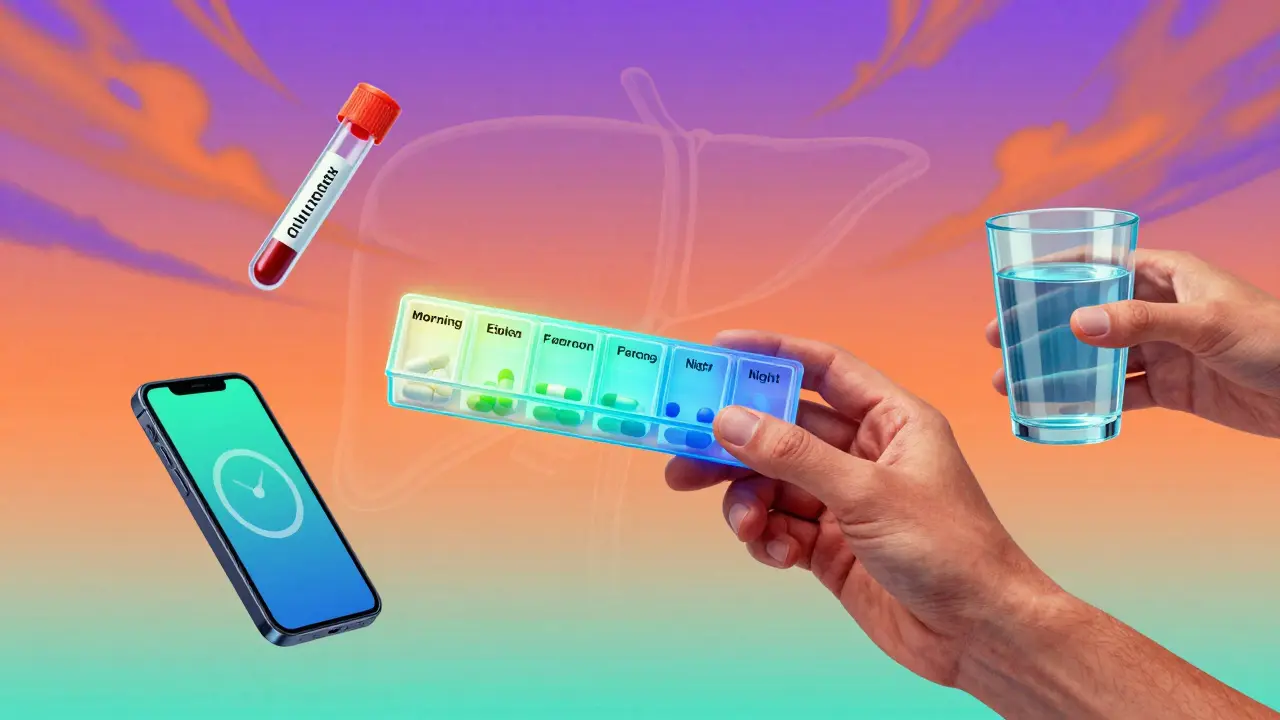
How to Stay on Track
The good news? There are proven ways to win this battle.- Use a pill organizer. A simple weekly box with compartments for morning, afternoon, and night helps more than you think. The NHS reports that 63% of patients who stick with their meds long-term use one.
- Set smartphone alarms. Three alarms a day - one for each dose - works better than any memory trick. A 2022 study showed this boosts adherence by 37%.
- Involve your family. Having someone else remind you, check your pill box, or drive you to appointments cuts rejection risk by 28%. It’s not about control - it’s about support.
- Use smart pill bottles. Some centers now give patients bottles that log every time they’re opened. If you haven’t opened it in 24 hours, you get a text reminder. Early data from Mayo Clinic shows this reduces rejection episodes by 22%.
- Ask for help. Many transplant centers now have pharmacists on staff who meet with you monthly to review your meds, check for side effects, and adjust your schedule. Johns Hopkins reports 92% adherence with this system - far above the national average of 76%.
If cost is a problem, talk to your transplant team. There are patient assistance programs, generic alternatives, and nonprofit groups that help cover drug costs. You’re not alone in this.
Monitoring: Your Lifelong Checkup
Your first month after transplant means weekly blood tests. Then biweekly. Then monthly. After a year, you’ll likely switch to every 2-3 months - but never stop. These aren’t routine. They’re survival tools. Your doctor is watching for three things:- Drug levels: Tacrolimus needs to stay between 5-10 ng/mL in the first year. Too low? Rejection risk rises. Too high? You risk kidney damage or nerve problems.
- Liver enzymes: ALT and AST spikes tell you your liver is under stress.
- Bilirubin and creatinine: Rising levels mean your liver (or kidneys) aren’t filtering properly.
Some centers are now using newer tools like the ImmuKnow assay, which measures how active your immune system is. It doesn’t replace blood tests - it complements them. If your immune system is suddenly more active, even with normal lab results, your doctor might adjust your meds before rejection starts.

The Future: Personalized Medicine
The field is changing fast. In January 2023, the FDA approved the first genetic test - XyGlo - that tells doctors how your body processes tacrolimus. Some people break it down fast. Others hold onto it too long. This test helps tailor your dose from day one, cutting guesswork and side effects. Researchers are also testing drugs like belatacept, which protects the liver without the kidney-damaging side effects of older drugs. Early trials show 18% less chronic rejection after five years. The most exciting breakthrough? A clinical trial from the Immune Tolerance Network found that 40% of patients who got a stem cell transplant along with their liver eventually stopped all immunosuppressants entirely. Their bodies learned to accept the new organ. This isn’t common yet - but it’s coming.What You Need to Remember
You didn’t get a liver transplant to go back to how things were. You got it to live - fully, freely, without fear. That means showing up for your meds, even on days you feel fine. It means calling your doctor the second something feels off - even if it’s just a little tiredness or a strange headache. Rejection doesn’t always scream. Sometimes it whispers. And if you’re not listening - because you skipped a pill, forgot a test, or thought you could handle it on your own - that whisper becomes a shout. Your transplant isn’t a one-time fix. It’s a daily commitment. And every pill you take, every test you do, every time you show up - that’s how you win.Can you have rejection without symptoms?
Yes. Up to 40% of rejection episodes have no noticeable symptoms. That’s why regular blood tests are critical - they catch rejection before you feel it. Relying on how you feel can be dangerous.
What happens if I miss a dose of my anti-rejection meds?
Missing even one dose can lower drug levels enough to trigger rejection. If you miss a pill, take it as soon as you remember - unless it’s close to your next dose. Never double up. Always call your transplant team for specific instructions. Repeated missed doses raise your risk of graft failure by three times.
How often do I need blood tests after a liver transplant?
In the first month, you’ll need blood tests weekly. Months 2-3: biweekly. After that, monthly for the first year. Once stable, tests may drop to every 2-3 months. But never stop them. Your liver’s health is tracked through these numbers - not how you feel.
Are generic immunosuppressants safe?
Some generics are approved and safe, but switching between brands - even generic versions - can change how your body absorbs the drug. Always consult your transplant team before switching. They may require extra blood tests to confirm your drug levels stay in the safe range.
Can I stop taking my meds if I feel fine after a few years?
No. Lifelong immunosuppression is still the standard. Even if you’ve had your transplant for 5 or 10 years, stopping meds can cause rejection - sometimes within days. A small number of patients in clinical trials have successfully stopped meds, but this is experimental and only done under strict medical supervision. Never stop on your own.
Erica Santos
March 10, 2026 AT 15:05The real issue isn’t adherence - it’s that we force people to take toxic, expensive drugs for life while ignoring the root problem: why the immune system attacks in the first place.
We’ve been putting Band-Aids on a hemorrhage for decades.
If you’re gonna make someone take 12 pills a day, at least make them work without destroying their kidneys, nerves, and sanity.
And stop acting like this is a moral failure. It’s a systemic failure.
Stephen Rudd
March 11, 2026 AT 08:29You’re telling people to take immunosuppressants forever while ignoring that 40% of rejection episodes are asymptomatic - which means the entire system is built on surveillance, not healing.
Why not just admit that transplants are a temporary fix for a broken healthcare model?
We’re not saving lives - we’re extending a profit cycle.
APRIL HARRINGTON
March 11, 2026 AT 11:09but also like literally every single person in this thread is acting like this is some kind of personal failure when it’s a fucking war zone out here
I work two jobs and still can’t afford my pills and my insurance dropped my coverage last year and now I’m choosing between insulin and tacrolimus
so don’t you dare lecture me about adherence
Philip Mattawashish
March 12, 2026 AT 08:21This isn’t about pills.
This is about control.
The medical industrial complex needs you dependent.
If you stopped taking your meds and your liver failed - who do you think gets to perform the next transplant?
The same system that sold you this one.
They don’t want you cured.
They want you addicted.
And you’re all too busy checking your pill boxes to see the cage.
Melba Miller
March 13, 2026 AT 20:50I’m a single mom with two kids and a 10-year-old transplant.
I forget pills sometimes.
I skip doses because I’m too exhausted to stand in line at the pharmacy.
I don’t have a family member to remind me.
I don’t have money for smart bottles.
And now I’m being told I’m the problem?
The system is broken.
Not me.
Mantooth Lehto
March 15, 2026 AT 09:53I didn’t skip it on purpose.
I was in the ER with my daughter’s asthma attack and the pills were in my bag at home.
I called my team.
They said ‘it’s fine, just take the next one.’
That was a lie.
I lost my liver.
I’m on the waitlist again.
Don’t tell me to ‘just be responsible.’
Tell them to stop lying to us.
Peter Kovac
March 16, 2026 AT 11:11The 95% survival rate for adherent patients is derived from a cohort with consistent access to healthcare infrastructure.
In contrast, non-adherent populations are disproportionately represented by individuals with socioeconomic barriers - not behavioral deficits.
Therefore, attributing graft failure to non-adherence is a misdirection of causality.
The variable is not compliance - it’s access.
Policy must shift from individual accountability to structural intervention.
Scott Easterling
March 17, 2026 AT 11:45And I’m just gonna say it - if you can’t remember to take your pills after a liver transplant, maybe you shouldn’t have gotten one.
This isn’t a game.
Someone else was on the waitlist.
Someone who would’ve taken their meds.
You took their spot.
Now you’re wasting it.
That’s not just selfish - it’s unethical.
Katy Shamitz
March 17, 2026 AT 16:59The real tragedy isn’t the missed doses - it’s the shame.
People feel guilty for forgetting.
They hide it.
They don’t call their team.
They wait until they’re collapsing.
We need compassion, not judgment.
A pill box doesn’t fix loneliness.
A reminder app doesn’t fix poverty.
We need to stop blaming the patient and start fixing the system.
Morgan Dodgen
March 18, 2026 AT 01:34Think deeper.
The real rejection is systemic.
The drugs are designed to fail you.
The blood tests? Surveillance.
The smart bottles? Tracking.
The ‘personalized medicine’? It’s just a new way to monetize your DNA.
You’re not being saved - you’re being harvested.
The immune system isn’t rejecting your liver.
The system is rejecting you.
And you’re too busy checking your levels to notice.
George Vou
March 19, 2026 AT 14:02and then I got really sick and had to go to the hospital
and they were like ‘you’re lucky you didn’t die’
so yeah maybe I’m dumb
but also why is this so hard to do every single day
like why can’t we just make one pill that works
instead of this whole circus
Dan Mayer
March 20, 2026 AT 22:26But here’s the thing no one says:
The doctors don’t even know what’s working.
They just guess.
Tacrolimus levels? A range.
No one knows what’s optimal for ME.
I’m not a number.
I’m not a statistic.
I’m a person being experimented on with drugs that weren’t designed for long-term use.
And they call it medicine.
Judith Manzano
March 22, 2026 AT 03:58I’m 3 years post-transplant.
I used to feel like I was failing every time I missed a pill.
But reading this - knowing that 40% of rejections happen without symptoms - it changed how I see myself.
I’m not lazy.
I’m not broken.
I’m surviving.
And if I can keep showing up - even imperfectly - I’m winning.
You’re not alone.
Tom Sanders
March 22, 2026 AT 14:53I’m 52.
I have diabetes.
I have neuropathy.
My hands shake.
I forget what day it is.
I take 18 pills a day.
And now I’m supposed to be a model patient?
Nah.
I’m just trying to live.
Don’t make me feel like a failure because I can’t do the impossible.
Jazminn Jones
March 22, 2026 AT 21:23The concept of ‘adherence’ as a behavioral metric ignores the sociopolitical determinants of health.
The notion that 23% increased risk of graft failure is attributable to individual non-compliance is a neoliberal construct.
The real failure lies in the absence of universal healthcare, pharmaceutical price regulation, and psychosocial support infrastructure.
To pathologize the patient is to absolve the system.