Mindful Eating: How to Stop Emotional and Binge Eating Without Dieting
 Jan, 30 2026
Most people who struggle with emotional or binge eating aren’t lacking willpower-they’re missing awareness. You sit down to eat, and before you know it, half the bag of chips is gone. Or you’re crying over a bowl of ice cream because the day felt unbearable. You don’t feel hungry. You don’t even like the food that much. But you keep eating anyway. That’s not about food. That’s about emotion.
What Mindful Eating Actually Means
Mindful eating isn’t another diet. It doesn’t tell you what to eat, when to eat, or how many calories to count. Instead, it asks you to pay attention-to really pay attention-to every bite. It’s about noticing the taste, the texture, the smell, even the sound of your food. It’s about recognizing when you’re eating because you’re stressed, bored, or sad, not because your body needs fuel.
This approach isn’t new. It comes from mindfulness practices rooted in ancient traditions, but it was adapted for modern eating habits by psychologist Jean Kristeller in the early 2000s. Her program, Mindfulness-Based Eating Awareness Training (MB-EAT), was one of the first to show that simply slowing down and tuning into your body could reduce binge episodes by nearly 40% in just 12 weeks. And those changes stuck. A follow-up study found that over half of participants were still practicing mindful eating a year later.
Unlike traditional diets, which fail for about 95% of people within five years, mindful eating works because it doesn’t fight your biology-it works with it. The American Psychological Association recognized it as a valid treatment for emotional eating back in 2018. And since then, research has only grown stronger.
How It Stops Binge Eating
Binge eating often happens on autopilot. You’re scrolling on your phone, the TV is on, you’re stressed from work, and suddenly you’re halfway through a whole pizza. Your brain isn’t registering what you’re eating. Your body isn’t sending signals. You’re not tasting anything. You’re just filling a void.
Mindful eating breaks that cycle by forcing you to pause. Here’s how:
- Eat slower. The average meal lasts 7 minutes. Mindful eaters take 18 minutes or more. That extra time lets your stomach signal your brain that you’re full-something that takes about 20 minutes to kick in.
- Remove distractions. Studies show that 95% of people who successfully reduce binge eating stop eating while watching TV, using their phone, or working. Your brain can’t register satisfaction if it’s distracted.
- Use your senses. Before you take a bite, look at your food. Notice the colors. Smell it. What aromas do you pick up? Chew slowly. Listen to the crunch. Feel the texture on your tongue. Taste each bite for 15 to 30 seconds. This isn’t about being fancy-it’s about reawakening your brain’s connection to food.
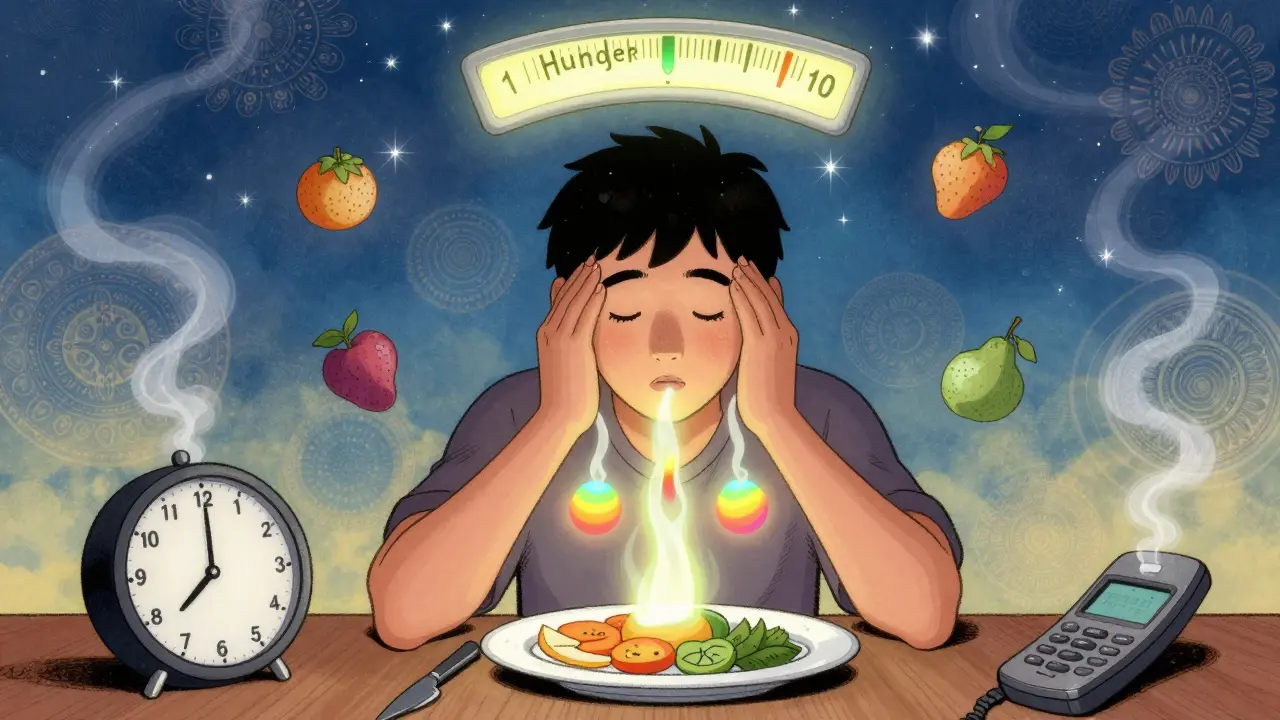
- Check in with your hunger. Use a simple 1-to-10 scale. Eat when you’re at a 3 or 4-not starving, but ready. Stop when you’re at a 6 or 7-not full, but satisfied. Most people don’t know what this feels like anymore.
A 2022 review of 17 clinical trials found that 67% of people who practiced mindful eating reduced their binge episodes significantly, compared to just 32% in control groups. That’s not a small difference. That’s life-changing.
Why It Works Better Than Dieting
Diets promise results but deliver frustration. You cut out carbs, you lose weight, you feel great-for a while. Then the cravings come back. The stress returns. The old habits snap back like a rubber band. That’s because diets treat the symptom, not the cause.
Mindful eating addresses the root: emotional triggers. A 2023 study from the Journal of Eating Disorders found that mindful eating was 37% more effective at reducing acute binge episodes than intuitive eating (which focuses more on food choices than moment-to-moment awareness). Another study showed it reduced stress-related eating by 63%, compared to just 32% for boredom-related eating. That’s key. Stress eating is the biggest driver of emotional overeating.
And here’s the kicker: mindful eating doesn’t make you feel deprived. In fact, 82% of people who try it say they enjoy food more. That’s because when you’re truly present, you savor it. A single cookie becomes a rich, chocolatey experience-not just something to shovel in to numb out.

What the Research Says About Long-Term Results
One of the biggest complaints about diets is that the weight comes back. Mindful eating is different. A 12-month follow-up of participants in clinical trials showed that 78% were still practicing mindful eating regularly. That’s not just adherence-that’s lifestyle change.
Compare that to cognitive behavioral therapy (CBT), the gold standard for binge eating disorder. CBT reduces binge episodes by about 62%. Mindful eating does 58%. Almost the same. But here’s the difference: 83% of people stick with mindful eating. Only 67% stick with CBT. Why? Because CBT often involves strict food logs, calorie tracking, and behavioral rules. Mindful eating asks you to listen. It doesn’t punish. It doesn’t shame. It just asks you to be there.
And it’s not just for people with diagnosed disorders. A Kaiser Permanente patient survey in 2023 found that 82% of people who practiced mindful eating reported reduced emotional eating. Two-thirds said they had fewer binge episodes. No medication. No meal plans. Just awareness.
Common Challenges-and How to Get Past Them
It’s not magic. It’s not easy. Especially at first.
Most people say their mind wanders during meals. That’s normal. Your brain isn’t used to slowing down. You might catch yourself thinking about your to-do list while chewing your food. That’s okay. Just notice it. Gently bring your attention back to the taste of the food. No judgment.
Here’s a simple tool called STOP that works for most people:
- Stop. Pause before you take another bite.
- Take three breaths. In through your nose. Out through your mouth.
- Observe. On a scale of 1 to 10, how hungry are you? Are you eating because you’re stressed, tired, or lonely?
- Proceed. Only if you’re still hungry, and only if you want to.
Another common complaint: “I don’t have time.” But you don’t need hours. Start with one meal a day. Even just breakfast. Eat without your phone. Chew slowly. Notice the flavor of your toast. The warmth of your tea. That’s it. After 21 days, your brain starts rewiring. You’ll notice cravings differently. You’ll pause before reaching for the snacks.
And if you’re struggling with severe binge eating disorder? Mindful eating alone isn’t enough. Research shows that when combined with medication or therapy, success rates jump from 55% to over 86%. That’s not a failure of mindful eating-it’s proof that it works best as part of a bigger plan.
What Experts Are Saying
Dr. Susan Albers, a clinical psychologist and author of Eating Mindfully, says, “78% of what we eat isn’t driven by hunger-it’s driven by emotion, habit, or environment.” That’s not an exaggeration. It’s backed by data.
Harvard Health Publishing rates mindful eating as “highly effective” based on 37 clinical trials. The American Heart Association calls it a “critical component of sustainable weight management.” And the NIH awarded $2.4 million in 2023 to study how mindful eating changes brain activity in people with binge eating disorder-using fMRI to track real-time shifts in the prefrontal cortex, the area responsible for impulse control.
It’s not just a trend. It’s becoming part of mainstream healthcare. Sixty-seven U.S. insurance plans now cover mindful eating therapy for diagnosed eating disorders. Google, Apple, and other Fortune 500 companies have added it to their wellness programs. And there are over 1,200 certified mindful eating coaches in the U.S. alone.
Where to Start Today
You don’t need an app, a coach, or a special diet. You just need to begin.
Try this tomorrow:
- Choose one meal. Breakfast works best for most people.
- Put your phone in another room. Turn off the TV.
- Take three deep breaths before you eat.
- Notice the color and shape of your food.
- Smell it. Really smell it.
- Take a small bite. Chew 15 times before swallowing.
- Ask yourself: Am I still hungry? Or am I eating because I’m anxious?
That’s it. No rules. No goals. Just presence.
After a week, you’ll start noticing things you never did before. The saltiness of your soup. The way your stomach feels when it’s full. The moment you stop enjoying your food-and keep eating anyway. That’s the breakthrough. That’s when you stop being controlled by your emotions and start choosing what you eat-on purpose.
It’s not about eating less. It’s about eating with meaning.
Frequently Asked Questions
Can mindful eating help me lose weight?
Yes-but not because it’s a weight-loss diet. Mindful eating helps you stop eating when you’re full, reduce emotional snacking, and make choices based on real hunger instead of stress or boredom. Many people lose weight naturally as a side effect. But the real benefit is long-term sustainability. Studies show people who practice mindful eating maintain healthier habits for years, unlike those on restrictive diets.
Do I need to meditate to practice mindful eating?
No. While meditation can help build awareness, mindful eating is about applying attention directly to meals. You don’t need to sit in silence for 20 minutes. Just slow down while you eat. That’s enough to start seeing changes. Many people find that practicing mindful eating makes meditation easier later on.
Is mindful eating the same as intuitive eating?
They’re related but different. Intuitive eating focuses on trusting your body’s signals about what and how much to eat, often rejecting diet culture. Mindful eating is more specific: it’s about paying attention to the moment-by-moment experience of eating-taste, texture, emotions, hunger cues. Research shows mindful eating is 37% more effective at reducing acute binge episodes because it targets the immediate behavior, not just long-term food choices.
How long until I see results?
Most people notice a shift in their relationship with food within two weeks. After 21 days of consistent practice, your brain starts forming new habits. You’ll begin recognizing emotional triggers before you reach for food. By 8 weeks, many report fewer binge episodes and more enjoyment of meals. The key is consistency-not perfection.
Can I practice mindful eating if I have a busy schedule?
Absolutely. You don’t need to eat slowly at every meal. Start with one meal a day-even just 5 minutes of focused eating. That’s enough to begin rewiring your habits. Many people practice during lunch breaks, before dinner, or even while having a snack. The goal isn’t to add more to your day, but to make what you’re already doing more meaningful.
Is mindful eating only for people with eating disorders?
No. While it’s clinically proven to help with binge eating disorder, it’s just as useful for anyone who eats out of habit, stress, or distraction. You don’t need a diagnosis. If you’ve ever eaten when you weren’t hungry, finished a bag of chips without realizing it, or felt guilty after eating-you can benefit from mindful eating.
What Comes Next
If you’re ready to move beyond the cycle of restriction and guilt, start small. Pick one meal. One bite. One moment of awareness. That’s where real change begins.
You’re not trying to become perfect. You’re trying to become present. And that’s enough.
Lily Steele
January 30, 2026 AT 18:53Just tried this with breakfast yesterday. Put my phone in another room, chewed each bite like I was tasting wine. Felt weird at first. Then I realized I hadn’t actually tasted my toast in years. My brain didn’t even know it was buttered. Mind blown.
Rohit Kumar
January 31, 2026 AT 11:58In Indian philosophy, this isn't new. The concept of *anna yoga*-eating as spiritual practice-dates back to the Upanishads. Food is prana. Chewing is meditation. Modern psychology just renamed it and sold it as a TED Talk. Still, glad it’s gaining traction. The West needs to stop treating meals like fuel stops.
Darren Gormley
February 2, 2026 AT 09:45LMAO this is just ‘eat slower’ wrapped in 2000 words of jargon. I ate a whole pizza last night while scrolling TikTok. Do I need a 12-week course to realize I’m a zombie? 😂
Marc Bains
February 3, 2026 AT 02:00For anyone thinking this is too ‘woo-woo’-try it for three days. One meal. No phone. Just you and your food. I used to binge on chips after work like it was a job. Now I notice the salt hits my tongue, I feel the crunch, and I stop at half. Not because I’m strong. Because I finally noticed I wasn’t hungry. It’s that simple.
Amy Insalaco
February 3, 2026 AT 22:58While the phenomenological reduction of eating behavior is undeniably compelling, I must interrogate the epistemological assumptions underpinning MB-EAT’s ontological framing. The reification of ‘hunger cues’ as discrete neurobiological signals ignores the sociocultural semiotics of consumption-how late-stage capitalism commodifies satiety, turning gustatory experience into a neoliberal performance of self-regulation. Are we truly cultivating awareness, or merely internalizing a new regime of dietary discipline disguised as liberation?
Eliana Botelho
February 5, 2026 AT 21:58Okay but what if you’re just a messy eater? I’m not some zen monk who sits cross-legged savoring quinoa. I’m a single mom eating cold pasta at 11pm while helping my kid with homework. This feels like another thing to fail at. Like, ‘oh you didn’t chew 15 times? Shame.’
Lily Steele
February 6, 2026 AT 11:53You’re not failing. You’re human. I eat pasta at midnight too. I just stop for one breath before the next forkful. That’s it. No judgment. Just pause. That’s the whole thing.
Jason Xin
February 7, 2026 AT 08:36Wow. Someone actually used the word ‘prana’ without sounding like they’re selling crystals. Respect. Also, the 37% stat for binge reduction over intuitive eating? That’s the real takeaway. It’s not about what you eat-it’s about how you’re present while eating. The brain doesn’t care about macros. It cares about whether you’re actually there.
Donna Fleetwood
February 7, 2026 AT 11:53I started with just my coffee in the morning. No phone. Just me and the steam. I noticed how the bitterness hit, then the sweetness. I didn’t even know coffee had sweetness. Now I look forward to it. It’s not about losing weight. It’s about feeling alive during the small things.
Sheila Garfield
February 7, 2026 AT 23:26My therapist suggested this last year. I thought it was dumb. Then I realized I’d been eating dinner while crying about a text I got in 2018. I didn’t even know I was still holding onto that. Mindful eating didn’t fix me. It just showed me I was running from something. And that’s the first step.
Shawn Peck
February 8, 2026 AT 17:53THIS IS THE BEST THING I’VE EVER READ. I ATE A WHOLE BAG OF CHIPS LAST WEEK AND NOW I KNOW WHY. I WASN’T HUNGRY. I WAS JUST SCARED. THIS CHANGED MY LIFE. 10/10 WOULD RECOMMEND TO MY ENEMIES.
Blair Kelly
February 10, 2026 AT 01:56Let’s be real. This works because it’s just cognitive behavioral therapy with a yoga mat. The ‘STOP’ method? That’s classic stimulus control. The 15-chew rule? That’s just behavioral satiation. The science is solid, but don’t let the fluffy language fool you. This isn’t magic. It’s psychology dressed up as enlightenment.