Medicaid Generic Drug Coverage: State-by-State Variations and Requirements Explained
 May, 1 2026
Walking into a pharmacy to pick up a prescription for a low-cost generic medication should be straightforward. You hand over your insurance card, the pharmacist scans it, and you walk out with your medicine. But if you rely on Medicaid, that simple transaction often hides a complex web of rules that change depending on which side of the state line you stand on.
Medicaid is a joint federal-state health program established in 1965 under Title XIX of the Social Security Act, designed to provide medical assistance for individuals and families with low incomes. While the federal government sets baseline standards, states have significant flexibility in how they manage drug benefits. This creates a patchwork system where a generic drug covered without hassle in one state might require weeks of paperwork in another. Understanding these variations is critical for patients, providers, and pharmacists trying to navigate the current landscape in 2026.
The Federal Baseline vs. State Control
To understand why coverage varies, you first need to look at the structure of the program. Under federal law, specifically Section 1927(d) of the Social Security Act, states are required to cover all outpatient drugs from manufacturers participating in the Medicaid Drug Rebate Program (MDRP). The MDRP requires manufacturers to pay rebates to state Medicaid programs for each unit of drug dispensed to eligible beneficiaries.. However, this mandate comes with exceptions. Federal law explicitly excludes certain categories like fertility drugs, cosmetic drugs, weight-loss medications, and sexual dysfunction drugs unless a state chooses to cover them voluntarily.
Despite these exclusions, every single state-including the District of Columbia-currently provides coverage for outpatient prescription drugs to categorically eligible individuals. According to data from the Centers for Medicare & Medicaid Services (CMS), pharmacy benefits are technically optional under federal statute, yet 100% of states opt in because the demand is universal. The real divergence happens in *how* those drugs are managed. States use tools like formulary tiers, prior authorization, and step therapy to control costs, leading to vastly different experiences for beneficiaries.
Generic Substitution Laws: Who Makes the Switch?
One of the most impactful differences between states lies in automatic generic substitution. When a doctor prescribes a brand-name drug but a therapeutically equivalent generic exists, who decides whether the patient gets the cheaper option? In many cases, the answer depends entirely on state statute.
As of 2025, at least 41 states mandate automatic generic substitution for Medicaid prescriptions. For example, Colorado’s statute (C.R.S. 25.5-5-501) requires that the generic must be prescribed if it is therapeutically equivalent, unless the brand name is more cost-effective or the patient has been stabilized on the brand. This means the pharmacist typically fills the generic without needing to call the doctor.
However, not all states operate this way. Some allow "therapeutic interchange," where pharmacists can swap a prescribed drug for a different generic within the same class if it saves money, provided specific clinical criteria are met. The Medicaid and CHIP Payment and Access Commission (MACPAC) reported in March 2025 that 17 states had implemented mandatory substitution policies with these therapeutic interchange provisions. In these jurisdictions, if the cost difference exceeds $10, the pharmacist may substitute an alternative even if it’s not the exact generic match, aiming to drive down overall program spending.
| Approach | Description | Patient Impact | Example States |
|---|---|---|---|
| Automatic Substitution | Pharmacist automatically fills generic if available. | Faster pickup, lower copay. | Colorado, California |
| Therapeutic Interchange | Pharmacist may switch to a different generic class to save costs. | May receive different medication; requires monitoring. | Texas, Florida |
| Physician Discretion | Doctor must explicitly approve generic substitution. | Higher administrative burden; potential for delays. | New York, Massachusetts |
Prior Authorization: The Paperwork Barrier
If generic substitution determines what you get off the shelf, prior authorization (PA) determines if you get it at all. Prior authorization is a process where a provider must prove to the insurer that a specific drug is medically necessary before the plan will cover it. For generic drugs, this seems counterintuitive-they are supposed to be the standard, low-risk option. Yet, PA remains a major point of variation.
In states with highly managed formularies, even generics can face scrutiny. For instance, Colorado’s Health First Colorado program uses a Preferred Drug List (PDL). Drugs on the preferred list generally do not require prior authorization. However, non-preferred generics-or those used for conditions requiring strict oversight-do. A study by the University of Pennsylvania found that excessive restrictions on generic coverage can lead to therapeutic discontinuity, with a 12.7% increase in hospital admissions among Medicaid beneficiaries who experienced medication switches due to PA denials.
The time it takes to get approval also varies wildly. Health First Colorado promises coverage decisions within 24 hours, setting a high benchmark for efficiency. In contrast, some states take up to 72 hours for similar determinations. For a primary care physician, navigating these rules is exhausting. The American Medical Association reported in February 2025 that doctors spend an average of 15.3 minutes per patient just handling prior authorizations for generic medications. That adds up to roughly $8,200 annually in administrative costs per physician, time that could otherwise be spent on patient care.
Copays and Financial Liability
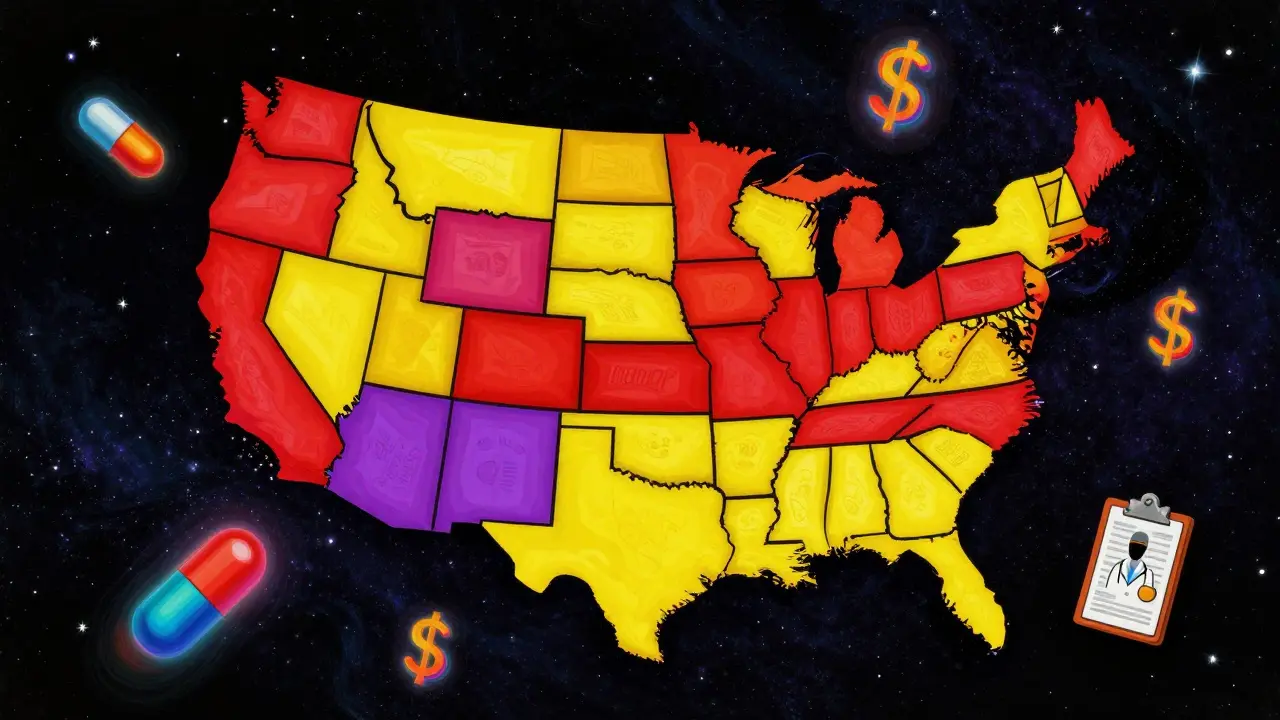
Cost-sharing is another area where state policies diverge significantly. Federal law allows states to impose copayments on Medicaid enrollees, but there are caps based on income. For beneficiaries with income at or below 150% of the federal poverty level (FPL), states can charge up to $8 for non-preferred generic drugs. However, many states choose to charge less, or nothing at all, for generics to encourage adherence.
KFF’s 2025 State Medicaid Pharmacy Copay Requirements report highlights this disparity. Some states have eliminated copays for essential generics entirely, recognizing that even small out-of-pocket costs can deter low-income patients from filling prescriptions. Other states maintain tiered structures where Tier 1 (generics) might have a $2-$4 copay, while Tier 2 (brand names) jump to $10 or more. The recent discontinuation of the Medicare Two Dollar Drug List Model by CMS in March 2025 offers a cautionary tale; only 20% of Medicare Part D beneficiaries were enrolled in plans offering such favorable generic coverage, suggesting that standardized low-cost models are difficult to scale across diverse populations.
Formulary Structures and Step Therapy
A formulary is essentially a list of approved drugs. Most Medicaid programs use tiered formularies. Tier 1 usually includes generic drugs, Tier 2 includes preferred brand names, and higher tiers include non-preferred or specialty drugs. But being on the formulary doesn’t mean you can just buy it immediately. Many states employ "step therapy" protocols.
Step therapy requires patients to try and fail cheaper, preferred alternatives before the insurer will cover a more expensive or specific generic. As of 2025, at least 32 states implement step therapy for certain drug classes. For example, to get coverage for a specific generic proton pump inhibitor, a patient might first need to trial three other preferred NSAIDs and PPIs at maximally tolerated doses. This clinical nuance aims to ensure cost-effectiveness but can delay treatment for patients who know exactly which medication works for them.
The complexity of these formularies affects provider satisfaction. The Commonwealth Fund’s 2024 State Medicaid Program Assessment rated Massachusetts 4.6 out of 5 stars for formulary clarity, while Mississippi scored only 2.8 out of 5. This gap suggests that some states have done a better job of communicating their rules to providers, reducing confusion and errors.

The Role of Pharmacy Benefit Managers (PBMs)
You cannot discuss Medicaid drug coverage without mentioning Pharmacy Benefit Managers. PBMs act as intermediaries between insurers, pharmacies, and drug manufacturers. They negotiate prices, manage formularies, and process claims. In the Medicaid space, the market is heavily consolidated. As of January 2025, CVS Caremark, Express Scripts, and OptumRx collectively managed pharmacy benefits for Medicaid programs in 37 states.
This consolidation brings both pros and cons. On one hand, it creates some standardization in how claims are processed and how formularies are structured. On the other hand, it raises concerns about market concentration and transparency. When a few large entities control the flow of billions in generic drug claims-approximately 1.2 billion generic claims annually according to CMS-they wield significant power over reimbursement rates. These rates directly impact community pharmacy participation. The National Community Pharmacists Association’s 2025 Access Report showed participation rates ranging from 98.2% in Vermont to just 67.4% in Texas, with reimbursement rates cited as the primary driver.
Future Trends and Policy Shifts
The landscape of Medicaid generic coverage is shifting rapidly. One major development is the proposed CMS rule from December 2024 requiring Medicaid coverage of anti-obesity medications. If finalized, this would represent the first major expansion of mandatory drug classes since the Affordable Care Act, potentially affecting 4.7 million beneficiaries. While these are often brand-name drugs, the influx of new treatments will inevitably pressure states to tighten controls on generics to offset costs.
Additionally, legislative efforts to exclude most generic drugs from the Medicaid Drug Rebate Program’s inflationary rebates could reshape the financial model. The National Association of Medicaid Directors (NAMD) commented on this in early 2025, noting that such changes could reduce state rebate revenues by an estimated $1.2 billion annually. States may respond by restricting generic access further or increasing copays, creating a challenging environment for beneficiaries.
Looking ahead, the Peterson-KFF Health System Tracker projects that Medicaid generic drug utilization will rise to 87.2% of total pharmacy claims by 2027. This growth is driven by biosimilar adoption and aggressive state cost-containment strategies. However, supply chain vulnerabilities remain a risk. The 2024 FDA drug shortage list included 17 Medicaid-reimbursed generic medications, highlighting that even the most efficient systems can falter when basic supplies run dry.
Navigating the System: Tips for Patients and Providers
Given the complexity, here are practical steps to manage Medicaid generic coverage:
- Check Your State’s Formulary Online: Most states publish their Preferred Drug Lists (PDL) online. Look for terms like "preferred" vs. "non-preferred" to anticipate prior authorization needs.
- Ask About Automatic Substitution: If you live in a state with automatic substitution laws, confirm with your pharmacist that the generic is being filled automatically to avoid unnecessary brand-name charges.
- Document Therapeutic Failures: If you are subject to step therapy, keep detailed records of previous medication trials and failures. This documentation speeds up prior authorization approvals.
- Understand Your Copay Caps: Know your income bracket relative to the federal poverty level. If you are below 150% FPL, your copay for non-preferred generics should not exceed $8, but check if your state offers lower rates.
- Appeal Denials Promptly: If a generic is denied due to prior authorization issues, appeal immediately. Cite clinical necessity and any relevant state statutes regarding therapeutic equivalence.
Does Medicaid cover all generic drugs?
Yes, generally speaking. All 50 states and DC cover outpatient prescription drugs for eligible beneficiaries. However, coverage is subject to state-specific formularies, prior authorization requirements, and step therapy protocols. Not every generic is covered without restriction; some may require proof that cheaper alternatives failed first.
Can my pharmacist substitute a generic for a brand-name drug?
In most states, yes. At least 41 states mandate automatic generic substitution if a therapeutically equivalent generic is available. However, this depends on state law and whether the doctor has marked the prescription "Dispense as Written." Some states also allow therapeutic interchange, where a different generic in the same class may be substituted to save costs.
What is prior authorization for generic drugs?
Prior authorization (PA) is a pre-approval process where your doctor must justify the medical necessity of a drug to the insurer. For generics, this usually happens if the drug is on a non-preferred list or if step therapy rules require trying other options first. It adds administrative time but ensures the drug is appropriate for your condition.
How much do I have to pay for generic copays?
Copay amounts vary by state and income. Federal guidelines allow states to charge up to $8 for non-preferred generics for beneficiaries earning below 150% of the federal poverty level. Many states charge less, and some offer zero copays for essential generics. Check your specific state’s Medicaid handbook for exact figures.
Why do Medicaid drug rules vary so much by state?
Medicaid is a joint federal-state program. While the federal government sets minimum standards and provides funding, states design and administer their own programs. This allows states to tailor benefits to local populations and budgets, but it results in significant variations in formularies, prior authorization rules, and copay structures.