How to Search FAERS Side Effect Reports: Practical Tips for Patients and Researchers
 Dec, 4 2025
FAERS Risk Calculator
FAERS reports don't prove causation - they just show reported events. This calculator helps you understand risk by comparing reports to estimated users.
Enter Your Data
Risk Results
Enter values to see your results
The FDA’s Adverse Event Reporting System (FAERS) is one of the most powerful tools for finding out what’s really happening with medications after they hit the market. But if you’ve tried searching it, you know it’s not straightforward. Thousands of reports, confusing terminology, and misleading numbers can make it feel like you’re digging through a haystack for a needle. The good news? You don’t need to be a data scientist to use it wisely. Here’s how to actually get useful information out of FAERS - without falling into common traps.
Understand What FAERS Actually Shows
FAERS doesn’t tell you that a drug causes a side effect. It tells you that someone reported a side effect after taking a drug. That’s a big difference. A report might come from a patient, a doctor, or a pharmaceutical company - but none of these reports are confirmed. The FDA doesn’t verify whether the drug actually caused the reaction. It just collects the information.
For example, if 500 people report nausea after taking Drug X, that doesn’t mean Drug X causes nausea in 500 people. Maybe 10,000 people took the drug and only 500 reported nausea. Or maybe 500 people took the drug and all of them had nausea - but only 500 reports were filed. Without knowing how many people used the drug, you can’t calculate risk. That’s why the FDA says FAERS is for signal detection, not proof.
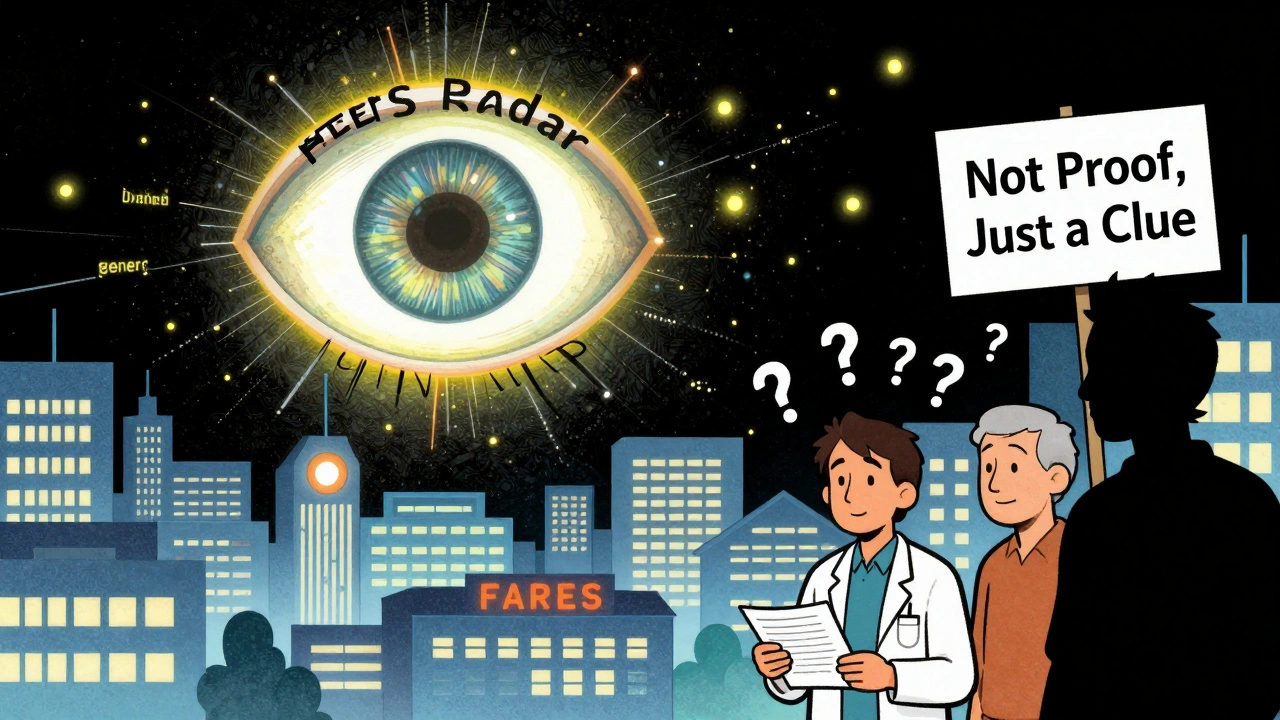
Think of it like a smoke alarm. It goes off when something’s wrong, but it doesn’t tell you if it’s toast burning or a house on fire. FAERS raises the alarm. You need to dig deeper to find out what’s really happening.
Use the FAERS Public Dashboard - But Know Its Limits
The easiest way to search FAERS is through the FAERS Public Dashboard. It’s free, web-based, and updated in real time as of August 2024. That’s a huge upgrade from the old quarterly system. Now, if a new safety issue pops up in July, you can see it in August - not November.
To search:
- Go to the dashboard and click the blue search bar at the top.
- Type in the generic name of the drug (e.g., “metformin,” not “Glucophage”).
- Click Search.
- By default, you’ll see a graph of reports by year. To see side effects, click the dropdown on the right and select “Cases by Reaction.”
But here’s the catch: you can only search up to five drug names at once. And if you’re looking for a brand-name drug, you might miss reports because people report using the generic name. Always search both. For example, search “lisinopril” AND “Zestril.”
Filter Smartly - Age, Gender, Outcome Matter
Not all reports are the same. A 72-year-old with kidney disease reporting dizziness after taking a blood pressure pill is very different from a 25-year-old with no health issues reporting the same thing. The dashboard lets you filter by:
- Patient age
- Gender
- Reporter type (healthcare professional vs. consumer)
- Report outcome (recovered, died, hospitalized, etc.)
- Year of report
Use these filters to narrow down what matters to you. If you’re concerned about elderly patients, filter for ages 65+. If you’re worried about deaths, filter for “fatal” outcomes. This helps you spot patterns that get lost in the noise.
Don’t Forget: Drugs Have Many Names
A single drug can have dozens of brand names, especially if it’s been on the market for years. Metformin is sold as Glucophage, Fortamet, Riomet, and others. If you only search one name, you’re missing half the data.
Pro tip: Use the FDA’s DailyMed website to find all brand and generic names for a drug. Copy them all into your FAERS search - one at a time, since you’re limited to five per search.
Also, don’t forget to check for discontinued drugs. If a drug was pulled from the market, it’s still in FAERS. You might find safety signals that led to its removal.
Compare Drugs With VisDrugs
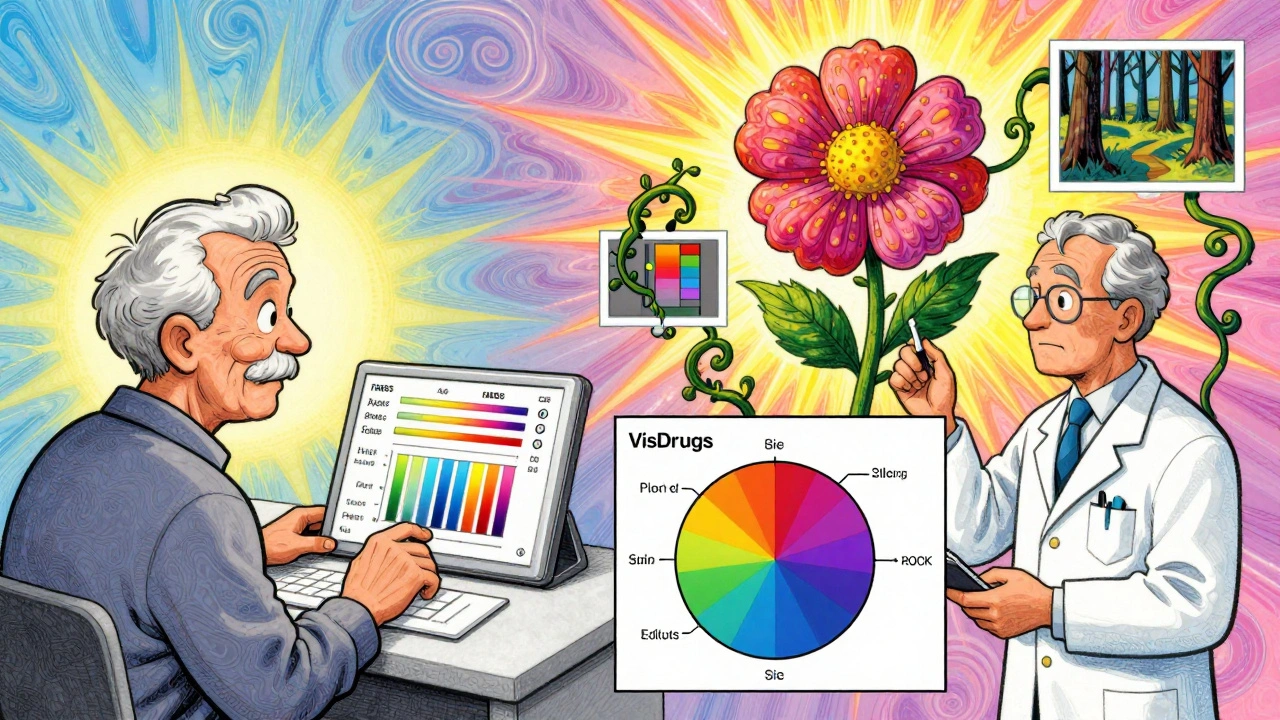
If you’re comparing two drugs - say, two antidepressants - the FAERS dashboard alone won’t help you see which one has more reports of weight gain. That’s where VisDrugs comes in.
VisDrugs is a free tool built by researchers to make FAERS data easier to interpret. You can input two or more drugs and instantly see:
- Pie charts of the most common side effects
- Forest plots showing how often each side effect was reported compared to other drugs
- Breakdowns by age and gender
It’s not perfect - but it turns confusing tables into visuals you can actually understand. No bioinformatics degree required.
What FAERS Can’t Tell You
Here’s what you should never use FAERS for:
- Calculating how likely a side effect is to happen
- Proving a drug is dangerous
- Deciding to stop a medication on your own
FAERS doesn’t know how many people took the drug. It doesn’t know if the side effect happened because of the drug, an interaction, or something else entirely. It also doesn’t include reports from countries outside the U.S. - so if a drug is widely used in Europe but not here, you won’t see those cases.
And here’s the kicker: 75% of reports come from drug companies. They’re required to report serious events, but they don’t report every minor complaint. That means the data is skewed toward serious cases - not the full picture.
When to Use MAUDE Instead
If you’re looking for side effects from a medical device - like a pacemaker, hip implant, or insulin pump - don’t use FAERS. Use MAUDE (Manufacturer and User Facility Device Experience). The two systems are separate. Devices have different naming conventions, versions, and manufacturers. Searching “Lap-Band” in FAERS will give you nothing. In MAUDE, you’ll find thousands of reports about leaks, migrations, and failures.
Same rules apply: use the exact device name, check for model numbers, and filter by outcome. If you don’t remember the device name, your medical records will have it. Request them from your provider.
What Happens After a Report Is Filed?
Just because a report shows up doesn’t mean the FDA will act. But if the same pattern shows up across hundreds or thousands of reports - say, a spike in liver failure with a new diabetes drug - FDA scientists flag it. They dig deeper. They look at lab data, patient histories, and sometimes launch new studies.
That’s how drugs get new black box warnings. Or how a generic drug loses its interchangeable status. Or how a drug gets pulled entirely. FAERS is the starting point - not the finish line.
For Legal or Medical Research
If you’re working on a legal case or academic study, the Public Dashboard won’t be enough. You’ll need the raw FAERS data files, which the FDA releases quarterly. These are massive CSV or ASCII files - thousands of columns, messy formatting. You need Python, R, or SQL to handle them.
For most people, stick with the dashboard or VisDrugs. But if you’re a researcher, download the raw data from the FDA’s FAERS downloads page. Just be warned: it takes hours to clean up.
Bottom Line: Use FAERS as a Warning System, Not a Diagnosis
FAERS is not a medical advice tool. It’s a public safety radar. If you’re worried about a medication, use FAERS to see what others have reported - then talk to your doctor. Don’t stop your medicine based on a dashboard. But do ask your doctor: “Have you seen this side effect in other patients? Is it common? Should we watch for it?”
The real-time updates mean we’re getting closer to true drug safety transparency. But the data is still messy. The key isn’t to trust FAERS - it’s to use it smartly. Filter. Compare. Question. And never forget: a report is not proof. It’s a clue.
Can I trust FAERS reports to know if a drug is safe?
No, you can’t trust FAERS reports alone to determine if a drug is safe. The system collects unverified reports from anyone - patients, doctors, or drug companies. A high number of reports doesn’t mean the drug causes the side effect; it just means people reported it. The FDA uses FAERS to spot patterns that need further study, not to confirm cause-and-effect.
Why do I see more reports for some drugs than others?
More reports don’t always mean more danger. Popular drugs like metformin or lisinopril are taken by millions, so naturally, more side effects get reported. Newer drugs get more attention from doctors and patients, leading to more reports. Older drugs may have fewer reports simply because people are used to their side effects and don’t report them. Always compare drugs using filters like patient age and outcome to get meaningful insights.
Should I search brand names or generic names in FAERS?
Search both. Many people report using the generic name, even if they were prescribed the brand. For example, someone might report “ibuprofen” even if they took Advil. To get the full picture, search the generic name first, then add the brand names one at a time. Remember, the FAERS dashboard only lets you search five drug names per query.
Is FAERS the same as MAUDE?
No. FAERS is for drugs and biologics. MAUDE is for medical devices like pacemakers, joint implants, and infusion pumps. If you’re looking for side effects from a device, use MAUDE. Searching for a device in FAERS will give you no results. The two systems use different data formats and reporting rules.
Can I use FAERS data to file a lawsuit?
FAERS data alone is not enough to prove a legal case. Courts require medical records, expert testimony, and evidence of causation. However, FAERS can help identify patterns that support a claim. If you’re considering legal action, obtain your medical records to confirm the exact drug or device name, then consult a lawyer who specializes in pharmaceutical litigation. FAERS can be a starting point - not evidence.
How often is FAERS updated?
As of August 2024, FAERS is updated in real time. This means reports are added to the public dashboard as soon as they’re processed - often within days. Before this change, updates happened only once every three months, which delayed safety alerts by up to 90 days. Real-time updates help the FDA and the public respond faster to emerging safety concerns.
What to Do Next
If you’re a patient: Use FAERS to ask better questions at your next doctor’s visit. Bring up any patterns you noticed - “I saw 12 reports of dizziness with this drug. Is that common?”
If you’re a researcher: Pair FAERS with other data sources - like clinical trial results or international databases - to get a fuller picture. Don’t rely on one system.
If you’re a journalist or advocate: Use VisDrugs to create clear visuals for your audience. Show, don’t just tell. A pie chart of side effects is more powerful than a paragraph of numbers.
FAERS isn’t perfect. But it’s the best public tool we have to see what’s happening with medications after they’re approved. Use it wisely - and always follow up with a professional.
Pavan Kankala
December 4, 2025 AT 19:10FAERS is just a government honeypot to make us think we have transparency while Big Pharma still owns the narrative. They filter out the real red flags - like sudden spikes in cardiac arrests - and let the minor stuff like 'mild nausea' dominate the charts. You think you're digging for truth? You're just scrolling through their curated distraction.
Martyn Stuart
December 4, 2025 AT 20:36Important clarification: FAERS is not a diagnostic tool - it's a signal detector. If you're using it to decide whether to stop your medication, you're risking your health. Always consult a clinician. That said, it's incredibly useful for spotting trends - especially when you filter by age, outcome, and reporter type. I've used it to help patients understand why their doctor is cautious about a new prescription. Just don't skip the human part of the equation.
Jessica Baydowicz
December 5, 2025 AT 15:23OMG YES. I literally used this last week when my grandma started that new blood pressure med and kept getting dizzy. I searched FAERS, filtered for 70+, and saw 37 reports of dizziness with 12 hospitalizations - that’s when I told her to call her doctor. She didn’t want to ‘bother’ him, but now she’s on a different med and feels like a new person. This tool is a superhero for patients who refuse to be silenced. 💪
Shofner Lehto
December 7, 2025 AT 10:06VisDrugs is a game-changer. I teach medical informatics and show my students how to compare drug side effect profiles using it. The forest plots make it impossible to misinterpret relative risk. FAERS raw data is a nightmare - 12,000 columns, inconsistent coding, missing values - but VisDrugs turns it into something even a undergrad can understand. Still, always cross-reference with PubMed and clinical guidelines. No single source tells the whole story.
Karl Barrett
December 8, 2025 AT 07:16The epistemological tension here is fascinating: FAERS operates as a phenomenological archive - a collection of subjective experiences - yet it's treated as if it were an objective epidemiological dataset. We mistake correlation for causation because we crave narrative certainty. The system is designed for signal detection, not statistical inference. To treat it as proof is to commit the ecological fallacy. The real power lies in its ability to surface anomalies - not to quantify risk. The FDA’s caution isn’t bureaucratic inertia; it’s epistemic humility.
Rachel Bonaparte
December 8, 2025 AT 22:28Let’s be real - the FDA doesn’t want you to know how much they suppress data. I’ve seen reports disappear after a drug maker pays for a 'reclassification'. And why do you think the dashboard only lets you search five drugs at once? To keep you from comparing the real killers - like the antipsychotics that cause metabolic syndrome in 60% of long-term users. They want you distracted by metformin and lisinopril. Meanwhile, the real danger? The drugs that kill slowly - and the reports that vanish.
And don’t get me started on how drug companies report only the worst cases - they bury the mild ones. That’s why you see 500 reports of liver failure but zero for mild fatigue. It’s not a system - it’s a smoke screen. If you really want truth, get the raw data, run your own SQL queries, and cross-reference with whistleblower documents. You’ll find things the FDA doesn’t want you to see.
And yes - I’ve done it. And no, I won’t tell you which drug. But I will say this: if your doctor says it’s 'safe', ask them if they’ve checked the 2021 Q3 FAERS dump. They won’t have.
Michael Feldstein
December 10, 2025 AT 01:10Great breakdown. I’d add one thing: always check the reporter type. If 90% of the reports come from patients and not doctors, that’s a red flag - it means the side effect might be common but not clinically significant. Conversely, if healthcare pros are reporting the same issue repeatedly, that’s a stronger signal. I use this method when advising my patients - it helps them understand why some side effects get flagged and others don’t. Also, don’t forget to check the 'outcome' field - 'recovered' vs. 'death' tells you a lot about severity.
Alex Piddington
December 10, 2025 AT 10:06Thank you for this clear and practical guide. As a healthcare professional, I often see patients who panic after seeing FAERS data without context. Your emphasis on signal detection versus causation is critical. I now direct my patients to the dashboard and walk them through filtering by age and outcome. It transforms fear into informed dialogue. Also, VisDrugs is now part of my standard patient education toolkit. A well-placed pie chart speaks louder than any lecture.
Libby Rees
December 12, 2025 AT 05:00FAERS is useful, but it's not magic. I used it to check a new anticoagulant my sister started. Found 12 reports of bleeding, all in patients over 75 with kidney issues. She’s 68 and healthy. That helped us decide to wait. Always match the data to your personal context. And yes, search both brand and generic. I once missed a whole set of reports because I only searched the brand name. Lesson learned.
Dematteo Lasonya
December 12, 2025 AT 19:22One thing I wish more people knew: FAERS doesn't include international data. So if a drug is widely used in Europe but not here, you won't see the full picture. I saw a spike in angioedema with a certain ACE inhibitor in the UK, but nothing in FAERS - until I checked EudraVigilance. Always check global sources if you're concerned about a drug's safety profile.
Rudy Van den Boogaert
December 13, 2025 AT 10:31Just wanted to say this post saved me. I was about to quit my meds after seeing a bunch of scary reports. Then I filtered by age and outcome - turns out 90% of the reports were from elderly patients with multiple conditions. I’m 32 and healthy. My doctor confirmed it’s not a big concern for me. FAERS is a tool, not a verdict. Thanks for the clarity.
Gillian Watson
December 14, 2025 AT 16:04Good guide. I’m a nurse and use this with patients all the time. The real win is teaching them to ask better questions. Instead of 'Is this drug dangerous?' they now say 'How many people like me had this side effect?' That shift changes everything. Also, VisDrugs is a hidden gem - I’ve shown it to three families this month. They all walked away feeling empowered.
Jordan Wall
December 16, 2025 AT 06:06FAERS? Pfft. You think that's the whole story? The FDA's system is a joke - they filter out anything that doesn't fit the pharma narrative. I checked the raw data for Ozempic last month - 2,300 reports of pancreatitis, but only 17 made it to the dashboard because they were 'non-serious'. And guess what? The 'serious' ones? All from patients with pre-existing conditions. Meanwhile, healthy people reporting GI issues? Buried. This isn't transparency - it's PR with a spreadsheet. Also, VisDrugs? Cute. But it's still just a pretty lie. Go to the source. Download the ASCII. Run the numbers. You'll see the truth. And then you'll understand why they don't want you to.