How to Read the Safety and Warnings Sections of Prescription Drug Labels
 Mar, 13 2026
Ever opened a prescription bottle and stared at the tiny print on the label, wondering what it all really means? You’re not alone. Millions of people take medications every day, but most don’t fully understand the warnings on the label - and that’s dangerous. A single missed warning can lead to serious side effects, dangerous drug interactions, or even hospitalization. The good news? Reading and understanding these sections isn’t complicated. You just need to know where to look and what to look for.
What’s in the Safety and Warnings Section?
The safety and warnings section of your prescription label isn’t just filler text. It’s a legally required summary of the most important risks tied to that medication. In the U.S., the FDA mandates this section be clear, specific, and prominently placed. It’s split into three main parts: the Boxed Warning, the Warnings and Precautions, and the Drug Interactions section.The Boxed Warning is the most serious type of warning the FDA can require. It’s called a "black box warning" because it’s printed in a black-bordered box on the drug’s packaging. These warnings appear on about 400 medications - roughly 8.7% of all prescription drugs approved since 2000. Examples include clozapine (risk of fatal blood disorders), isotretinoin (severe birth defects), and certain antidepressants (increased suicidal thoughts in young adults). If your drug has this box, it means the risk isn’t just possible - it’s proven, serious, and sometimes life-threatening.
The Warnings and Precautions section dives deeper. It lists side effects that happen often enough to be dangerous, like liver damage, severe allergic reactions, or sudden drops in blood pressure. This part uses precise language: "may cause," "has been associated with," or "can lead to." It doesn’t say "might" or "could." That’s intentional. These are not guesses - they’re based on clinical trials and real-world reports. For example, a label might say: "This drug has been associated with sudden loss of consciousness in 1 out of every 100 users." That’s not vague. That’s data.
The Drug Interactions section tells you which other drugs, supplements, or even foods can make your medication dangerous. This isn’t just "don’t mix with alcohol." It’s specific: "CYP3A4 inhibitors may increase plasma concentrations of this drug by up to 400%." That’s a technical way of saying: taking this with grapefruit juice or certain antibiotics can turn a safe dose into a toxic one. These warnings are backed by lab studies and patient data. Ignoring them isn’t risky - it’s statistically dangerous.
How Pharmacy Labels Are Different
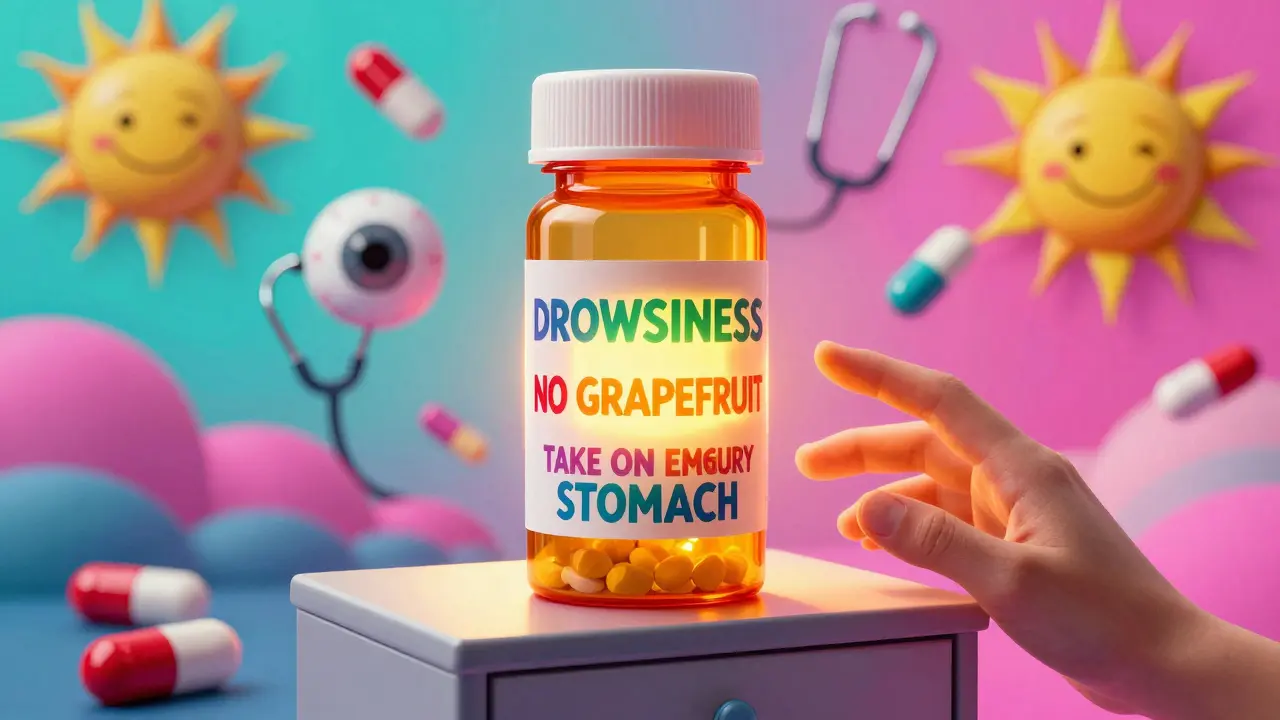
The label your pharmacist puts on the bottle is just as important as the one in the drug’s original packaging - maybe even more so. It’s what you’ll see every day. And it’s designed to be read quickly.By law, pharmacy labels must use a minimum 10-point font size (per USP Chapter 17) for critical warnings. That’s about twice the size of the small print on the original package. You’ll often see stickers like:
- "May cause drowsiness - do not drive or operate heavy machinery."
- "Take on an empty stomach."
- "Do not take with antacids."
These aren’t suggestions. They’re safety rules. A 2023 Reddit survey of over 1,200 patients found that 89% of people who noticed a "drowsiness" sticker avoided a potential car accident. But here’s the problem: 38% of patients reported that critical warnings were printed on the bottom of the bottle - where they get hidden when stored in a medicine cabinet. Always turn the bottle over. Check the cap. Read every sticker.
Why You’re Still Missing the Point
Even if you read the label, you might not understand it. Studies show that 68% of patients don’t realize "black box" means "life-threatening." Another 52% misunderstand timing instructions like "take 2 hours before meals." And 41% of people on five or more medications overlook interaction warnings entirely.One 2022 case from the Patient Safety Network tells the story: a 68-year-old man took dextromethorphan (a common cough medicine) with his SSRI antidepressant. The label said "do not take with SSRIs," but he didn’t see it. He developed serotonin syndrome - a dangerous, sometimes fatal condition. He survived, but only because his wife noticed he was confused and called 911.
Why does this keep happening? Three big reasons:
- Font size. The original label uses 6-point font. Your eyes aren’t what they used to be.
- Too much text. Paragraphs are harder to read than bullet points. The FDA found that bullet points with icons improve understanding by 35% in patients with low health literacy.
- Assuming it doesn’t apply to you. "That won’t happen to me" is the deadliest mindset in medication safety.
How to Actually Understand Your Warning Labels
Here’s a simple, step-by-step method that works - backed by real-world results.- Find the Boxed Warning. Look for the black border. If it’s there, read it twice. Ask yourself: "What’s the worst thing that could happen?" Write it down.
- Check for stickers. Look at the cap, the front, and the back of the bottle. If a sticker says "do not" or "avoid," treat it like a red light.
- Ask: "Does this affect me?" If you’re over 65, pregnant, have kidney disease, or take other meds, your risk changes. The same drug can be safe for one person and deadly for another.
- Use the "teach-back" method. After your pharmacist explains a warning, say: "So, just to make sure I got it - this medicine can cause dizziness, so I shouldn’t drive until I know how it affects me?" If you can repeat it back correctly, you’ve understood it.
- Keep a warning log. Use a notebook or phone note to write: Drug name - Key warning - Why it matters to me. Example: Warfarin - Avoid cranberry juice - My INR levels spike dangerously if I drink it. People who do this are 41% more likely to follow warnings correctly.
CVS Health tested a system in 2021 that color-coded warnings: red for critical, yellow for important, blue for general. Patients who got these labels remembered 22% more of the warnings. You can’t control the color, but you can control how you read. Treat red like a stop sign. Yellow like a caution light. Blue like a reminder.
What’s Changing in 2026
The system is getting better - slowly. Starting in January 2024, the FDA requires all new drug applications to include warning language tested on people with low literacy. That means simpler words, clearer instructions, and fewer medical terms.Some pharmacies are testing new tech. Walgreens piloted NFC chips on prescription bottles. You tap your phone, and a short video explains the warning in plain English. In trials, 92% of patients understood the warning - compared to 63% with paper labels. But here’s the catch: 24 million Americans don’t have smartphones or reliable internet. That’s why the FDA still requires paper labels - and why you still need to read them.
When to Call Your Doctor or Pharmacist
Don’t guess. Don’t assume. If you see a warning and think:- "I’ve been taking this for months and nothing happened. Is it still a problem?"
- "I take this with my other pills. Should I stop one?"
- "The label says "avoid grapefruit," but I love it. Can I have just one?"
Then call your pharmacist. They’re trained to explain this stuff. You don’t need a medical degree to understand the warning - you just need to ask.
And if you’re on five or more medications? Schedule a medication review. Many pharmacies offer this for free. It’s not a sales pitch. It’s a safety check. One study showed it reduced hospital visits by 27% in Medicare patients.
What does a black box warning mean?
A black box warning is the strongest warning the FDA can require. It means the drug has been linked to serious, sometimes life-threatening side effects. These are not rare guesses - they’re based on real patient data. If your drug has this warning, you need to understand exactly what the risk is and how to avoid it.
Can I ignore a warning if I’ve taken the drug before without problems?
No. Medication risks can change over time. Your body changes. Other drugs you take may change. A warning that didn’t affect you last year might be dangerous this year. The label isn’t a suggestion - it’s a rule based on what happens to people like you.
Why do some warnings say "may cause" instead of "will cause"?
"May cause" means the side effect has been observed in clinical trials or patient reports - but not in everyone. It doesn’t mean it’s unlikely. It means it’s real. For example, "may cause liver damage" means it happened in a small percentage of users - but those cases were serious enough to require a warning. If it said "will cause," it would mean everyone gets it - which isn’t true.
Do I need to read the warning if my doctor told me it’s safe?
Yes. Your doctor knows your health history, but they don’t know everything about how the drug interacts with your diet, supplements, or other prescriptions. The label includes information your doctor might not have time to explain. Reading it is your last line of defense.
Are pharmacy warnings different from the original drug label?
Yes. The original label has full details, but the pharmacy label is designed for daily use. It highlights the most urgent warnings in larger print. The pharmacy label is often the only one you’ll see - so treat it like the most important one.
Next Steps: Make Your Medication Safe
Start today. Take your next prescription bottle. Find the black box. Read the stickers. Write down one warning that applies to you. Ask your pharmacist to explain one thing you didn’t understand. That’s all it takes.Medication safety isn’t about memorizing science. It’s about asking questions, paying attention, and refusing to ignore the small print. The right warning - read and understood - can keep you out of the hospital. And that’s worth five minutes of your time.
Adam M
March 14, 2026 AT 06:50Everything else is noise.
Stephanie Paluch
March 14, 2026 AT 07:00Just checked my blood pressure med-yep, there’s a tiny 'avoid grapefruit' on the cap. I’ve been eating grapefruit every morning for years... whoops.
Thanks for the wake-up call 🙏❤️
tynece roberts
March 16, 2026 AT 04:33and dont even get me started on the 'take on empty stomach' sticker that got folded under the cap
also why does every warning say 'may cause' like its a weather forecast??
its not may, its WILL if you do it wrong
also why is the font smaller than the barcode??
Jimmy V
March 16, 2026 AT 05:57Boxed warning? That’s your first and last priority. Everything else is bonus content.
Stop pretending you 'understand' it. If you didn’t write it down, you didn’t learn it.
Richard Harris
March 17, 2026 AT 06:14Will try this tomorrow with my statin. Thanks for the reminder, this is actually really helpful.
Kandace Bennett
March 19, 2026 AT 01:34Why isn’t this mandatory? Why isn’t every label printed in 14-point bold with a siren sound when you open the bottle?
Also-grapefruit? Really? We still have to warn people about this? We’re not even trying anymore.
Jinesh Jain
March 19, 2026 AT 15:47douglas martinez
March 21, 2026 AT 04:23Sabrina Sanches
March 22, 2026 AT 08:24Shruti Chaturvedi
March 22, 2026 AT 21:55we need more of this in community centers and clinics
thank you for writing this
Katherine Rodriguez
March 23, 2026 AT 19:04Devin Ersoy
March 24, 2026 AT 05:47Let me guess-you also believe the FDA knows what’s best?
Newsflash: the original drug insert has the full toxicology data. The sticker is a marketing gimmick for people who can’t read.
Also, 'teach-back'? That’s for toddlers. I’m an adult. I’ll read the damn package insert in the original 6-point font, thank you very much.
And grapefruit? Please. I’ve been drinking it with my statin since 2012. My liver is a tank.