How to Prevent Moisture Damage to Pills and Capsules: Expert Storage Tips
 Dec, 25 2025
Moisture doesn’t just ruin your phone or your books-it can also ruin your medicine. If your pills or capsules have been sitting in a humid bathroom, a damp drawer, or a poorly sealed bottle, they might not work anymore. Worse, they could become unsafe. In fact, moisture damage is one of the top reasons medications fail before their expiration date, especially in places like the UK where humidity levels regularly climb above 70% in summer. You might not see it, but inside that tablet, chemical reactions are already happening-active ingredients breaking down, coatings dissolving, or powders clumping. This isn’t speculation; it’s documented science.
Why Moisture Is a Silent Killer for Pills
When water gets into a pill or capsule, it triggers hydrolysis-a chemical reaction where water molecules break apart the active drug. Aspirin turns into salicylic acid and vinegar. Vitamin C oxidizes faster. Antibiotics like amoxicillin/clavulanate lose potency within days if unprotected. The result? You take your medicine, but it doesn’t work. You might think your condition isn’t improving because the treatment failed, when really, the pill itself was already dead.
Studies show that 67% of medication shortages in the US between 2010 and 2012 were linked to quality issues, and moisture was a leading cause. Even if the pill looks fine-no discoloration, no odd smell-it could be losing up to 30% of its strength in just a few months under high humidity. That’s not a small risk. That’s a health risk.
The Three-Layer Defense System
Manufacturers don’t leave your medicine defenseless. The best protection comes from three layers working together: film coating, packaging, and desiccants. If any one of these is missing, your pills are more vulnerable.
- Film coating is the first line of defense. Modern pills often use polyvinyl alcohol (PVA)-based coatings like Opadry® amb II. These are three times better at blocking moisture than older coatings made from hydroxypropyl methylcellulose (HPMC). In tests, uncoated or HPMC-coated tablets lost all their clavulanic acid after 10 days outside their original packaging. PVA-coated tablets? Still fully potent.
- Packaging matters too. HDPE bottles (the common plastic ones) stop liquid spills, but they don’t stop water vapor. That’s why many high-quality medications come in aluminum blisters or foil-laminated packaging. These materials act like a sealed shield. If your pills came in a foil pack, never transfer them to a plastic container unless you add a desiccant.
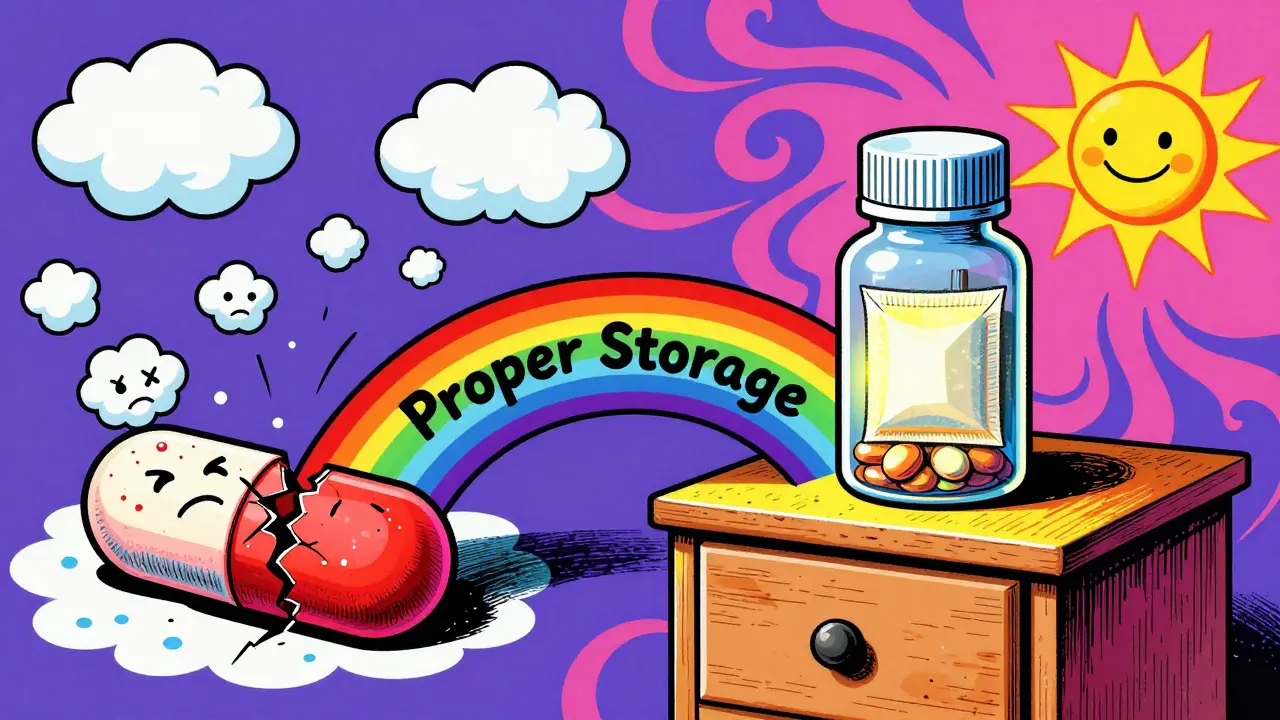
- Desiccants are the unsung heroes. Those little white packets labeled “Do Not Eat” are silica gel-engineered to suck up moisture like a sponge. A properly sized desiccant can keep moisture levels in a 500-pill bottle from rising above 3.4% over two years, even in humid climates. Without it, every time you open the bottle, you’re letting in a fresh wave of moisture. Over 250 openings in a year? That’s 250 chances for your pills to degrade.
What You Can Do at Home
You can’t control how the manufacturer packages your medicine, but you can control how you store it.
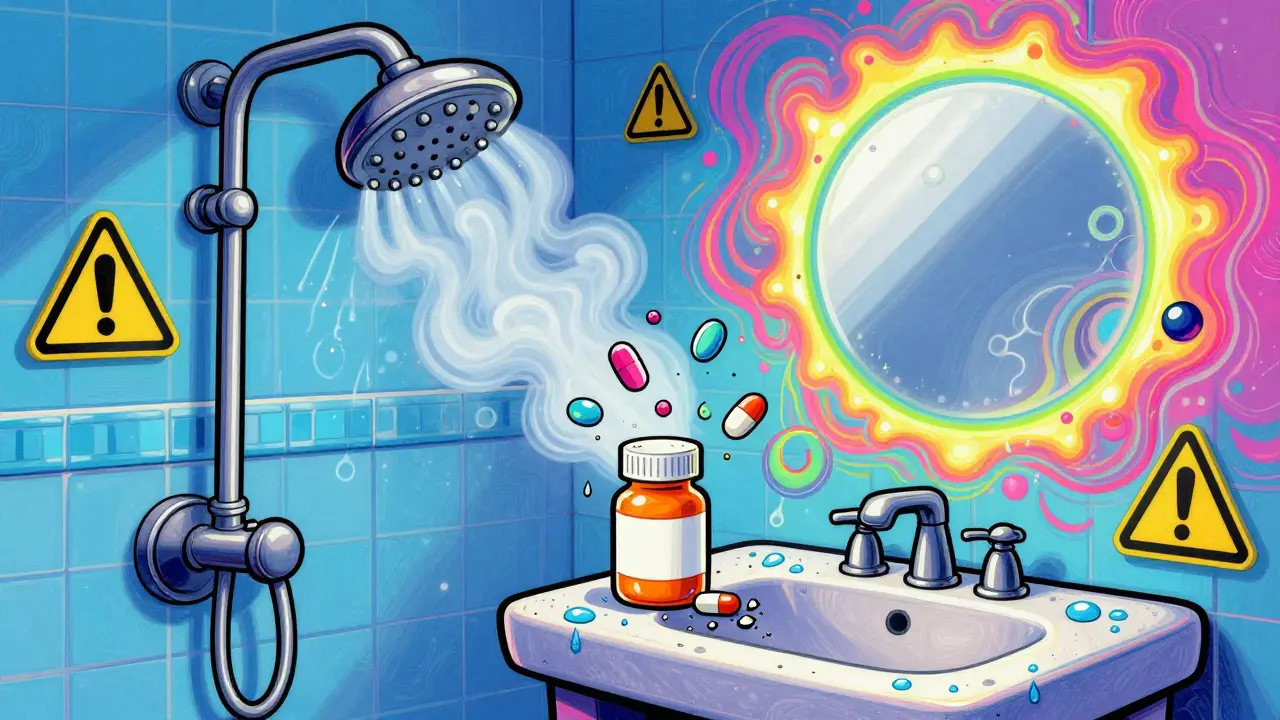
- Never store pills in the bathroom. Showers create steam. Sinks leak. Humidity builds up. Even if the cabinet looks dry, the air is wet. A bedroom drawer or kitchen cabinet away from the stove is better.
- Keep pills in their original bottle. That bottle was designed with the right material, cap seal, and desiccant. Transferring pills to a pill organizer? Fine-but only if you use it within a week. Long-term storage? Stick to the original container.
- Check for desiccants. If your bottle has a little packet inside, don’t throw it out. If it doesn’t, and you live in a humid area, consider buying silica gel packs separately. Place one in the bottom of your pill organizer or in a sealed container with your meds. They’re cheap, safe, and effective.
- Don’t refrigerate unless instructed. Cold air holds less moisture, but when you take a cold bottle out into warm air, condensation forms on the pills. That’s worse than humidity. Only refrigerate if the label says so.
- Buy only what you need. If you have a 90-day supply of a medicine you only take once a month, you’re storing it for three months longer than necessary. That’s extra time for moisture to do damage.

Red Flags Your Pills Are Damaged
Some signs are obvious. Others aren’t.
- Cracking, crumbling, or sticking together? That’s moisture.
- Discoloration-yellow, brown, or cloudy spots? That’s chemical breakdown.
- Odd smell-like vinegar or mildew? That’s decomposition.
- Tablets that taste bitter or metallic? That’s degraded active ingredients.
If you see any of these, don’t take the pill. Don’t flush it. Don’t throw it in the trash. Take it to your pharmacy. They have safe disposal bins for expired or damaged medication.
Why Some Medications Are More at Risk
Not all pills are created equal. Some are naturally more sensitive to moisture:
- Vitamin C (ascorbic acid)-reacts with oxygen when wet, loses potency fast.
- Antibiotics like amoxicillin, doxycycline, and azithromycin-hydrolysis breaks down the active compound.
- Thyroid meds like levothyroxine-even small changes in potency can affect your metabolism.
- Sublingual tablets-designed to dissolve under the tongue. Moisture makes them dissolve too early.
- Generic versions-sometimes use cheaper coatings or skip desiccants to cut costs.
If you’re on any of these, pay extra attention to storage. Ask your pharmacist: “Is this coated for moisture resistance?” If they don’t know, it’s worth checking the manufacturer’s website or switching brands.
What Manufacturers Are Doing Right (and Wrong)
Big pharma companies know moisture is a problem. Most now use PVA coatings and include desiccants. But smaller manufacturers? They still cut corners. You’ll find some generic antibiotics sold in HDPE bottles with no desiccant-especially in online pharmacies or discount retailers. In humid regions like Brazil or Southeast Asia, this leads to frequent returns and complaints. One pharmacist on Reddit said: “Since we switched to Opadry-coated antibiotics, customer complaints dropped from five a month to zero.”
Regulators like the FDA and EMA require manufacturers to prove their packaging keeps medicine stable. But enforcement isn’t perfect. If your medicine looks old, smells off, or came from an unfamiliar source, don’t assume it’s safe.
The Future of Moisture Protection
Next-generation solutions are already here. Some companies are testing color-changing labels that turn blue when moisture gets in. Others are developing biodegradable desiccants made from plant-based materials. A few even experiment with moisture-absorbing polymers built directly into the pill itself-so even if you lose the bottle, the tablet still protects itself.
But for now, the best system is still the simple one: good coating, good packaging, and a silica gel pack. It’s not fancy. It’s not expensive. But it works.
Final Rule: When in Doubt, Don’t Take It
Medicines aren’t like bread. You can’t just eat them a few days past their prime. A weakened antibiotic won’t kill your infection-it might make it worse by encouraging resistant bacteria. A degraded thyroid pill could throw your whole metabolism off balance.
If you’re unsure whether your pills are still good, bring them to your pharmacy. They’ll check the batch, the expiration, and the condition. It’s free. It’s safe. And it’s better than risking your health.
Can I put my pills in the fridge to keep them dry?
Only if the label says to. Refrigeration can cause condensation when you take the bottle out, which adds moisture instead of removing it. Most pills are stable at room temperature, as long as they’re kept away from humidity and heat. The bathroom is the worst place; a cool, dry drawer is best.
Are desiccant packets safe if I accidentally swallow one?
Silica gel is non-toxic. If you swallow one, you won’t be poisoned. But it’s not meant to be eaten-it can cause choking or stomach upset. If a child or pet swallows one, call poison control. Don’t induce vomiting unless told to. The real danger isn’t the gel-it’s the risk of losing your medicine to moisture if you throw the packet away.
How many desiccant packs do I need for a 500-pill bottle?
Industry standards recommend desiccants that can absorb at least 150% of the expected moisture from bottle openings. For a typical 500-pill bottle with daily use, a single 2-gram silica gel packet is usually enough. If you live in a very humid climate or open the bottle frequently, use two. Never use more than three-over-saturation can cause condensation inside the bottle.
Can I reuse silica gel packets?
Yes, if they’re the silica gel type (not clay or mineral). Bake them at 200°F (93°C) for 2-3 hours to reactivate them. Let them cool completely before putting them back in the bottle. But for medication storage, it’s safer and cheaper to just buy new ones. They cost less than a coffee.
What’s the difference between a blister pack and a bottle with a desiccant?
Blister packs seal each pill individually in foil, so moisture can’t reach them until you push the pill out. Bottles with desiccants protect the whole batch but rely on the desiccant to absorb moisture from the air inside. Blister packs are better for long-term storage and travel. Bottles with desiccants are better for daily use and larger quantities. The best option? Blister packs with a desiccant inside the box-dual protection.
Next Steps: Protect Your Medicines Today
Take five minutes right now. Look at your medicine cabinet. Are your pills in their original bottles? Is there a desiccant inside? Are they stored away from the sink or shower? If not, fix it. Buy a cheap silica gel pack from the pharmacy. Transfer your daily pills to a small, dry container-but keep the rest sealed. Write the date you opened the bottle on the label. Check your pills every few months. If they look strange, don’t take them.
Moisture damage doesn’t announce itself. It creeps in slowly. But you can stop it. You just have to care enough to act.
Prasanthi Kontemukkala
December 27, 2025 AT 03:36So many people just toss their meds in the bathroom and wonder why they don’t work. I used to do this too-until my grandma’s blood pressure pills turned to mush. Now I keep everything in a sealed container in my bedroom drawer. Silica gel packs are cheap as dirt at the pharmacy. Just don’t throw them away.
Lori Anne Franklin
December 27, 2025 AT 05:59omg i had no idea vitamin c could just… die like that. i’ve been leaving my supplements in the bathroom for years. i’m moving them tonight. also, i just found a desiccant packet in my ibuprofen bottle and i thought it was a sugar packet?? lol
Jeanette Jeffrey
December 29, 2025 AT 05:05Let’s be real-most people don’t care until they’re sick. And even then, they’ll pop expired pills like candy. This post is basically a lecture on personal responsibility. If your medicine looks weird, don’t be lazy. Go to the pharmacy. Or don’t. Your funeral, your choice.
Ellie Stretshberry
December 29, 2025 AT 11:09i read this and immediately checked my medicine cabinet. my levothyroxine bottle had no desiccant. i threw out the one i had and bought a new bottle with one. also, i put a silica pack in my weekly pill organizer. i dont want to feel off again because of bad storage
Sarah Holmes
December 31, 2025 AT 06:52It is a tragic irony that the very substances designed to preserve life are so often rendered inert by the most basic environmental negligence. One must question the societal infrastructure that permits such preventable degradation to persist under the guise of consumer convenience. The pharmaceutical industry profits from your ignorance.
Alex Ragen
December 31, 2025 AT 22:26Let’s not mince words: HDPE bottles are a joke. They’re vapor-permeable, which means they’re essentially porous sarcophagi for your pharmaceuticals. PVA coatings? Yes. Desiccants? Mandatory. But the real villain? The FDA’s lax enforcement of packaging standards for generics. You’re not being paranoid-you’re being scientifically literate.
Jay Ara
January 1, 2026 AT 02:02i live in india and the humidity here is brutal. i used to keep my meds in the kitchen cabinet and they’d get sticky. now i put them in a plastic box with a silica packet and seal it. works great. also, dont refrigerate unless you have to. condensation is worse than humidity
Ryan Cheng
January 2, 2026 AT 09:15One thing no one talks about: generic brands. I switched from a name-brand antibiotic to a generic one that came in a plain HDPE bottle with no desiccant. Two weeks later, the pills started crumbling. I went back to the brand with the PVA coating and silica pack. Worth every extra dollar. Your health isn’t a budget item.
Angela Spagnolo
January 2, 2026 AT 16:51i just realized… i’ve been reusing those little packets for years… i even washed them. are they still safe? i’m terrified i’ve been poisoning my meds. someone please tell me i’m not a monster
Bryan Woods
January 3, 2026 AT 03:41Reusing silica gel packets is technically safe if properly reactivated, but the risk of contamination or improper drying outweighs the cost savings. For medication storage, new packets are inexpensive and eliminate uncertainty. I recommend purchasing them in bulk from medical supply vendors.
wendy parrales fong
January 3, 2026 AT 09:31i used to think this was overkill until my mom’s diabetes meds got soggy and she passed out. now i check every bottle like it’s a time bomb. i put a little note on my cabinet: "don’t touch unless you’re the medicine." it’s weird, but it works.
Dan Alatepe
January 4, 2026 AT 19:09bro… i just found a desiccant in my ibuprofen and i thought it was a sugar cube?? i ate it. i’m fine. but now i’m scared. like… what if it’s not silica gel? what if it’s poison?? my whole life is a lie 😭
Shreyash Gupta
January 5, 2026 AT 17:34you people are overreacting. i’ve been storing my pills in my bathroom for 15 years. i’m 72 and still running marathons. if your meds don’t work, maybe you’re just weak. 🤷♂️
Zina Constantin
January 7, 2026 AT 02:26As someone who works in public health, I’ve seen too many cases where people assume their meds are still potent because they "look fine." The science here is irrefutable: moisture degrades active ingredients invisibly. If you’re on thyroid meds, antibiotics, or vitamin C, treat this like a life-or-death protocol-not a suggestion. Buy the silica gel. Use the original bottle. Write the date you opened it. And if you’re unsure? Bring it to the pharmacy. It’s free. It’s responsible. And it might save your life.