Global Medication Safety: How Different Countries Regulate Drugs
 Jan, 31 2026
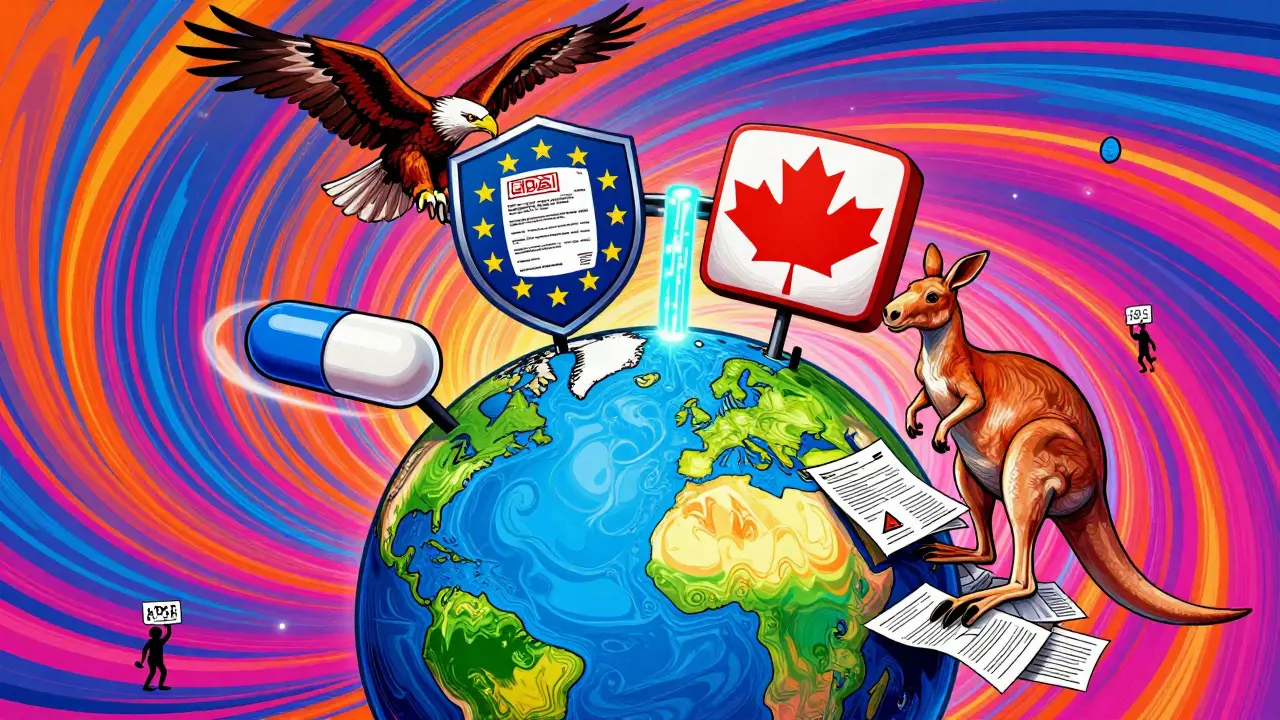
When you take a pill, you assume it’s safe. But that safety isn’t guaranteed by a single global rulebook. It’s built by dozens of agencies, each with their own rules, timelines, and priorities. The same drug approved in the U.S. might carry a different warning in Europe, or even be pulled entirely in Australia. Why? Because drug regulation isn’t one system-it’s a patchwork of national laws, cultural attitudes, and political choices.
How the U.S. FDA Works: Speed, Clarity, and Central Control
The U.S. Food and Drug Administration (FDA) runs a tightly controlled, single-agency system. If a drug wants to hit American shelves, it goes through the FDA. No exceptions. This centralization means clear accountability. Doctors and pharmacies know exactly where to look for updates. In 2022, 94% of U.S. physicians said they trusted FDA safety communications as timely and actionable. The FDA’s approval process averages 10.2 months for new drugs. That’s faster than most other major regulators. But speed comes with trade-offs. The agency prioritizes evidence of effectiveness over long-term safety data, often approving drugs based on early clinical results. Post-market surveillance then catches problems later. That’s why the FDA’s MedWatch system gets over 100,000 adverse event reports every year. In 2022, the FDA approved 18.3% more rare disease therapies than the EMA. Why? Because the U.S. system is more willing to accept higher risks for patients with no other options. It’s a philosophy: faster access, even if it means more follow-up monitoring.The EU’s Hybrid Model: Shared Power, Slower Decisions
The European Medicines Agency (EMA) doesn’t act alone. It coordinates with 27 national agencies across the European Union. For new, complex drugs-like biologics or gene therapies-the EMA handles centralized approval. But for generics and older medicines, each country can make its own call. That means a drug can be approved in Germany but delayed in Italy. The EU’s average approval time is 12.7 months, slower than the U.S. But European regulators pride themselves on transparency. Seventy-one percent of doctors in the EU rate EMA benefit-risk reports as comprehensive and understandable, compared to 63% for FDA documents. The EU also moves faster when safety issues arise. When the painkiller Vioxx was pulled in 2004, 22 EU countries coordinated their warnings within 14 days. The U.S. took 28. The EU’s system also allows more flexibility. Countries can impose extra restrictions-like limiting a drug to hospitals only-without waiting for EMA approval. But this creates chaos for drugmakers. Sixty-eight percent of European pharmaceutical companies say navigating multiple national rules is a major headache.Canada and Australia: Bridging the Gap
Canada’s Health Canada operates somewhere between the U.S. and EU models. It’s centralized like the FDA, but it has a formal agreement with the EU since 2019. That means if the EMA approves a drug, Canada can often accept the same data without redoing trials. The result? An 87% alignment with EU safety decisions. Australia’s Therapeutic Goods Administration (TGA) is known for being cautious. It doesn’t rush approvals. In 2022, it approved 12% fewer oncology drugs than the FDA. But its safety alerts are highly trusted. The TGA matches FDA decisions 79% of the time, but only 63% with the EMA. That’s because Australia often waits for more data before acting-sometimes too long for patients. Both countries have smaller populations, so they can afford to be more deliberate. They also benefit from sharing data with larger regulators, reducing duplication.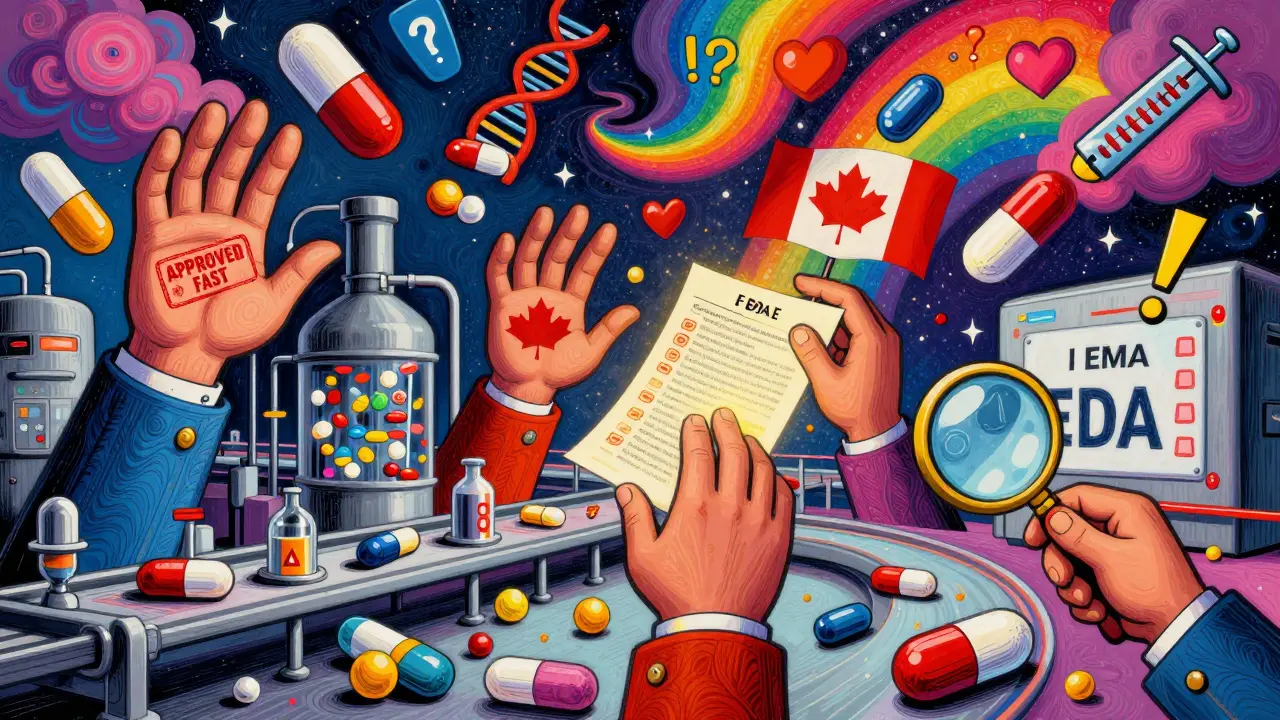
Why Safety Warnings Don’t Match Up
Here’s the startling fact: only 10.3% of safety warnings issued by the U.S., Canada, the UK, and Australia agree on the same drug risk. That means if you take a medication approved in multiple countries, you might get conflicting advice. Why? Because regulators weigh risk differently. The FDA might say a drug’s benefit outweighs its side effects for a life-threatening condition. The EMA might say the side effects are too common, even if rare. Australia might wait for more real-world data. Canada might defer to the EU. This isn’t just bureaucratic noise. It’s dangerous. A 2022 study from the Institute of Medicine warned that this fragmentation could confuse up to 200 million patients annually who use drugs approved in more than one country. Imagine a traveler in Spain taking a medication they bought in the U.S.-and getting a different warning than their doctor back home.The Cost of Compliance: What It Takes to Get a Drug Approved Globally
Getting a drug approved in the U.S., EU, Canada, and Australia isn’t just about science. It’s about paperwork. A single new drug application to the FDA can run 15,000 to 20,000 pages. The EMA wants 12,000 to 18,000. That’s not just printing-it’s years of work by teams of regulatory specialists. The average cost to build a global regulatory team? $1.2 million per company. The total cost to bring one drug to market? Around $2.6 billion. That’s why only big companies can play this game. Small biotechs often pick one market first-usually the U.S. or EU-and delay others for years. Even the rules on testing kids differ. The U.S. requires pediatric studies for most new drugs under the Pediatric Research Equity Act. The EU has similar rules, but they’re enforced differently. Sixty-one percent of drug companies say reconciling these requirements is one of their biggest challenges.
Where the World Is Falling Behind
Most of the world doesn’t have an FDA or EMA. In Africa, only 37% of drug manufacturing sites meet basic safety standards. In India, the Central Drugs Standard Control Organization (CDSCO) ramped up inspections in 2022-but many small labs still cut corners. The World Health Organization (WHO) tries to fill the gap with guidelines, but they’re not legally binding. Over 150 countries use them as a reference, but without enforcement, compliance is patchy. In Nigeria and Bangladesh, delayed safety alerts have led to preventable deaths. The African Medicines Agency, launched in 2021, is trying to change that. It’s already harmonized rules across 22 countries. But funding is thin. It’s like trying to build a highway with a shovel.The Future: AI, Harmonization, and Patient Safety
The good news? Change is coming. The FDA already uses AI to process 43% of routine manufacturing inspections. The EMA reviewed 189 advanced therapies in 2022 using digital tools. By 2027, AI could cut approval times by 30-40%. The International Council for Harmonisation (ICH) is pushing for global alignment. Its E6(R3) guidelines, adopted by 89% of major regulators, cut clinical trial paperwork by 22%. The goal? 75% alignment between the U.S., EU, Japan, and Canada by 2028. But political will matters. The U.S. and EU still don’t have a formal mutual recognition agreement for drug approvals, despite 10 years of talks. Canada and the EU do. Australia doesn’t. Without binding agreements, safety gaps will keep growing.What This Means for You
You don’t need to understand regulatory codes. But you should know this: your medication’s safety isn’t automatic. It’s the result of decisions made in Washington, Brussels, Ottawa, and Canberra. If you travel often, take multiple prescriptions, or use generic drugs from abroad, ask your pharmacist: Is this version the same as the one approved here? Advocacy groups are pushing for global safety alerts to reach patients directly-not just doctors. That’s the next frontier. Because when a drug is unsafe, it shouldn’t matter where it was made. It should matter that it’s unsafe everywhere.Why do different countries have different safety warnings for the same drug?
Each country’s regulator weighs risk differently based on local health priorities, patient populations, and available data. The FDA may approve a drug faster for life-threatening conditions, while the EMA might demand more long-term safety data. Australia often waits for real-world evidence. These differences aren’t mistakes-they’re choices shaped by culture, law, and available resources.
Is one system better than the others?
There’s no single best system. The U.S. FDA is faster and clearer, ideal for patients needing urgent access. The EU EMA offers more transparency and coordinated safety responses. Canada and Australia balance both. The best system depends on what you value: speed, caution, or local flexibility. No system is perfect, but all are improving.
How do I know if my medication is safe if I bought it abroad?
Always check the active ingredient and manufacturer. Use trusted sources like your country’s health authority website or ask your pharmacist. Avoid buying prescription drugs from unknown online vendors. Even if the packaging looks official, it may not meet your country’s safety standards. When in doubt, don’t take it.
Why doesn’t the world just use one drug approval system?
Sovereignty. Countries want control over their own health policies. The U.S. fears losing its fast-track system. The EU wants to protect its public health model. Developing nations need flexibility to adapt rules to their resources. Harmonization efforts like the ICH are making progress, but full global unity is unlikely without major political compromise.
Are generic drugs less safe in some countries?
Not necessarily-but quality control varies. In the U.S. and EU, generics must prove they’re identical to the brand-name drug. In some developing countries, enforcement is weaker. The WHO estimates 1 in 10 medical products in low-income regions are substandard or falsified. Always get generics from licensed pharmacies and check for regulatory approval labels.
Jaden Green
February 1, 2026 AT 22:52Look, I get it-everyone thinks their country’s system is the best. But let’s be real: the FDA is basically a glorified speedrun for Big Pharma. They approve drugs on half-baked data and then pray people don’t die. And when they do? Oh, they’ll slap a black box warning on it like that fixes everything. Meanwhile, Europe’s actually trying to protect people instead of just hitting quarterly profit targets. It’s not even close. The U.S. system is a casino with a medical license.
Angel Fitzpatrick
February 3, 2026 AT 09:44They’re not just slow-they’re complicit. Did you know the FDA’s top brass have ties to the same pharma execs who lobby for faster approvals? The whole thing’s a revolving door. And don’t get me started on the ‘post-market surveillance’ scam. That’s just a PR stunt to make you think they’re watching. Meanwhile, the real data-like the 300,000+ unreported adverse events each year-is buried under layers of corporate NDAs. The WHO’s guidelines? Useless. They’re just there to make the UN feel important while people in India and Nigeria die from fake pills because the FDA’s too busy approving the next $100k/month migraine drug.
Nidhi Rajpara
February 4, 2026 AT 11:58As someone from India, I can confirm that regulatory oversight is still inconsistent. While CDSCO has improved, many small manufacturers still lack proper GMP certification. I’ve seen generic medicines with incorrect dosages sold in rural pharmacies. The problem isn’t just the system-it’s enforcement. Even if guidelines exist, without trained inspectors and accountability, they’re just words on paper. We need more international collaboration-not just in approval, but in training and auditing.
Chris & Kara Cutler
February 5, 2026 AT 08:00YESSS this is so important!! 🙌 If you’re traveling, ALWAYS check with your pharmacist. I got a ‘similar’ med in Mexico once and it gave me a rash for a week. Never again. Safety first, savings second! 💊🌍
Donna Macaranas
February 7, 2026 AT 03:55I appreciate how this breaks down the differences without taking sides. It’s easy to get frustrated with the system, but the truth is, every country’s trying to balance risk and access in their own way. I think the real win is that more regulators are sharing data now. Even if it’s slow, it’s moving in the right direction.
Rachel Liew
February 8, 2026 AT 14:00My dad takes 7 meds and he’s always confused when he sees different labels on his bottles from different countries. I showed him how to check the FDA and TGA websites and now he feels way less anxious. It’s crazy how little people know about this stuff. Just a little info goes a long way.
Lisa Rodriguez
February 8, 2026 AT 23:56Big Pharma doesn’t want global harmony because it’d cut their profits. The $2.6 billion cost to bring a drug to market? That’s not science-it’s a tax on innovation to keep small players out. And yes, the FDA’s fast approvals are sketchy, but the EU’s 12-month wait means patients with rare diseases die waiting. We need a middle path: faster for urgent cases, stricter for chronic meds. AI can help, but only if we stop letting lobbyists write the rules
vivian papadatu
February 10, 2026 AT 11:51I’ve worked in regulatory affairs for 15 years. The ICH guidelines are the quiet hero here. They’ve cut redundancy by nearly a quarter. But here’s what no one talks about: the real bottleneck isn’t science-it’s translation. A 15,000-page dossier in English isn’t useful in Japan or Brazil without culturally adapted summaries. We need plain-language safety alerts for patients, not just doctors. And yes, AI can help with that. But only if regulators fund it.
Melissa Melville
February 11, 2026 AT 22:52So let me get this straight: the U.S. approves drugs faster, Europe waits longer, and Australia waits even longer… but somehow the U.S. gets more complaints? Sounds like the FDA is just really good at making people feel like they’re getting something before it’s ready. Classic American hustle. 🤷♀️
Bryan Coleman
February 12, 2026 AT 00:19My cousin’s on a drug that’s banned in Australia but sold over the counter in Thailand. He’s fine, but I worry. The real issue isn’t regulation-it’s access. If you’re poor or live in a rural area, you don’t care about FDA vs EMA. You care if the pill in your hand works and doesn’t kill you. We need global transparency, not just harmonization.