Genetic Factors in Statin Tolerance: How Pharmacogenomics Testing Can Help
 Dec, 22 2025
Statin Tolerance Risk Calculator
Statin Tolerance Risk Calculator
Calculate your risk of muscle pain with statins based on your SLCO1B1 genotype and find the safest options for you.
Results
Select your statin type and genotype to see your risk level
Many people take statins to lower cholesterol and prevent heart attacks, but nearly 1 in 4 stop because of muscle pain, weakness, or cramps. For years, doctors assumed this was just bad luck or aging. But now we know: for some people, it’s written in their DNA.
Why Some People Can’t Tolerate Statins
Statins work by blocking an enzyme your liver uses to make cholesterol. But they don’t just stay in the liver. Some of the drug gets into your bloodstream and can affect your muscles. That’s where the problem starts. Muscle pain from statins-called statin-associated muscle symptoms, or SAMS-isn’t always obvious. It might be mild soreness after walking, or it could be severe enough to keep you from climbing stairs. The worst case? A rare but dangerous condition called rhabdomyolysis, where muscle tissue breaks down and can damage your kidneys. For decades, doctors blamed dose, age, or other medications. But then came a breakthrough in 2008. A study in the New England Journal of Medicine found a clear link between a single gene variant and severe muscle damage from simvastatin. That gene is SLCO1B1. It controls a protein that pulls statins out of the blood and into the liver. If that protein doesn’t work well, the drug builds up in your muscles instead.The SLCO1B1 Gene and Your Risk
Everyone has two copies of the SLCO1B1 gene-one from each parent. The variant that matters is called rs4149056, or the C allele. If you have two C copies (CC genotype), you’re at the highest risk. About 1-2% of people of European descent fall into this group. If you take 80mg of simvastatin, your chance of serious muscle damage is more than four times higher than someone with two T copies (TT genotype). If you have one C and one T (TC genotype), your risk is still about 2.5 times higher. About 15% of Europeans have this mix. Even at lower doses, this group may feel muscle pain more often. But here’s the catch: this gene matters mostly for simvastatin. For other statins like atorvastatin or rosuvastatin, the same gene doesn’t seem to play a big role. That’s why guidelines don’t recommend testing before prescribing those drugs. The science just isn’t there yet.What Other Genes Might Be Involved
SLCO1B1 isn’t the whole story. Other genes also influence how your body handles statins:- CYP3A4 and CYP2D6: These help break down statins like atorvastatin and lovastatin. If you’re a slow metabolizer, the drug sticks around longer, raising your risk.
- ABCB1 and ABCG2: These are like pumps that push statins out of cells. If they don’t work right, more drug stays in your muscles.
- GATM and CACNA1S: These are newer finds linked to muscle symptoms, though their exact role isn’t clear yet.
- SOAT1: A 2021 study found this gene had a strong statistical link to muscle pain, but we still don’t know how it works.
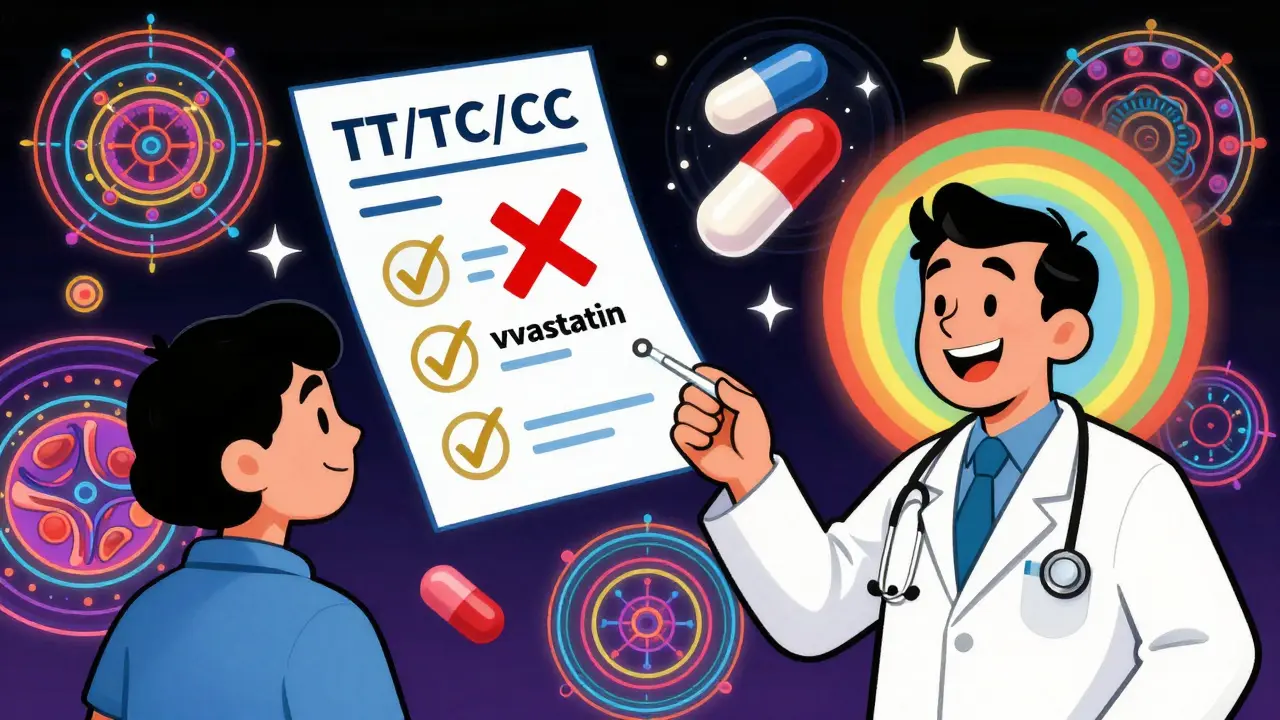
Who Should Get Tested?
You don’t need a genetic test just because you’re starting a statin. The guidelines are clear: testing is most useful if you’ve already had muscle symptoms with a statin and want to try again. The Clinical Pharmacogenetics Implementation Consortium (CPIC) recommends SLCO1B1 testing before restarting simvastatin in someone who previously couldn’t tolerate it. If you’re CC genotype, avoid 80mg simvastatin. Even 40mg might be risky. Better options? Pravastatin or fluvastatin. These don’t rely on SLCO1B1 to enter the liver, so they’re much safer for you. A 2021 study at Mayo Clinic found that 78% of patients who had stopped statins due to muscle pain were able to restart one successfully after genetic testing. That’s a huge win for people who need statins to avoid heart disease. But if you’ve never had side effects? Testing isn’t recommended. It won’t prevent problems you haven’t had yet-and it won’t change your risk for heart disease.What the Test Actually Looks Like
Getting tested is simple. You swab the inside of your cheek or give a blood sample. The lab sends back a report showing your SLCO1B1 genotype: TT, TC, or CC. Turnaround time? Usually 5 to 10 days. Some labs, like Mayo Clinic and ARUP, include clear dosing recommendations. Others? Just raw data. That’s a problem. If your doctor doesn’t know how to read it, the test is useless. That’s why some hospitals are adding alerts to electronic records. If a doctor tries to prescribe simvastatin 80mg to a patient with a CC genotype, the system pops up a warning. Epic and Cerner already have these tools built in.Insurance and Cost: The Real Barrier
The test itself costs between $150 and $400 out of pocket. Insurance coverage? Patchy at best. Only about 28% of commercial insurers covered it in 2022. Medicare rarely pays unless it’s part of a specific program. Many patients pay themselves-and then wonder if it was worth it. One woman in her 50s, who had severe muscle pain on simvastatin, paid $300 for testing. Her result: CC genotype. Her doctor switched her to pravastatin. Her LDL dropped from 168 to 92. No more pain. She says it was the best $300 she ever spent. But others report the same symptoms even after switching. About 27% of users on patient forums say genetic testing didn’t help. That’s not failure-it’s complexity. Not all muscle pain is genetic. Some comes from vitamin D deficiency, thyroid issues, or overexertion. Testing helps narrow it down, but it doesn’t solve everything.
What Doctors Say
There’s a big gap between what the science says and what doctors do. A 2021 survey found only 43% of primary care doctors felt comfortable interpreting genetic results. Cardiologists? 82%. That’s because cardiologists see the most patients with statin intolerance. They’ve seen the patterns. Dr. Julie Johnson, a top pharmacogenomics expert, calls SLCO1B1 testing one of the strongest examples of precision medicine in cardiology. But Dr. Robert Green’s 2020 trial showed something surprising: giving doctors genetic results didn’t improve patient adherence or reduce symptoms. Why? Because many doctors didn’t change their prescribing habits. They didn’t know what to do with the info. The American College of Cardiology says testing “may be considered” after intolerance-but not for everyone. That’s the current standard. It’s cautious, but it’s based on evidence.What’s Next?
The future isn’t just one gene. Researchers are building polygenic risk scores-combining SLCO1B1 with 10 to 15 other variants to predict risk more accurately. Early studies show these scores improve prediction from 58% to 67% accuracy. That’s still not perfect, but it’s progress. By 2025, a new group called the Statin Pharmacogenomics Implementation Consortium plans to roll out standardized testing in 50 U.S. hospitals. That could change everything-if doctors are trained, systems are integrated, and insurance catches up. For now, if you’ve had muscle pain on a statin, ask your doctor about SLCO1B1 testing. If you’re on simvastatin and have unexplained muscle aches, it might be worth it. But don’t assume genetics is the only answer. Check your vitamin D. Review your other meds. Talk about exercise. Statin intolerance is rarely just one thing.What to Do If You’re on Statins
- If you have muscle pain: Don’t quit cold turkey. Talk to your doctor. There are alternatives.
- If you’ve been told you can’t take statins: Ask if SLCO1B1 testing is an option. You might be able to try again safely.
- If you’re on simvastatin 80mg: Ask if a lower dose or different statin might work better.
- If you’re considering testing: Make sure your doctor understands the results. Ask for a referral to a pharmacist or genetic counselor if needed.
Is pharmacogenomic testing for statins covered by insurance?
Coverage varies widely. As of 2023, only about 28% of commercial insurers cover SLCO1B1 testing. Medicare typically doesn’t cover it unless it’s part of a specific molecular diagnostic program. Out-of-pocket costs range from $150 to $400. Some hospitals offer testing at reduced rates if you’re part of a research study or have a history of statin intolerance.
Does SLCO1B1 testing work for all statins?
No. The SLCO1B1 gene variant rs4149056 is strongly linked to muscle side effects from simvastatin, especially at high doses (80mg). It has little to no effect on atorvastatin, rosuvastatin, or pravastatin. That’s why clinical guidelines only recommend testing before restarting simvastatin-not for other statins.
If I test positive for the SLCO1B1 C allele, do I have to avoid statins entirely?
No. You don’t need to avoid statins altogether. You just need to avoid high-dose simvastatin. Switching to pravastatin, fluvastatin, or low-dose rosuvastatin often resolves muscle symptoms while still lowering cholesterol. Many people with the CC genotype tolerate these alternatives just fine.
Can I get tested before starting a statin?
Yes, but it’s not routinely recommended. Pre-emptive testing (before any statin is prescribed) has been shown to increase adherence by nearly 20% in some studies. However, major guidelines like those from the American College of Cardiology say there’s not enough proof it improves heart outcomes to justify testing everyone. It’s best reserved for people with a history of muscle symptoms or strong family history of statin intolerance.
How accurate is the SLCO1B1 test in predicting muscle pain?
The test is good at identifying people at highest risk for severe muscle damage from simvastatin, especially those with the CC genotype. But it only explains about 6% of all statin-related muscle symptoms. Many people with the TT genotype still get muscle pain, and some with CC genotype don’t. Genetics is one piece-other factors like age, kidney function, drug interactions, and vitamin D levels also matter.
Chris Buchanan
December 23, 2025 AT 19:21Okay but let’s be real - if your doctor prescribes you 80mg simvastatin without even blinking, they’re not a doctor, they’re a vending machine with a stethoscope. I had muscle pain so bad I couldn’t lift my coffee cup. Tested CC. Switched to pravastatin. LDL down, pain gone. $300 well spent. Thanks, DNA.
Raja P
December 24, 2025 AT 05:47This is actually super helpful. In India, most docs just say 'take it or quit'. No testing, no alternatives. Glad to see someone finally explaining it like normal people can understand. Maybe this’ll change things here too.
Delilah Rose
December 25, 2025 AT 21:05I’ve been thinking about this a lot since my dad had to stop his statin after 12 years because his legs felt like lead weights. He’s 72, so everyone assumed it was just aging - until his cardiologist mentioned SLCO1B1. We got him tested, turned out he was TC, switched to rosuvastatin, and now he’s hiking again. I just wish more doctors knew this wasn’t just ‘old people being weak’ - it’s biology. And honestly, I think we’re gonna look back in 20 years and laugh at how we used to just guess with meds instead of reading the genetic manual.
Abby Polhill
December 26, 2025 AT 17:50SLCO1B1 is the poster child for pharmacogenomics, but let’s not ignore the noise - CYP3A4 polymorphisms, ABCB1 efflux variants, even GATM’s role in creatine metabolism might be confounding SAMS phenotypes. The 6% variance explained by SLCO1B1? That’s the tip of the iceberg. Polygenic risk scores are the future, but we’re still stuck in the Stone Age with EHRs that can’t even auto-flag high-dose simvastatin for CC carriers without a 3-page workflow.
Rachel Cericola
December 28, 2025 AT 07:15If you’re still not testing for SLCO1B1 after someone has muscle pain on simvastatin, you’re not being cautious - you’re being negligent. We’ve had the data since 2008. We have clinical guidelines. We have EHR alerts built into Epic and Cerner. The only thing stopping us is laziness and insurance bureaucracy. And yes, I’m mad. I’ve seen too many patients quit statins entirely because no one told them there was another option. Your heart doesn’t care if your insurer won’t pay for a $300 test. Your arteries do. Get tested. Get informed. Don’t let a billing code kill you.
Christine Détraz
December 29, 2025 AT 00:54My sister got tested after her muscle cramps got worse than her divorce. CC genotype. Switched to fluvastatin. No more pain. She’s now doing yoga and eating kale. Honestly? It’s wild how one tiny gene change can flip your whole life. I didn’t believe in this stuff until it happened to someone I love. Now I’m the one nagging my doctor to order the test for my mom.
CHETAN MANDLECHA
December 30, 2025 AT 09:03Interesting. In India, we rarely hear about this. Most people take statins like candy. But I’ve seen friends with muscle weakness - they just think it’s 'work stress'. Maybe we need more awareness. Also, is this test available in Delhi? Or do we have to send samples abroad?
Katie Taylor
January 1, 2026 AT 03:38Stop pretending this is about science. It’s about money. Insurance won’t pay. Doctors don’t care. Pharma doesn’t want you switching to cheaper statins. This whole 'genetic testing' thing is a Band-Aid on a bullet wound. If they really cared, they’d make every statin safe for everyone. Instead, they sell you a $300 test so you feel like you’re doing something while they keep raking in billions.
Sidra Khan
January 3, 2026 AT 02:13Genetic testing? 😂 I’ve been on statins for 10 years. No pain. My neighbor had muscle cramps. He’s a vegan. He hikes 10 miles a day. He’s 42. He doesn’t even have high cholesterol. Coincidence? Nah. It’s all a scam. Big Pharma + Big Genetics = Big $$$ for labs. Your vitamin D is low. Drink milk. Stop blaming your DNA.
Ademola Madehin
January 3, 2026 AT 04:05Bro I was on simvastatin for 3 months and I couldn’t even walk to the fridge. My wife thought I was cheating on her because I was always 'tired'. Then I found out I was CC. Switched to pravastatin. Back to normal. But here’s the twist - my doctor didn’t even know what SLCO1B1 was. I had to print the NEJM paper and show him. I cried. Not from pain. From frustration.
suhani mathur
January 4, 2026 AT 08:15Let’s be honest - if you’re paying $300 out of pocket for a test that only helps 6% of cases, you’re either rich or desperate. I’m both. But here’s the thing: if you’ve had muscle pain before, it’s worth it. I’m TC. Took simvastatin anyway. Got cramps. Switched. Done. No drama. Just science. And yes, my doctor rolled his eyes. But he changed the script.
bharath vinay
January 5, 2026 AT 02:02They say it’s genetics. But what if it’s the glyphosate in your bread? Or the aluminum in your deodorant? Or the 5G towers? I’ve read 17 studies. NONE of them mention EMF exposure. Why? Because the FDA is owned by Pfizer. Your DNA is fine. Your environment is poisoned. Get off the statins. Eat butter. Live free.
Dan Gaytan
January 5, 2026 AT 15:05My uncle got tested after he couldn’t climb stairs. CC. Switched to rosuvastatin. Now he’s dancing at his granddaughter’s wedding. 💃🕺 This stuff works. If you’re scared of statins, don’t quit - ask for the test. It’s not magic. It’s just smarter medicine. And honestly? It’s kind of beautiful that our genes can help us live better.
claire davies
January 5, 2026 AT 17:43Oh my god, this is the most beautifully written, practical, and compassionate breakdown of statin pharmacogenomics I’ve ever read. I’m a GP in London and I’ve been trying to get my practice to adopt this for years. The insurance hurdle is brutal - but that woman who called it the best $300 she ever spent? That’s the kind of story that changes minds. I’ve already emailed my local lab to see if we can partner for a pilot. If we can get even 20 patients tested and switched safely, it’s a win. Thank you for writing this - it’s not just science, it’s humanity with a DNA helix.