Fiber Supplements and Constipation: When to Take Them With Medications
 Dec, 2 2025
Fiber-Medication Timing Calculator
This calculator helps you determine the safest time to take fiber supplements relative to your medications based on the latest medical guidelines. Always consult your pharmacist for personalized advice.
Your Medication Timing
Results will appear here after calculation
Constipation is one of the most common digestive complaints, and fiber supplements like psyllium (found in Metamucil) are often the first thing doctors recommend. But here’s the catch: if you’re taking any kind of medication, timing your fiber supplement wrong can make your pills less effective-or even dangerous. It’s not just about getting regular. It’s about making sure your heart medicine, diabetes drug, or antidepressant actually works.
Why Fiber Interferes With Medications
Fiber supplements, especially psyllium, don’t just add bulk to your stool. When they hit your gut, they absorb water and swell into a thick, gel-like substance. That’s great for softening stool and easing constipation. But that same gel can trap medications as they pass through your digestive system, keeping them from being absorbed properly. It’s like wrapping your pill in saran wrap before swallowing. The American Gastroenterological Association confirms this effect: fiber changes how fast food and drugs move through your gut. If you take a pill and a fiber capsule at the same time, your body might absorb only half-or less-of the medicine. That’s not theoretical. People on metformin for diabetes, carbamazepine for seizures, or lithium for bipolar disorder have reported spikes in blood sugar, seizures, or mood swings after mixing fiber with their meds without spacing them out.How Far Apart Should You Take Them?
There’s no single answer, but the safest rule is simple: wait at least two hours. Metamucil’s official instructions are clear: take fiber supplements at least two hours before or after any medication. That’s the baseline. But some drugs need even more distance. For example:- Carbamazepine, lithium, metformin, and olanzapine: wait 4 hours after taking the drug before taking fiber.
- Thyroid medication (like levothyroxine): take fiber at least 4 hours apart-this is critical, as even small drops in absorption can throw off your whole hormone balance.
- Antibiotics: fiber can reduce their effectiveness, so space them out by at least 2 hours.
What’s the Best Time of Day to Take Fiber?
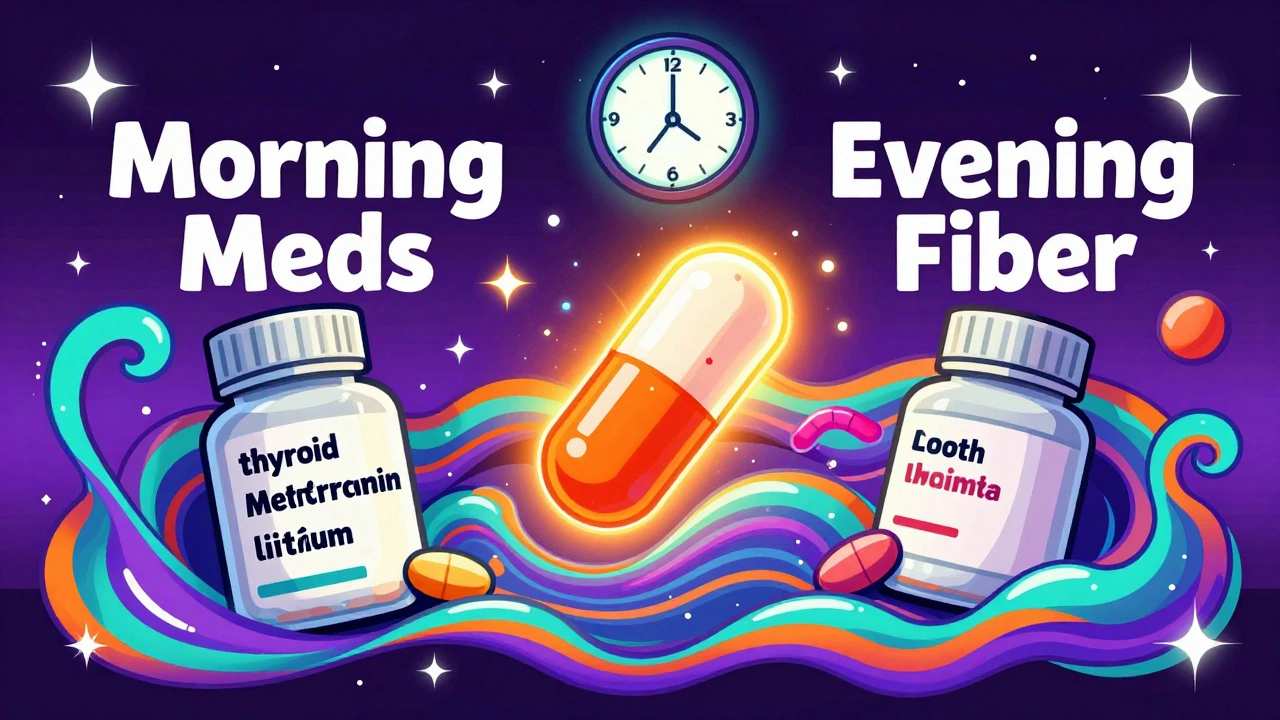
Forget the idea that fiber must be taken with breakfast. The best time depends on your meds, your routine, and your body. If you take most of your medications in the morning-blood pressure pills, statins, thyroid meds-then take your fiber in the afternoon or evening. SAMPA Docs recommends this exact timing: “Favor your fiber supplements in the afternoon or evening if your medications are taken in the morning.” If your meds are taken at night-like some antidepressants, painkillers, or sleep aids-take your fiber in the morning. That gives your body a full day to absorb the medicine before the fiber gel builds up. Avoid taking fiber right before bed. Not because it’s bad-it’s because it’s uncomfortable. Over 80% of users who took fiber at night reported sleep disruption due to bloating and gas. Nature Made’s own customer reviews show a 4.2/5 rating for fiber taken 20-30 minutes before meals versus just 3.1/5 when taken before bed. The difference? Timing.
Dosage Matters-More Isn’t Always Better
You can’t just dump a handful of fiber powder into your water and call it a day. Psyllium works best at doses above 10 grams per day. Metamucil’s standard serving is 3 grams per teaspoon or wafer. That means you need at least three servings daily to hit the therapeutic threshold shown in clinical studies to increase bowel movements by three times per week. But here’s the trap: many people start with one serving, get no results, and then take more without enough water. That’s how people end up in the ER with esophageal blockages. Always drink at least 8 ounces (237 mL) of water with every dose. For elderly patients or those with swallowing issues, this isn’t optional-it’s life-saving. Also, don’t assume all fiber is the same. Psyllium is the gold standard. It’s the only type proven in multiple studies to outperform osmotic laxatives. Other fibers like methylcellulose or inulin might help a little, but they don’t deliver the same consistency of results.When to Stop Taking Fiber
Fiber is generally safe, but it’s not for everyone. If you’re experiencing any of these, stop immediately and call your doctor:- Abdominal pain that doesn’t go away
- Nausea or vomiting
- Rectal bleeding
- Constipation lasting more than 7 days
- Sudden, unexplained change in bowel habits
Real-World Tips for Managing Fiber and Meds
If you’re on multiple medications, this gets complicated. Here’s how to make it work:- Write down every medication you take, including doses and times.
- Identify which ones are affected by fiber (most are-ask your pharmacist).
- Choose one time of day for fiber and stick to it-morning or evening, not both.
- Set phone alarms for fiber and meds so you don’t mix them up.
- Use a pill organizer with separate compartments for fiber and meds.
- Always drink water with fiber-never dry-swallow capsules.
What’s Changing in 2025?
The American Gastroenterological Association’s 2024 draft guidelines now specifically recommend psyllium as the first-line treatment for chronic constipation-and they’ve added clear timing rules for common drug classes. This isn’t just advice anymore. It’s becoming standard clinical protocol. The FDA is cracking down, too. In November 2023, they sent warning letters to three supplement makers for falsely claiming their products don’t interfere with medications. One company, FiberSuppCo, had to pull its “safe with all drugs” label. And the future? Time-release psyllium formulations are in clinical trials (NCT05678901). These capsules are designed to release fiber slowly, avoiding the thick gel that traps meds. Early results show promise-patients report fewer interactions and better sleep. If approved, this could be the biggest shift in fiber therapy in decades.Bottom Line
Fiber supplements are powerful. They work better than many laxatives, reduce cholesterol, and help stabilize blood sugar. But they’re not harmless. When taken with meds, they can turn a lifesaving drug into a useless one. The solution isn’t avoiding fiber. It’s mastering timing. Take it at least two hours away from your medications. Preferably four for certain drugs. Take it in the morning if your meds are at night, and vice versa. Drink water. Watch for side effects. And never assume “natural” means “safe with everything.” If you’re unsure, ask your pharmacist. They’ve seen this a thousand times. And if your constipation doesn’t improve after 4 weeks of proper fiber use, see your doctor. There’s probably a better answer than just another scoop of powder.Can I take fiber supplements with my morning medications?
No-not if you’re taking medications like metformin, thyroid hormone, or lithium. Fiber can bind to these drugs and reduce absorption. Wait at least two hours after taking your meds before taking fiber. If your meds are in the morning, take fiber in the afternoon or evening instead.
Is it safe to take fiber before bed?
It’s not recommended. Many people experience bloating, gas, and cramps at night, which can disrupt sleep. User reports show 82% of those who had sleep issues fixed the problem by switching to morning fiber. If you must take it at night, use the lowest dose and drink plenty of water.
How much fiber do I need for constipation?
Studies show you need at least 10 grams of psyllium per day to see results. That’s about three servings of Metamucil (3 grams per serving). Take it in divided doses-never all at once-and always with 8 ounces of water per dose.
What’s the best type of fiber supplement?
Psyllium husk is the most effective. It’s been proven in clinical trials to increase bowel movements more than other fibers like inulin or methylcellulose. Look for products that list psyllium husk as the first ingredient. Avoid blends with added sugars or artificial flavors.
Should I stop fiber if I’m constipated for more than a week?
Yes. If constipation lasts more than 7 days despite proper fiber use, or if you notice rectal bleeding, vomiting, or severe pain, stop taking fiber and see your doctor. These could be signs of a blockage, diverticulitis, or another serious condition that fiber won’t fix.
Will fiber help with IBS-C?
Yes. Fiber, especially psyllium, is recommended as first-line treatment for IBS with constipation (IBS-C). Studies show it reduces bloating and improves stool consistency. But start low-1 gram per day-and increase slowly. Some people with IBS-C react badly to too much fiber too fast.
Can I take fiber with my multivitamin?
It’s risky. Fiber can reduce absorption of fat-soluble vitamins (A, D, E, K) and minerals like zinc and iron. Take your multivitamin at least two hours before or after your fiber supplement. If you take both in the morning, space them out by 2-3 hours.
Does insurance cover fiber supplements?
Most commercial insurance plans treat fiber supplements as over-the-counter items, so you pay out-of-pocket. But Medicare Part D may cover them if prescribed for a specific condition like IBS-C or chronic constipation. Always ask your pharmacist to check your plan’s formulary.
Palanivelu Sivanathan
December 3, 2025 AT 20:46Okay so let me get this straight-you’re telling me that my daily Metamucil is basically a drug-sucking sponge?? I’ve been taking it with my antidepressants since last winter like it’s cereal milk… and now I’m supposed to believe my mood swings weren’t just life being a bitch but my fiber outsmarting my SSRIs?? I feel betrayed. Like, I trusted this powder. I named it Barry. Barry, you little traitor.
Also-why does everything in medicine have to be a timed dance? I can’t just take my pills and go about my day like a normal human? Do I need to schedule fiber like a Tinder date? “Hey Barry, I’ll see you in 2 hours… no, wait, 4… no, wait, your ex metformin is in the room.”
I’m just saying-if the FDA had to write a Yelp review for psyllium, it’d be: “3 stars. Works great… if you’re okay with your entire life becoming a pharmaceutical obstacle course.”
Joanne Rencher
December 5, 2025 AT 01:18Ugh. I hate when people treat fiber like it’s some magical cure-all. You’re telling me I can’t just take my thyroid med and my fiber together because of some ‘gel’? Newsflash: I’m not a lab rat. I’m a person who’s tired of being told what to do by people who’ve never had to juggle 7 pills before breakfast.
Also, why is everyone acting like this is new information? I’ve been spacing my meds since 2018. It’s not rocket science. Stop acting like you discovered fire.
Erik van Hees
December 5, 2025 AT 01:47Let me break this down for the people still confused: fiber = sponge. Medications = water. You don’t pour water into a sponge and expect it to reach the glass. Basic physics. Why are we even having this conversation?
Also-psyllium is the only fiber that matters. Inulin? Methylcellulose? Those are the cheap knockoffs. You wouldn’t use a plastic spoon to stir your coffee if you had a silver one. Don’t settle for inferior fiber.
And for the love of god, if you’re taking levothyroxine and fiber at the same time, you’re basically throwing money down the toilet. Your endocrinologist will cry. I’ve seen it. I’ve been that guy.
Also-time-release psyllium? That’s the future. I’ve been on the waiting list for NCT05678901 since last year. If you’re not tracking clinical trials, you’re not living in 2025. You’re living in 2005.
Cristy Magdalena
December 6, 2025 AT 15:06I just want to say-this article is beautifully written. The tone is calm, the science is precise, and the warnings are delivered with the gravity they deserve. I’m not just saying that because I’m a nurse. I’m saying it because I’ve seen what happens when people don’t space their meds. One woman came in with a bowel obstruction from dry-swallowing psyllium. She didn’t even know you needed water. She thought it was like a gummy.
And yes-80% of people who take fiber at night report sleep disruption. I’ve had patients cry because they thought they were ‘doing the right thing’ by taking it before bed. They weren’t being lazy. They were being misinformed.
Please, if you’re reading this-don’t be that person. Drink the water. Space the doses. Your gut-and your meds-will thank you.
Adrianna Alfano
December 7, 2025 AT 01:46I took fiber with my blood pressure meds for 6 months because I didn’t read the label. I thought ‘natural’ meant ‘safe.’ Turns out, my BP spiked so bad I ended up in the ER. The nurse looked at me like I’d just admitted I thought the moon was made of cheese.
Now I take my fiber at 8 p.m. and my meds at 7 a.m. It’s a pain, but I’m alive. Also-my poop is finally not a brick. So… win? I guess.
PS: I don’t trust any supplement that doesn’t say ‘psyllium husk’ on the front. If it’s hiding behind ‘blend’ or ‘proprietary mix,’ it’s probably just sawdust with a fancy label.
Casey Lyn Keller
December 8, 2025 AT 09:22I think the real issue here is that Big Pharma doesn’t want us to know fiber works better than half their drugs. So they make it sound complicated. ‘Wait 2 hours.’ ‘Wait 4 hours.’ ‘Avoid this, avoid that.’
Meanwhile, people in India have been eating psyllium with their chai since the 1800s and they’re not dropping dead. Maybe we’re overcomplicating this because we’ve been trained to fear everything that isn’t patented.
Also-why is everyone acting like fiber is a drug? It’s ground-up plant husk. It’s not lithium. It’s not insulin. It’s not magic.
Jessica Ainscough
December 10, 2025 AT 06:23Thank you for writing this. I’ve been struggling with constipation since my chemo, and I was terrified to try fiber because I take so many meds. This actually gave me a plan. I’m taking mine at 5 p.m. now-after my afternoon meds, before dinner. No bloating. No sleep issues. Just… regular. It’s quiet. It’s simple. And honestly? That’s the best kind of win.
Also-drinking water with it? I didn’t realize how much I needed to drink. I thought ‘a glass’ meant half a glass. Turns out, no. Full glass. Every time. Now I have a water bottle by my meds. It’s my new ritual.
May .
December 11, 2025 AT 19:46Take fiber at night. Sleep fine. No bloating. Just don’t overdo it. That’s it.