FDA Generic Approval Changes 2023-2025: What Manufacturers and Patients Need to Know
 Mar, 14 2026
The U.S. generic drug market is changing faster than most people realize. If you’ve noticed prices dropping on common medications like blood pressure pills or antibiotics, or if you’ve heard about delays in drug availability, it’s not random. It’s the result of major shifts at the FDA between 2023 and 2025. These aren’t minor tweaks-they’re the biggest overhaul of the generic approval system since 2012. And they’re reshaping who makes drugs, where they’re made, and how fast they reach pharmacies.
Why the FDA Changed the Rules
During the pandemic, the U.S. ran out of critical medicines. Insulin. Antibiotics. Anesthetics. Many of them came from factories in India and China. When borders closed or shipping slowed, hospitals scrambled. The government realized: relying on overseas suppliers for life-saving drugs was a national risk.
In 2023, the National Defense Authorization Act forced the Department of Health and Human Services to act. That led to Executive Order 14080, which told the FDA: fix this. The result? The ANDA Prioritization Pilot Program, launched in October 2025. This isn’t just a new form to fill-it’s a whole new game.
The goal? Bring more drug manufacturing back to the U.S. Right now, only 9% of active pharmaceutical ingredient (API) makers are American. China has 22%. India has 44%. The FDA doesn’t just want more domestic production-it wants faster, more reliable access to essential medicines.
How the ANDA Prioritization Pilot Works
The old system for approving generic drugs (called an ANDA) took 12 to 15 months on average. Now, if you manufacture and test your drug entirely in the U.S., you can get approved in as little as 8 months.
The FDA created four tiers of priority:
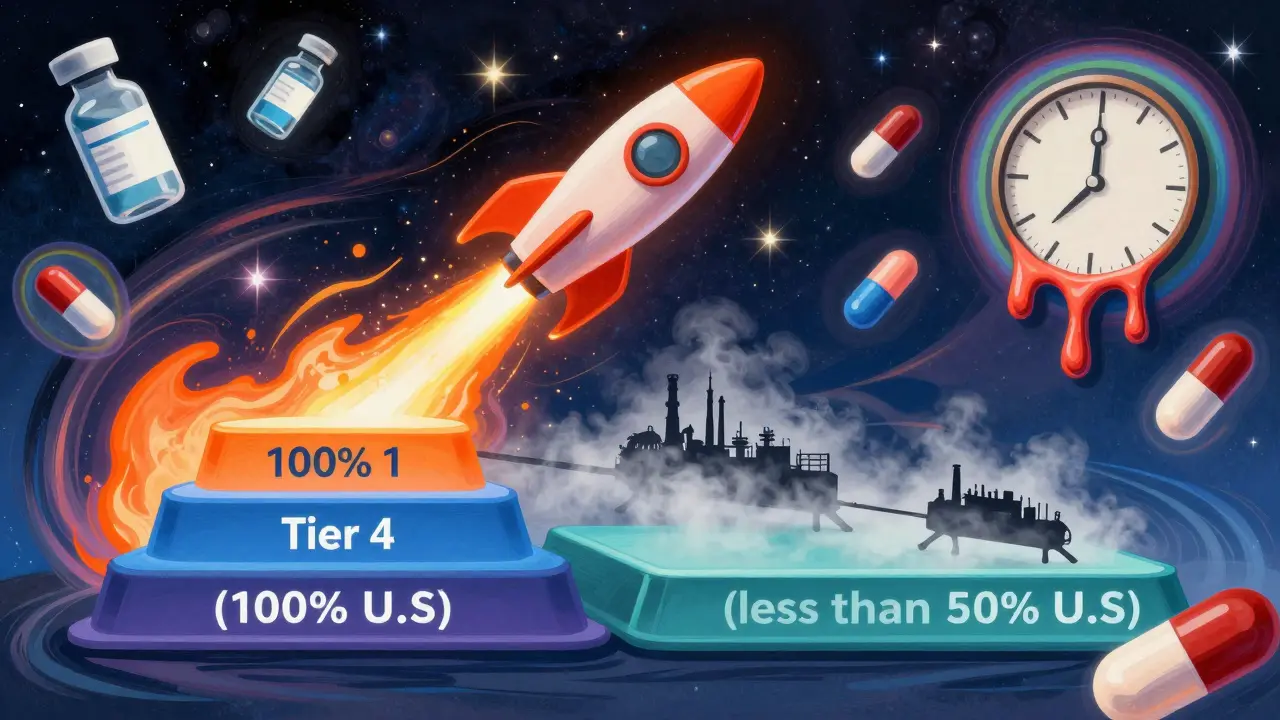
- Tier 1: 100% U.S. manufacturing and testing → fastest track (8-month review)
- Tier 2: 75-99% U.S. components → 10-month review
- Tier 3: 50-74% U.S. components → 11-month review
- Tier 4: Less than 50% U.S. → standard 12-15 months
To qualify, companies must prove:
- APIs come from U.S. facilities or meet U.S. equivalence standards
- Bioequivalence studies are done at FDA-registered labs in the U.S.
- Manufacturing sites pass CGMP inspections without delays
And here’s the kicker: applications for drugs on the FDA’s Drug Shortage List get top priority. There are 147 drugs on that list as of September 2025. If your generic treats one of them, and you’re making it in America, you jump to the front of the line.
What’s Changed in Approval Speeds
Before the pilot, companies waited 60 to 90 days just for the FDA to start reviewing their application. Now, under the pilot, the initial review happens in 30 days. Complete response letters-those detailed lists of problems the FDA finds-used to take 120 days. Now they’re sent in 45.
The numbers speak for themselves:
- Time-to-market dropped from 15.6 months to 11.2 months on average
- Major deficiency letters fell by 41%
- First-cycle approval rates jumped from 58% to 91%
Companies like Teva say the change is revolutionary. One executive told the FDA’s industry forum that their nimodipine solution got approved 8 months faster than planned. That’s money saved, and patients who get the drug sooner.
First Generic Drugs Are Piling Up
First generics-meaning the very first version of a brand-name drug to hit the market after patent expiry-are now coming faster than ever. Through mid-2025, the FDA approved 9 new first generics, including:
- Ivermectin Tablet (for parasitic infections)
- Nimodipine Solution (used after brain aneurysms)
- Azilsartan Medoxomil and Chlorthalidone Tablet (for high blood pressure)
GoodRx data shows first generic approvals are up 18.7% compared to 2024. And when these drugs enter the market, prices crash. On average, they drop 78.3% within six months. That’s not just good for patients-it’s good for Medicare and private insurers.
The Cost of Going Domestic
There’s a catch. Building a U.S. manufacturing facility isn’t cheap. Experts estimate it costs $120 million to $180 million to set up a medium-scale generic drug plant. Smaller companies can’t afford it. Even for big players, the added cost of domestic API sourcing and testing adds $1.2 million to $1.8 million per application.
A survey of 127 generic manufacturers found:
- 54% started expanding U.S. facilities
- 31% delayed product launches because of the cost
- 79% said the financial pressure was immediate and real
For high-volume, low-margin drugs-like common antibiotics-the cost advantage of making them overseas still wins. But for high-value, low-volume drugs-especially those on the shortage list-the U.S. option is now the smarter bet.
Who’s Winning and Who’s Struggling
Big players like Teva, Mylan, and Sandoz still control 48% of the market. But domestic-focused companies like Amneal and Aurobindo have gained 7.3 percentage points since 2023. Why? They moved early.
The pilot’s adoption rate is 37% of all new ANDA submissions by Q3 2025. Mid-sized companies (50-500 employees) lead the way with 63% participation. Large manufacturers? Only 41%. Small companies? Just 28%.
The reason? Bigger companies have more overseas infrastructure to unwind. Smaller ones, with fewer legacy systems, can pivot faster. The FDA’s technical team has fielded over 1,200 questions since the pilot started-78% of them about sourcing APIs domestically. That’s the biggest hurdle.
Quality and Safety: Are These Drugs Still Safe?
Some critics worry faster approval means lower standards. But data says otherwise. A March 2025 study in JAMA Internal Medicine found that drugs approved under the pilot performed just as well as traditionally approved generics. The efficacy range? Between 0.97 and 1.03-essentially identical.
The FDA’s own review of 27 approved pilot drugs showed no safety red flags. No recalls. No unexpected side effects. The agency doubled down on bioequivalence testing, not cut corners.
Still, concerns linger. The Alliance for Pharmacy Compounding warned about potential compromises. And MedPAC, which advises Medicare, estimates the pilot could raise generic drug prices by 12-18% in the short term. But they also predict those costs will normalize in 3-5 years as domestic capacity grows.
What’s Coming Next
The pilot is expanding. Starting January 2026, it will include complex generics: nasal sprays, eye drops, and skin patches. These are harder to copy, harder to test, and harder to make. But they’re also the ones most likely to go out of stock.
The FDA is also rolling out AI tools to speed up document review. These tools will scan submissions for missing data, flag inconsistencies, and reduce human review time by another 25%.
By 2028, the FDA expects U.S. API manufacturing to jump from 9% to 23%. That’s 14 percentage points of growth in just three years. If that happens, the U.S. won’t just be less dependent on foreign suppliers-it’ll be a global leader again.
What This Means for You
If you’re a patient: expect more generics to hit the market faster, especially for drugs you rely on. Prices will keep falling. Stockouts should become rarer.
If you’re a pharmacist: your supply chain will get more reliable. Fewer emergency orders. Fewer calls from doctors asking, "Where’s the generic?"
If you work in pharma: this is a make-or-break moment. Companies that invest in U.S. manufacturing now will dominate the next decade. Those that wait may find themselves priced out.
The FDA didn’t just change a process. They changed the rules of the entire generic drug game. The goal isn’t just to approve more drugs-it’s to make sure the U.S. never runs out of them again.
What is the ANDA Prioritization Pilot Program?
The ANDA Prioritization Pilot Program is an FDA initiative launched in October 2025 that gives faster review times to generic drug manufacturers who produce and test their products entirely in the United States. It prioritizes applications for drugs on the FDA’s Drug Shortage List and offers review timelines as short as 8 months, compared to the standard 12-15 months. Eligibility requires proof of U.S.-based API sourcing, domestic bioequivalence testing, and compliance with Current Good Manufacturing Practices (CGMP).
How has the FDA improved approval timelines?
Under the pilot, the FDA now issues initial reviews within 30 days (down from 60-90 days) and complete response letters within 45 days (down from 120 days). Applications with full U.S. manufacturing and testing are reviewed in as little as 8 months, compared to 12-15 months under the old system. This represents a 35-40% reduction in overall review time for qualifying applications.
Are drugs approved under the pilot as safe as traditionally approved generics?
Yes. A March 2025 study published in JAMA Internal Medicine found that generics approved under the pilot program had therapeutic outcomes within 0.97 to 1.03 of traditionally approved generics-meaning they are equally effective. The FDA has maintained strict bioequivalence standards and has not lowered safety requirements. No safety issues have been reported for the 27 pilot-approved drugs as of late 2025.
Why are some manufacturers not joining the pilot?
The main barrier is cost. Building or converting a U.S. manufacturing facility can cost $120 million to $180 million. Adding domestic API sourcing and testing increases per-application costs by $1.2 million to $1.8 million. Smaller companies, especially those making low-margin, high-volume drugs, often can’t afford the investment. A 2025 survey found 31% of manufacturers delayed product development due to these costs.
Will generic drug prices go up because of these changes?
In the short term, yes-MedPAC estimates a 12-18% increase in generic drug costs due to higher manufacturing expenses. But long-term projections show this will reverse. As domestic capacity scales up over 3-5 years, costs are expected to normalize. The Congressional Budget Office predicts the program will save $4.2 billion annually by 2030 by reducing emergency drug purchases and shortages, making it cost-neutral to taxpayers by 2027.
What types of drugs are prioritized under the pilot?
Drugs on the FDA’s Drug Shortage List (147 medications as of September 2025) get top priority. These include antibiotics, heart medications, insulin, and anesthetics. The program also targets essential medicines identified by the Department of Health and Human Services. Complex generics like transdermal patches and nasal sprays will be added in January 2026, expanding the scope beyond simple tablets and capsules.
Sabrina Sanches
March 14, 2026 AT 13:12Shruti Chaturvedi
March 15, 2026 AT 20:47Katherine Rodriguez
March 17, 2026 AT 16:59Devin Ersoy
March 19, 2026 AT 03:47Scott Smith
March 19, 2026 AT 11:49Sally Lloyd
March 20, 2026 AT 21:42Emma Deasy
March 22, 2026 AT 04:58tamilan Nadar
March 22, 2026 AT 06:52