Epidural and Spinal Procedures on Anticoagulants: Understanding Hematoma Risks
 Feb, 3 2026
Anticoagulant Timing Calculator for Spinal Procedures
When a patient is on blood thinners and needs an epidural or spinal procedure - whether for labor, chronic pain, or surgery - the risk of a spinal hematoma looms large. It’s rare, but when it happens, the consequences can be permanent: paralysis, loss of bladder control, even death. And yet, stopping anticoagulants isn’t always safe either. The real challenge isn’t just about avoiding complications - it’s about balancing two life-threatening risks: a bleed in the spine, or a clot in the lung or brain.
What Exactly Is a Spinal Epidural Hematoma?
A spinal epidural hematoma (SEH) is a collection of blood that forms between the dura mater - the tough outer membrane around the spinal cord - and the ligamentum flavum, a ligament in the back. It sounds minor, but the spinal canal is a tight space. Just 1 to 2 milliliters of blood - about the size of a sugar cube - can compress the spinal cord. That’s enough to crush nerves, cut off blood flow, and cause irreversible damage.This isn’t a slow-developing issue. Symptoms usually appear within 12 hours after the procedure. Patients often report sudden, severe back pain - 93% of cases have it. Then comes numbness, weakness in the legs, and trouble controlling bowel or bladder function. If you wait too long to act, the damage becomes permanent. Studies show that patients who get surgery within 8 hours have a 79% chance of full recovery. After 24 hours? Only 9% recover fully.
Which Blood Thinners Carry the Highest Risk?
Not all anticoagulants are created equal. The risk varies dramatically depending on the drug, the dose, and how close it is to the procedure.Warfarin has been the classic culprit. If a patient’s INR (a measure of clotting time) is above 1.4, their risk jumps 8.7 times. Even when INR is brought down to 1.0 or 1.2 - what we think is "normal" - there are documented cases of hematomas. One case in 2018 showed permanent foot drop despite surgery within 6 hours. That’s a warning: normal lab numbers don’t always mean safe.
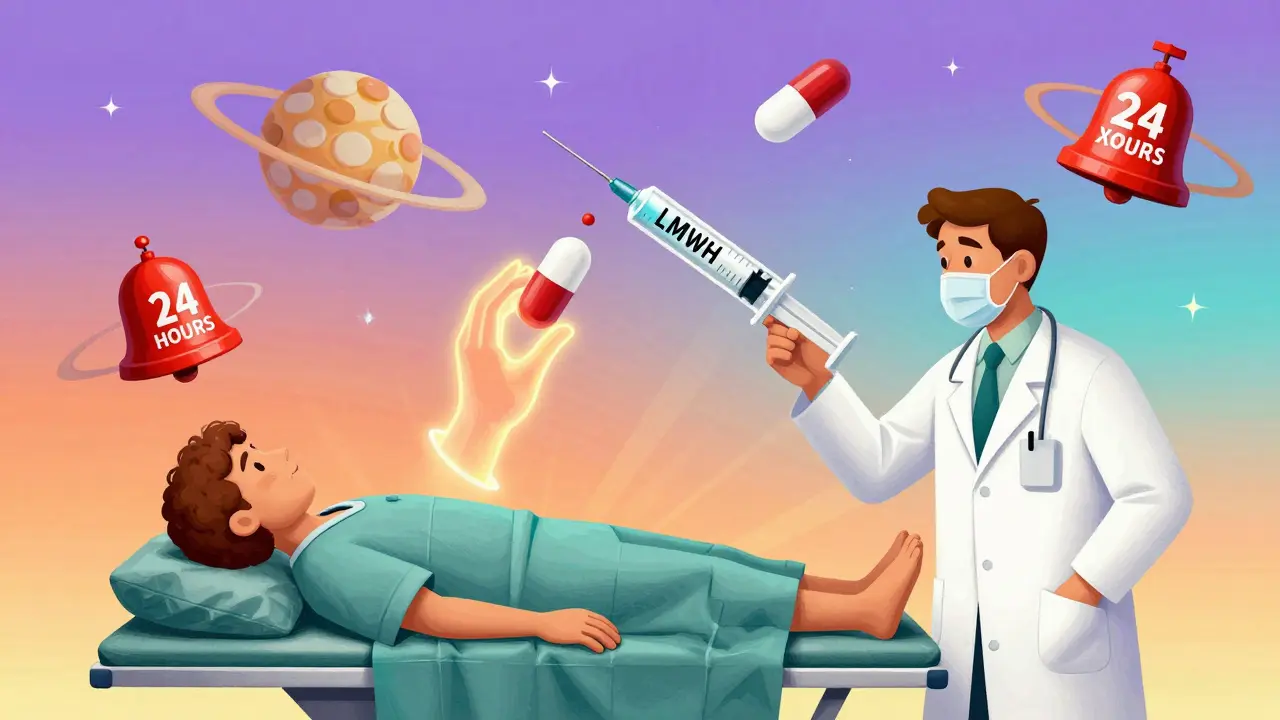
Low Molecular Weight Heparin (LMWH), like Lovenox, is tricky. If given within 8 hours before a procedure, the risk is 0.31%. Wait 24 hours? It drops to 0.04%. That’s why guidelines insist on waiting at least 10-12 hours for prophylactic doses and 24 hours for therapeutic doses. The FDA documented 100 confirmed cases of SEH linked to Lovenox between 1992 and 2013. Many of those cases had poor documentation - no one knew when the last dose was given.
Direct Oral Anticoagulants (DOACs) - like rivaroxaban (Xarelto), apixaban (Eliquis), and edoxaban - are newer and more popular. But they’re not safer. Rivaroxaban carries a 0.08% risk if timed right, but jumps to 0.42% if stopped too late. Apixaban is slightly lower at 0.05%. Edoxaban? A 2023 case report showed a hematoma even after 72 hours of cessation. That’s a red flag: our current timing rules might not be enough for all DOACs.
Aspirin? Surprisingly low risk. Studies of over 1,200 epidural steroid injections where patients kept taking aspirin showed zero hematomas. But dual antiplatelet therapy - like aspirin plus clopidogrel - increases risk 3.8 times. That’s why Johns Hopkins and others say to stop both for at least 7 days before invasive procedures.
It’s Not Just the Drug - Procedure Factors Matter Too
The needle itself can be the problem. A single, clean epidural stick carries less risk than multiple attempts. If the needle hits a blood vessel and causes blood-tinged fluid (a traumatic puncture), the risk spikes 11.8 times. Three or more needle passes? Risk goes up 6.2 times.Epidural catheters - the tubes left in place for continuous pain relief - are riskier than single injections. They increase the chance of a hematoma by 2.3 times. That’s why some hospitals avoid them in patients on anticoagulants unless absolutely necessary.
And then there’s the patient. Age over 70? Risk triples. Kidney problems? Risk jumps nearly fivefold. Spinal stenosis? Risk doubles. Low hemoglobin? Blood loss over a liter during surgery? All of these pile up. One study of nearly 12,500 spinal procedures found that patients with three or more risk factors had a 10x higher chance of developing a hematoma.
Timing Is Everything - Here’s the Real-World Schedule
You can’t guess. You can’t wing it. You need exact hours.- Warfarin: Check INR within 24 hours before the procedure. Target must be under 1.4. Restart 4 hours after a single injection, 6 hours after a catheter.
- LMWH (prophylactic): Stop 10-12 hours before. Restart 2 hours after single injection, 4 hours after catheter.
- LMWH (therapeutic): Stop 24 hours before. Restart 4 hours after.
- Rivaroxaban, Apixaban: Stop 48 hours before if kidneys are normal. Extend to 72 hours if CrCl is under 50 mL/min.
- Edoxaban: 72 hours is the standard - but recent cases suggest even that may not be enough.
Here’s the scary part: a 2022 survey of 345 pain doctors found only 58% knew all these timing rules. And 27% had personally experienced a near-miss because someone got the timing wrong. In one case, a patient on rivaroxaban developed saddle anesthesia 12 hours after catheter removal. Emergency surgery saved their life - but they still lost L5 nerve function.
What Happens When You Don’t Follow the Rules?
The cost isn’t just medical - it’s financial and legal. A single spinal hematoma case costs an average of $287,450. That’s over $280,000 more than a routine epidural steroid injection. The hospitalization alone is $182,600. Rehabilitation? $78,300. Long-term care for paralysis? $26,550.And the lawsuits? In 2022, 78 malpractice claims were filed in the U.S. over SEH. Sixty-two percent resulted in settlements - averaging $1.2 million each. Why? Failure to follow ASRA guidelines (41% of cases) and poor monitoring (37%).
One common mistake? Assuming a patient is "safe" because they stopped their medication "a few days ago." But DOACs don’t clear the same way as warfarin. They’re fast-acting and fast-clearing. Miss the window by 6 hours, and you’re back in danger.
What’s New in 2025?
The FDA now requires a Risk Evaluation and Mitigation Strategy (REMS) for all anticoagulants. That means prescribers must complete training on neuraxial risks before they can write prescriptions.Also in 2025, U.S. hospitals performing more than 50 spinal procedures a year must report SEH prevention metrics to the Agency for Healthcare Research and Quality. That’s not just a recommendation - it’s a mandate.
Emerging research is also shifting the game. A 2022 study found that a simple blood test for GFAP - a protein released by damaged nerve cells - can predict a developing hematoma with 94% accuracy within 2 hours of the procedure. That could mean earlier detection, faster surgery, and better outcomes.
The 2024 ASRA guidelines (in final review) will introduce a scoring system. Twelve risk factors - from age to kidney function to number of needle passes - will be weighted. A score over 15 means "high risk." Those patients may need alternative pain control, like peripheral nerve blocks, instead of spinal or epidural.
Is There a Better Way?
Some experts argue the current guidelines are too cautious. A 2021 poll of 1,243 physicians showed 68% thought the rules on antiplatelets were overly strict. But when you look at the data - permanent paraplegia in 24% of cases, death in 3-5% - caution isn’t just prudent. It’s necessary.What works best is a team approach. The anesthesiologist, the surgeon, the pharmacist, and the patient all need to be on the same page. Use checklists. Use apps like "Neuraxial Anticoag" - downloaded over 12,000 times. But verify the app is updated. A 2021 study found 17% of these tools had outdated info.
And never assume. A patient says they’re off blood thinners? Check the bottle. Call the pharmacy. Confirm the last dose. Document everything. Because in this scenario, the difference between a full recovery and lifelong disability often comes down to one missed detail.
Can you have an epidural if you’re on aspirin?
Yes, in most cases. Single-dose aspirin carries an extremely low risk - studies show zero hematomas in over 1,200 epidural steroid injections where aspirin was continued. However, if the patient is on dual antiplatelet therapy (like aspirin + clopidogrel), the risk increases nearly fourfold. In that case, guidelines recommend stopping both for at least 7 days before the procedure.
How long should I stop my blood thinner before a spinal block?
It depends on the drug. For warfarin, stop enough to get INR under 1.4 - usually 5 days before. For LMWH (Lovenox), stop 10-12 hours before for low doses, 24 hours for high doses. For rivaroxaban or apixaban, stop 48 hours before if kidneys are normal, 72 hours if they’re impaired. Always confirm with your provider - timing varies by procedure and individual risk.
What are the warning signs of a spinal hematoma after a procedure?
The most common signs are sudden, severe back pain, followed by numbness or weakness in the legs, difficulty walking, and loss of bladder or bowel control. These usually appear within 12 hours. If you experience any of these, seek emergency care immediately. Delaying treatment beyond 8 hours dramatically reduces your chance of recovery.
Are newer blood thinners like Xarelto safer than warfarin for spinal procedures?
Not necessarily. While DOACs like Xarelto (rivaroxaban) don’t require regular blood tests like warfarin, their bleeding risk around spinal procedures is similar - and sometimes higher if timing is off. Xarelto has a 0.08% risk when stopped properly, but jumps to 0.42% if stopped too late. Warfarin’s risk is 0.024% if INR is under 1.4. Both require strict timing. Neither is inherently safer.
Can a spinal hematoma be treated without surgery?
In very rare cases with mild symptoms and no progression, doctors may monitor without surgery. But this is extremely uncommon. The standard of care is emergency surgical decompression. Delayed treatment leads to permanent nerve damage in most cases. If a hematoma is suspected, imaging (MRI) must be done immediately, and surgery should follow within hours.
Why do some patients develop hematomas even when their INR is normal?
INR only measures one part of clotting. Other factors can increase bleeding risk: kidney dysfunction, low platelets, recent trauma from needle insertion, or even genetic variations in clotting proteins. One documented case had an INR of 1.2 - considered normal - but still developed a hematoma after an epidural. That’s why guidelines look at the whole picture: drug, timing, procedure, and patient factors - not just one lab number.
Coy Huffman
February 3, 2026 AT 13:54Amit Jain
February 3, 2026 AT 20:52Nathan King
February 5, 2026 AT 17:55Harriot Rockey
February 7, 2026 AT 02:47rahulkumar maurya
February 7, 2026 AT 13:10Alec Stewart Stewart
February 8, 2026 AT 18:30Demetria Morris
February 10, 2026 AT 01:02Geri Rogers
February 10, 2026 AT 12:00Samuel Bradway
February 12, 2026 AT 00:24