Dissolution Testing: How the FDA Ensures Generic Drug Quality
 Dec, 23 2025
When you pick up a generic pill at the pharmacy, you expect it to work just like the brand-name version. But how does the FDA make sure it does? The answer isn’t in clinical trials on patients-it’s in a lab, with a machine spinning a cup of liquid, measuring how fast the drug dissolves. This process is called dissolution testing, and it’s the backbone of how the FDA ensures generic drugs are safe and effective without repeating expensive human studies.
Why Dissolution Testing Matters
Dissolution testing isn’t just a formality. It’s a direct predictor of how a drug will behave in your body. If a generic tablet doesn’t release its active ingredient at the same rate as the brand-name drug, it won’t work the same way. Too fast, and you could get side effects. Too slow, and the drug won’t help at all. The FDA uses this test for almost all oral solid drugs-tablets and capsules-and some semi-solid forms like suspensions. But it doesn’t apply to liquids you swallow or creams you rub on your skin. Why? Because those are already dissolved or absorbed differently. For pills, the release speed is everything. The goal? Match the reference listed drug (RLD)-the original brand-name product. If the generic dissolves the same way in a test tube, it’s very likely to behave the same in your gut. That’s why the FDA calls dissolution testing a "surrogate" for bioequivalence. It saves time, money, and avoids putting healthy volunteers through unnecessary studies.How the FDA Sets the Rules
The FDA doesn’t guess at dissolution standards. They build them based on real data from the original drug. Every generic applicant must submit five types of dissolution data with their application:- How soluble the active ingredient is in different pH levels
- Exactly how the test was set up-what machine, how fast it spins, what liquid it’s in, how much, and when samples are taken
- Proof the test works even if conditions change slightly (robustness)
- Validation that the lab can accurately measure how much drug is dissolved
- Proof the test can tell the difference between good and bad formulations
Comparing Profiles: The f2 Factor
It’s not enough to hit one number. The FDA looks at the full dissolution profile-how the drug releases over time. They use a mathematical tool called the f2 similarity factor. Think of it like a match score between two curves. If the f2 value is 50 or higher, the two profiles are considered similar enough. A score of 100 means they’re identical. A score below 50 means they’re too different. For example, if a brand-name drug releases 20% at 15 minutes, 50% at 30 minutes, and 85% at 60 minutes, the generic must follow the same pattern. Not just end up at 80% at 45 minutes. This is especially important for extended-release pills. Those are designed to release slowly over hours. If the generic releases too quickly, it could cause a dangerous spike in blood levels-what’s called "dose dumping." That’s why the FDA requires testing under multiple pH levels (1.2, 4.5, and 6.8) and even with alcohol added (up to 40% ethanol). Why alcohol? Because people drink while taking meds. If a pill releases its entire dose in beer, that’s a safety risk.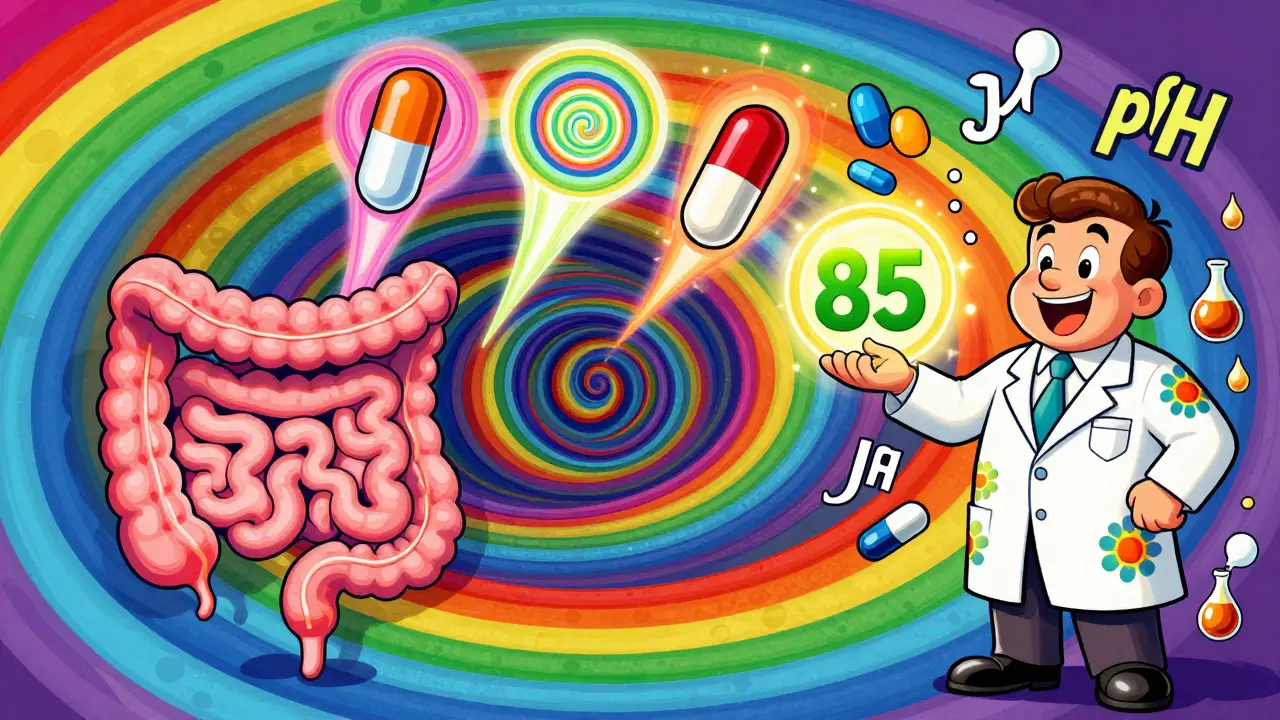
What Happens When the Test Doesn’t Match?
Sometimes, a generic product doesn’t match the brand’s dissolution profile-but still works in the body. In those cases, the FDA doesn’t automatically reject it. Instead, they may set different acceptance criteria for that specific generic. This happened with several antiretroviral drugs and epilepsy medications. The agency looks at the full picture: dissolution data, bioequivalence results, and clinical history. But if the difference is too big, the application gets stuck. Manufacturers often spend 6 to 12 months tweaking formulations just to get the dissolution right. That’s because small changes in excipients (inactive ingredients), particle size, or coating can dramatically alter how the drug releases.What About Changes After Approval?
The FDA doesn’t stop watching after approval. If a company changes the manufacturing site, switches suppliers, or alters the formula-even slightly-they must prove the dissolution profile hasn’t changed. This is part of the SUPAC-IR guidelines. They have to test the new version side-by-side with the old one, across multiple time points. If the f2 score drops below 50, they need to submit new data, and sometimes even run new bioequivalence studies. This is why generic drug makers keep detailed records. One change, one test failure, and the whole batch could be pulled from shelves. It’s not just about quality control-it’s about trust.
The FDA’s Dissolution Database
To help manufacturers get it right, the FDA maintains a public database of recommended dissolution methods. As of late 2023, it includes over 2,800 drug products. If your generic is on that list, you follow the exact method. No guesswork. For drugs not listed, companies have to develop their own method from scratch. That’s expensive and time-consuming. But the FDA makes it clear: the method must be product-specific. You can’t copy someone else’s test for a different drug, even if it’s the same class.What’s Next for Dissolution Testing?
The FDA is pushing toward more realistic testing. Right now, most tests use simple buffers. But the human gut is complex-full of enzymes, bile, and food. Researchers are testing methods that mimic those conditions. If successful, future tests could be even better at predicting real-world performance. The agency is also exploring whether biowaivers can be extended to BCS Class III drugs-those that dissolve easily but don’t absorb well. If proven safe, that could cut development time for dozens of new generics. By 2025, experts predict nearly one-third of all generic approvals will use standardized dissolution methods to skip human trials. That’s up from 25% in 2020. It’s not about cutting corners-it’s about smarter science.Why This All Matters to You
You might never see a dissolution machine. But every time you take a generic pill and feel better, it’s because someone in a lab made sure it dissolved just right. The FDA doesn’t trust assumptions. They trust data. And that data comes from precise, repeatable tests-not opinions. This system keeps prices low, speeds up access, and protects your health. It’s one of the quietest, most effective public health tools in modern medicine.What is dissolution testing in generic drugs?
Dissolution testing measures how quickly a drug releases its active ingredient from a tablet or capsule in a controlled lab environment. For generics, it proves the drug behaves the same as the brand-name version, ensuring therapeutic equivalence without needing human trials.
How does the FDA decide if a generic drug passes dissolution testing?
The FDA compares the dissolution profile of the generic to the brand-name drug using the f2 similarity factor. An f2 score of 50 or higher means the profiles are statistically similar. The test must also meet specific time points and conditions based on the drug’s properties, like solubility and release type.
Can a generic drug be approved without human bioequivalence studies?
Yes, if it meets strict dissolution criteria. For highly soluble and well-absorbed drugs (BCS Class I), the FDA allows biowaivers based solely on dissolution profile matching. This avoids unnecessary human testing while maintaining safety and effectiveness.
Why is dissolution testing required for extended-release pills?
Extended-release pills are designed to release slowly. If they release too fast-due to a formulation error or interaction with alcohol-they can cause dangerous spikes in drug levels. The FDA tests these under multiple pH levels and with alcohol to prevent "dose dumping," a serious safety risk.
What happens if a generic drug’s dissolution profile changes after approval?
Any change in manufacturing, ingredients, or process requires retesting. If the new dissolution profile differs significantly from the original (f2 < 50), the manufacturer must submit new data. In some cases, the FDA may require additional bioequivalence studies or even recall the product.
Where can I find the FDA’s official dissolution methods?
The FDA maintains a public Dissolution Methods Database with recommended test conditions for over 2,800 drug products. Manufacturers use this as a reference when developing generic versions. The database is updated regularly and is accessible through the FDA’s Office of Generic Drugs website.
Rosemary O'Shea
December 23, 2025 AT 22:02Let me tell you, as someone who's spent 17 years in pharma regulatory affairs, this is the most elegant example of science over spectacle. The FDA doesn't need to poison healthy volunteers with placebo pills to prove a generic works-they use physics, chemistry, and statistical rigor. It's not just efficient, it's *ethical*. Most people think 'generic' means 'cheap,' but they don't realize it's the most meticulously regulated product on the shelf. The f2 factor? That's not some spreadsheet trick-it's a mathematical marriage between kinetics and clinical reality. If you're still skeptical, go read the SUPAC-IR guidelines. Then come back and tell me this isn't genius.
Lindsey Kidd
December 25, 2025 AT 15:37This is why I love science 💙👏
So many people think generics are 'fake' meds, but this? This is how we make life-saving drugs affordable without sacrificing safety. The alcohol test?? Genius. People drink. The FDA knew that. They didn't ignore reality-they built the test around it. 🤯
Also, 2,800+ methods in the database?? That's like a library of drug behavior. We should teach this in high school. 📚💊
Austin LeBlanc
December 26, 2025 AT 10:41Yeah right. You think this is all about safety? Wake up. This is about control. The FDA doesn’t want you to have cheap drugs-they want you to have *their* cheap drugs. Every time a company tweaks a coating or switches a filler, they’re forced to retest for months. That’s not science-it’s a barrier to entry for smaller labs. Big Pharma loves this system. It keeps generics from competing too hard. And don’t even get me started on how they cherry-pick dissolution conditions to favor certain brands. This isn’t public health. It’s corporate gatekeeping dressed up in lab coats.
niharika hardikar
December 26, 2025 AT 19:43It is imperative to underscore that the dissolution testing paradigm, as promulgated by the United States Food and Drug Administration, constitutes a paradigmatic exemplar of regulatory science predicated upon physicochemical fidelity and statistical robustness. The application of the f2 similarity factor, derived from multivariate analysis of dissolution profiles across discrete time points, enables the establishment of bioequivalence without recourse to in vivo experimentation-a procedural innovation of considerable magnitude in pharmaceutical jurisprudence. Furthermore, the adherence to BCS classification and the implementation of biowaiver protocols for Class I substances represent a paradigmatic optimization of resource allocation in global public health policy. Any deviation from standardized dissolution methodologies constitutes a material breach of Good Manufacturing Practices and undermines the integrity of the therapeutic equivalence framework.
Rachel Cericola
December 27, 2025 AT 16:03Look, I get why people are skeptical-generic drugs are cheap, so they must be low quality, right? Wrong. This system exists because real people-like my dad, who takes four pills a day for hypertension-can’t afford $500 a month for brand names. The dissolution testing isn’t just a box to check. It’s the reason his generic lisinopril works just as well as the brand. The FDA didn’t just invent this-they fought for it. They spent years building those test conditions, validating them against actual human data, and then making them public so anyone, anywhere, can replicate them. And now? They’re testing with bile salts and food simulants because the gut isn’t a test tube. That’s not bureaucracy-that’s care. If you think this is overkill, try being the person who gets sick because a generic dissolved too fast and spiked their blood pressure. This isn’t about control. It’s about not letting someone die because they couldn’t pay for a name on the bottle.
John Pearce CP
December 27, 2025 AT 17:03It is an affront to national sovereignty that foreign manufacturers are permitted to utilize FDA-approved dissolution methods to produce medications for American consumption, often under conditions that would be deemed unacceptable in any domestic pharmaceutical facility. The very premise of biowaivers, predicated upon foreign-developed dissolution profiles, represents a dangerous abdication of scientific autonomy. The United States, as the world’s preeminent innovator in pharmaceutical science, should not be outsourcing its regulatory validation to entities operating under inferior oversight regimes. The f2 factor may be mathematically elegant, but it is not a substitute for domestic clinical validation. This is not efficiency-it is strategic vulnerability. We must demand that all generics be manufactured, tested, and certified on American soil under American standards-or not at all.
Charles Barry
December 27, 2025 AT 20:47They're lying. Every single one of these 'dissolution profiles' is cooked. The FDA doesn't test the pills you buy-they test the ones the company sends them. And those? They're made in a special batch, under perfect conditions, with the best ingredients they can find. The pills you get at CVS? Different batch. Different factory. Different country. And guess what? They don't test those. The 'f2 score' is a magic number they use to pretend everything's fine. But if you know where to look, you'll find the whistleblower reports-dozens of them. One company was caught switching fillers and just resubmitting the same old data. And the FDA? They approved it. Why? Because they're paid by the same industry they're supposed to regulate. This isn't science. It's a shell game. And you're the sucker paying for it.
Joe Jeter
December 29, 2025 AT 20:32Actually, the whole dissolution testing thing is overblown. I’ve taken generics for 15 years and never noticed a difference-but I’ve also seen people swear their brand-name version ‘felt better.’ Coincidence? Maybe. But the FDA’s obsession with f2 scores and ethanol tests ignores the fact that biology isn’t a lab. Your gut isn’t a beaker. People metabolize drugs differently. Maybe we should stop pretending a machine can replace human experience. This isn’t precision medicine-it’s industrial conformity.