Childhood Obesity: Why Family-Based Treatment Works Better Than Diets
 Jul, 11 2026
Watching your child struggle with their weight is one of the most stressful experiences for a parent. You might feel guilty, confused, or overwhelmed by conflicting advice on social media. The hard truth? Telling a kid to "eat less and move more" rarely works. In fact, it often backfires. The real solution isn't about willpower; it's about changing the environment your child lives in. That’s why experts now agree that family-based treatment is the gold standard for helping children achieve healthy weights.
This approach doesn't just focus on the child. It involves the whole household-parents, siblings, and routines. Research shows that when families change together, the results stick. Let’s look at how this method works, why it beats traditional diets, and what you can start doing today.
What Is Family-Based Behavioral Treatment (FBT)?
Family-Based Behavioral Treatment (FBT) is a structured therapy program where parents and children work together with healthcare professionals to change eating and activity habits. Unlike a diet plan handed to a teenager, FBT recognizes that kids don’t shop for groceries or cook dinner. They eat what’s available at home.
The concept was pioneered by Dr. Leonard Epstein at the University at Buffalo in the 1980s. His research proved that involving parents leads to much better long-term results than treating the child alone. Today, major organizations like the American Academy of Pediatrics (AAP) and the American Psychological Association (APA) recommend FBT as the first line of defense against childhood obesity.
Here is how it typically looks in practice:
- Duration: Programs usually last 6 to 24 months.
- Sessions: Families attend 16 to 32 sessions with certified health coaches.
- Participants: At least one parent and the child must actively participate.
- Setting: It can happen in primary care offices, community centers, or specialty clinics.
The goal isn’t rapid weight loss. It’s building sustainable habits that prevent weight gain and improve overall health markers.
The Core Strategy: The Stoplight Diet
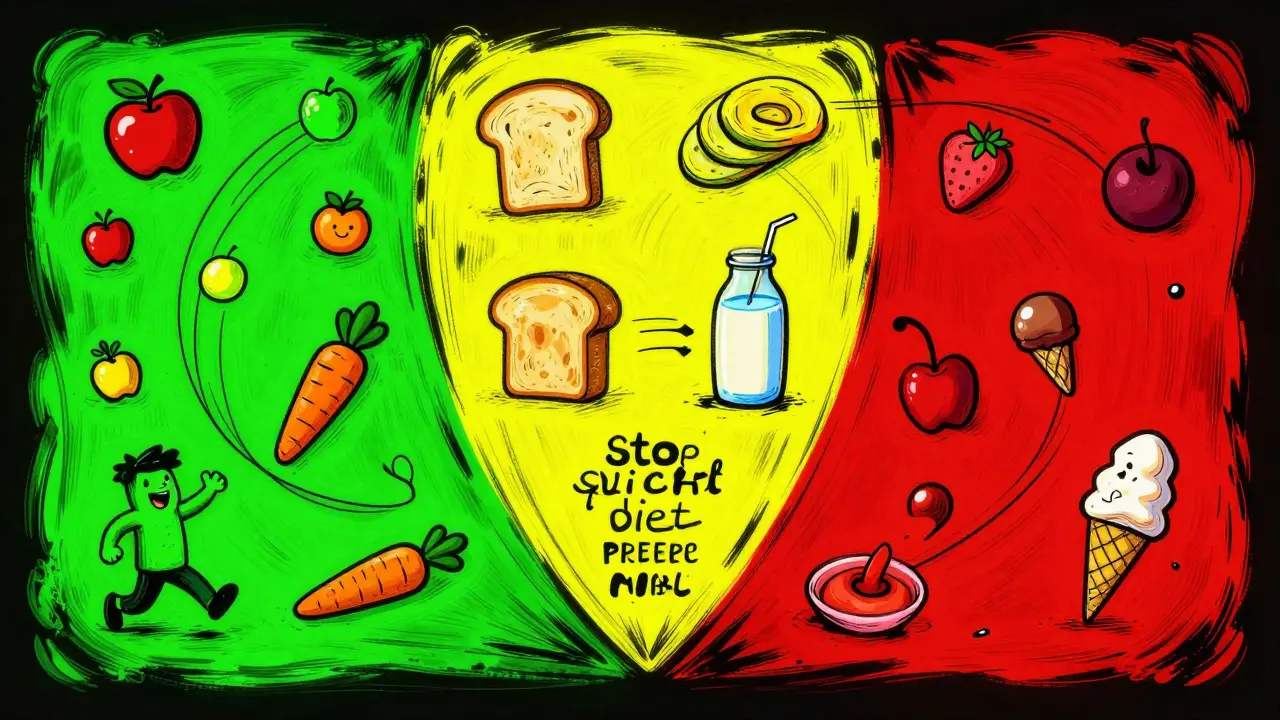
One of the most famous tools within FBT is the Stoplight Diet, which categorizes foods into three groups based on nutritional value and frequency of consumption. This simple system helps families make quick decisions without counting calories or feeling deprived.
| Color Category | Frequency | Examples |
|---|---|---|
| Green | Eat freely | Fruits, vegetables, water, lean proteins |
| Yellow | Eat in moderation | Bread, pasta, milk, yogurt, some snacks |
| Red | Eat sparingly | Candy, soda, fried foods, ice cream |
Why does this work? It removes the stigma of "forbidden" foods. Instead of saying "no cookies ever," you teach kids that red foods are occasional treats. Studies show this approach reduced percentage overweight by nearly 9% in just six months compared to control groups. It’s practical, easy to understand, and keeps the whole family on the same page.
Why Family Involvement Beats Child-Only Interventions
You might wonder, "Can’t my teen handle this themselves?" Data says no. A meta-analysis cited by the APA found that family-based treatments produced significantly greater weight loss (0.55 standard deviations more) than interventions focusing only on the child.
Here’s why:
- Environmental Control: Parents control the food supply. If sugary drinks aren’t bought, they aren’t consumed.
- Modeling Behavior: Kids mimic what they see. If parents exercise and eat veggies, kids are more likely to do the same.
- Support System: Changing habits is hard. Having a partner (parent or sibling) makes it easier to stay motivated.
In a major 2023 trial published in JAMA Network Open, children in FBT programs showed a 12.3% greater reduction in BMI z-scores compared to those receiving usual care. Even more surprisingly, untreated siblings in these families also improved their weight outcomes by 7.2%. The ripple effect is real.
Practical Steps for Parents: What You Can Do Now
You don’t need to wait for a doctor’s referral to start making changes. Here are evidence-based strategies from FBT protocols that you can implement at home immediately:
1. Master the Home Environment
Remove sugar-sweetened beverages. Replacing soda with water or milk can reduce BMI by 1.0 unit over 12 months. Keep fruit visible and accessible. Put apples on the counter, not hidden in the crisper drawer. Make healthy choices the easiest choices.
2. Set Screen Time Limits
Excessive screen time is linked to higher BMI. Aim for less than 2 hours of recreational screen time per day. Replace scrolling with active play, board games, or reading. Every hour of extra TV watching is associated with a small but significant increase in obesity risk.
3. Prioritize Family Meals
Eating together as a family is protective. Children who share meals with parents regularly have a 12% lower risk of obesity. These meals provide structure, model healthy eating, and offer opportunities for connection without screens.
4. Focus on Movement, Not Just Exercise
Forget intense gym workouts for young kids. The goal is 60 minutes of moderate-to-vigorous physical activity daily. This could be biking, dancing, playing tag, or walking the dog. Make it fun, not a chore.
5. Use Positive Reinforcement
Praise effort, not appearance. Say, "I’m proud of you for trying broccoli," instead of commenting on weight. Avoid using food as a reward or punishment. This builds a positive relationship with food.
Barriers to Success and How to Overcome Them
FBT isn’t perfect. It requires time, money, and consistency. Many families face real-world challenges:
- Scheduling Conflicts: Working parents may find it hard to attend weekly sessions. Look for hybrid models that combine in-person visits with app-based monitoring.
- Cost: While FBT is cost-effective ($3,200 average vs $4,100 for specialty care), upfront costs can be high. Check if your insurance covers Intensive Behavioral Therapy (IBT) under CPT code G0447.
- Parental Resistance: Some parents feel blamed. Remember, FBT is about teamwork, not guilt. Coaches help reframe this as a shared journey toward health.
- Cultural Barriers: Traditional foods may not fit neatly into the Stoplight categories. Work with providers to adapt guidelines respectfully, ensuring cultural staples are included in green/yellow lists where appropriate.
If you live in an area with limited access to specialists, ask your pediatrician about "coached care" models. These integrate behavioral health specialists directly into primary care practices, reducing travel time and waitlists.

When Is More Intensive Help Needed?
For most children, FBT is sufficient. However, if your child has severe obesity (BMI ≥120% of the 95th percentile) and hasn’t responded to lifestyle changes after 6-12 months, additional options exist.
The 2023 AAP guidelines suggest considering pharmacotherapy (weight-loss medications approved for adolescents) or metabolic surgery in extreme cases. These are serious decisions requiring specialist evaluation. But for the vast majority of families, sticking with consistent, family-wide behavior change yields the best long-term results.
Key Takeaways for Families
Childhood obesity is complex, but the path forward is clear. It’s not about strict diets or blaming anyone. It’s about creating a supportive home environment where healthy habits thrive naturally.
- Start early: Intervention as young as age 4-5 prevents worse problems later.
- Involve everyone: Parents must model the behaviors they want to see.
- Be patient: Sustainable change takes 6-24 months, not weeks.
- Seek professional support: Certified coaches provide structure and accountability.
By working together, families can turn weight management into a healthier, happier lifestyle for everyone.
Is family-based treatment covered by insurance?
Many insurance plans cover Intensive Behavioral Therapy (IBT) for obesity, often billed under CPT code G0447. Coverage varies by provider and plan, so check with your insurer. Medicare also covers IBT for adults, and some pediatric plans include similar benefits. Always verify coverage before starting treatment.
How long does family-based treatment take to show results?
Most programs run for 6 to 24 months. Initial improvements in eating habits and activity levels can be seen within weeks, but significant changes in BMI typically emerge after 6 months. Long-term maintenance requires ongoing support and routine reinforcement.
What if my child refuses to participate?
Resistance is common. Therapists use motivational interviewing techniques to engage reluctant children. Parents can help by focusing on non-weight-related benefits like energy, mood, and sports performance. Forcing participation often backfires; gentle encouragement and parental modeling are more effective.
Can I do this without a therapist?
You can implement many FBT principles at home, such as the Stoplight Diet and screen time limits. However, professional guidance provides structure, accountability, and personalized strategies. Self-help approaches often lack the behavioral coaching needed for lasting change, especially in complex family dynamics.
Does FBT work for teenagers?
Yes, FBT is effective for teens aged 2-18. Teenagers benefit from parental involvement in setting boundaries around food and activity, even if they resist initially. Programs adapt to respect growing independence while maintaining family support structures.
Earl Oleary
July 11, 2026 AT 20:30Let's be real for a second because this article is sugar-coating a very bitter pill. The data doesn't lie and if you actually look at the long-term follow-up studies from the University of Buffalo, the weight regain rate is astronomical once the parental supervision drops off. You're not building habits; you're building dependency on external control mechanisms that vanish when the kid hits college or moves out. The Stoplight Diet is a cute heuristic for toddlers but it fails miserably with adolescents who have access to social media influencers selling them 'healthy' processed garbage that technically fits into the yellow category but destroys their metabolic health anyway. We need to talk about pharmacological intervention earlier, not hide behind 'family dynamics' which are often the root cause of the obesity in the first place due to emotional eating cycles passed down through generations.
Laura Odom
July 12, 2026 AT 02:02oh my gosh stop trying to fix kids like they are broken appliances!!! this whole vibe is so toxic and reductive. its not about 'willpower' or 'environment' its about the soul of the child being crushed by societal expectations of thinness. we are creating a generation of anorexics and orthorexic nightmares by policing what goes into our mouths. food is love, food is culture, food is joy. turning dinner into a color-coded tactical operation is just sad. also why do we assume all fat kids are unhappy? maybe theyre fine. maybe the problem is the observer not the observed. lets deconstruct the patriarchy of diet culture instead of blaming mom for buying soda.
Trey Newkerk
July 12, 2026 AT 09:26You are completely missing the point and frankly your pseudo-intellectual drivel is exhausting. It is not about 'soul' it is about biology and physics. Calories in, calories out. If you ignore the physiological reality of insulin resistance and leptin signaling, you are complicit in the suffering of these children. I see parents watching their kids develop type 2 diabetes at age twelve and then crying about 'diet culture' while feeding them processed sludge. The 'joy' you speak of is a fleeting dopamine hit followed by a crash that ruins their lives. Stop romanticizing pathology. The environment controls the input. If the input is poison, the output will be disease. It is that simple and your refusal to accept basic thermodynamics is a form of intellectual laziness that hurts everyone involved.
Sean Allwurden
July 12, 2026 AT 21:28I think we can find some middle ground here because both perspectives highlight valid concerns regarding patient engagement and long-term adherence strategies. From a clinical implementation standpoint, the Family-Based Behavioral Treatment (FBT) model leverages the concept of social scaffolding to ensure that behavioral modifications are reinforced across multiple contexts. While Earl raises a fair point about the sustainability of interventions post-treatment, the meta-analyses clearly indicate that the inclusion of caregivers significantly mitigates the risk of relapse compared to individual-only modalities. Laura’s emphasis on the psychological impact of restrictive environments is also crucial; we must ensure that the 'Stoplight' framework is presented as an educational tool rather than a punitive measure. The key is to optimize the therapeutic alliance between the healthcare provider, the parent, and the child to foster intrinsic motivation rather than extrinsic compliance. We should advocate for hybrid models that integrate nutritional psychiatry principles to address the emotional components of eating disorders alongside the mechanical aspects of dietary intake.
Kieran Healy
July 14, 2026 AT 01:06i totally get where you guys are coming from :o it seems like such a heavy topic and i can imagine how stressful it must be for parents trying to do the right thing. its really hard when you feel like no matter what you do someone is going to criticize you. i think the idea of doing it together as a family sounds nice because nobody likes feeling alone in a struggle. maybe we can all just try to be a bit kinder to each other since we are all just trying to figure out life ? :)
Patrick Plummer
July 15, 2026 AT 18:35Oh, absolutely! Because nothing says "empowerment" like having a therapist tell you what color your vegetables should be!! And let us not forget the sheer audacity of suggesting that parents are responsible for their children's health outcomes!! What about genetics?! What about metabolism?! What about the fact that some people are just naturally larger and healthier than others?! This entire premise is built on a foundation of shame and control!! It is ridiculous!! It is absurd!! It is insulting!! Why do we keep falling for these simplistic solutions to complex biological problems?! We need to stop pathologizing normal body diversity!!
Gary Hull
July 16, 2026 AT 04:12look i dont know much about science but this feels wrong. its too controlling. why cant kids just eat what they want? its not like its killing them immediately. we worry too much. back in my day we ate whatever was there and we were fine. now everyone is obsessed with numbers and charts. its sickening. lets just let nature take its course. survival of the fittest and all that. if they cant handle it they cant handle it. stop coddling them.
Megan Crossland
July 16, 2026 AT 11:32this is moral failure disguised as medical advice. you are teaching children that their worth is tied to their consumption choices. it is deeply unethical. we should be focusing on mental health and self acceptance not calorie counting. the industry profits from insecurity. do not feed the beast. reject the paradigm. live authentically regardless of size.
Jairam Prasad
July 16, 2026 AT 13:13In India, we have a saying: "The stomach is the door to the house." Our traditional meals are inherently balanced-dal, rice, vegetables, yogurt-all eaten together. The Western obsession with isolating nutrients into 'green' and 'red' categories is quite amusingly naive. Of course, adapting to globalized junk food is a challenge, but perhaps the solution isn't more American therapy sessions. Maybe it is returning to communal eating traditions where the family eats the same meal without judgment. Your 'Stoplight' system ignores the cultural context of food entirely. It is a colonial approach to nutrition, imposing rigid structures on organic human behavior. Very interesting, but ultimately shallow.
Padraic Cepek
July 18, 2026 AT 00:16This is typical weak western thinking. In America we used to just work hard and eat real food. Now everyone wants a handout and a coach to hold their hand. Kids are lazy and parents are useless. Fix your own damn country before worrying about BMI scores. Real Americans don't need a 24 month program to learn how to eat. Grow up.
Mildred Fierce
July 18, 2026 AT 08:06The structural analysis of this situation reveals a profound failure of the neoliberal state to provide adequate nutritional infrastructure for working-class families. Expecting parents to 'model behavior' when they are working three jobs and relying on cheap, calorie-dense processed foods is not only unrealistic but morally bankrupt. The 'Stoplight Diet' is a bourgeois luxury that assumes access to fresh produce and time to prepare meals. We must dismantle the systemic inequalities that force low-income families into food deserts. Until we address the economic determinants of health, any discussion of 'family-based treatment' is merely victim-blaming wrapped in therapeutic jargon. The aggression of the market against the body politic is what creates obesity, not bad parenting.
Najmunisa Govender
July 20, 2026 AT 02:16I can understand the frustration!! It is so overwhelming!! But please remember that every small step counts!! My daughter struggled with this too!! We started with just one green vegetable a day!! It made a huge difference!! Don't give up!! Support each other!! Love is the most important nutrient!!
Vineet Hawelia
July 21, 2026 AT 05:08It is imperative to acknowledge the limitations of anecdotal evidence in public discourse. While the sentiments expressed by various commenters reflect genuine concern, the scientific consensus supports the efficacy of structured behavioral interventions. However, it is equally important to recognize that cultural competence must be integrated into these frameworks. A one-size-fits-all approach is insufficient. Healthcare providers must engage in continuous education regarding diverse dietary practices to ensure that recommendations are respectful and applicable. Furthermore, policy-level changes are necessary to support families economically and logistically. Without systemic support, individual efforts may indeed be thwarted by external constraints.