Cannabis and Medications: What You Need to Know About Drug Interactions
 Jan, 9 2026
When you're taking prescription meds and considering cannabis for pain, sleep, or anxiety, you're not just adding a new supplement-you're stepping into a hidden chemical conversation inside your body. The most dangerous part? Most people have no idea it's even happening.
How Cannabis Changes How Your Medications Work
Cannabis doesn't just float through your system. Its main active compounds-CBD and THC-directly interfere with enzymes in your liver that break down about 60% of all prescription drugs. These enzymes, called CYP450, are like the body's recycling crew for medications. When CBD or THC shows up, they jam the machinery. The result? Your meds build up to toxic levels or get flushed out too fast, losing their effect. For example, if you're on warfarin (a blood thinner), adding CBD can cause your INR levels to spike by nearly 50% in just 72 hours. That means your blood takes much longer to clot. In real cases, this has led to internal bleeding, hospitalizations, and even death. One 2022 review found 17 documented cases of serious bleeding linked to CBD and warfarin use together. It's not just blood thinners. CBD inhibits CYP3A4 and CYP2C19, which process clobazam (an anti-seizure drug), tacrolimus (used after organ transplants), and many antidepressants. THC blocks CYP1A2 and CYP2C9, which handle theophylline (for asthma) and some painkillers. Even small doses of CBD-5 to 10 mg per day-can trigger these effects in sensitive individuals.High-Risk Interactions You Can't Afford to Ignore
Some drug combinations with cannabis are outright dangerous. These aren't theoretical risks-they've caused real harm.- Warfarin: CBD increases INR by 29-48%. A 2022 study documented 12 life-threatening bleeding events. The American Society of Health-System Pharmacists now recommends checking INR every 3-5 days if you're using cannabis, not weekly.
- Tacrolimus: Used by transplant patients to prevent organ rejection. CBD can push tacrolimus levels up by 300-500% in under 72 hours. One case report described a kidney transplant patient going into kidney failure after starting CBD oil.
- Clobazam: In epilepsy patients, CBD can raise clobazam levels by 60-500%. Many patients end up too drowsy to walk, speak, or drive. One Reddit user wrote, "I couldn't walk straight-my neurologist cut my clobazam dose by 40% right away."
Medium-Risk Interactions That Need Monitoring
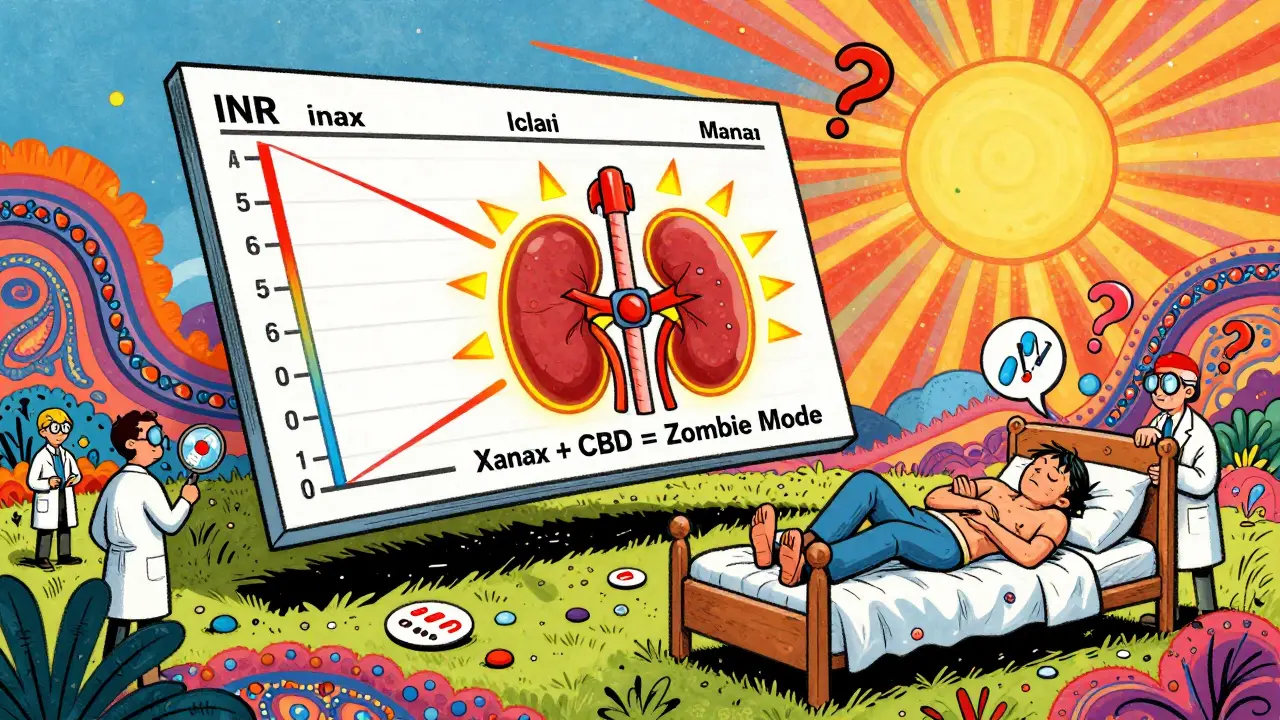
These combinations won't always cause disaster, but they can sneak up on you.- Benzodiazepines (like alprazolam or lorazepam): Cannabis boosts sedation by 35-60%. In older adults, this raises fall risk by 47%, according to the Pennsylvania Pharmacists Association. One patient described "feeling like a zombie" after combining CBD with Xanax.
- Opioids (like oxycodone or morphine): Cannabis can reduce how fast your body clears these drugs, increasing drowsiness and respiratory depression. While some users report no issue, others have needed emergency care for slowed breathing.
- Calcium channel blockers (like amlodipine): CBD can raise blood levels by 30-40%. That leads to dizziness, fainting, or dangerously low blood pressure in 15-25% of users.
Low-Risk Interactions (But Still Not Risk-Free)
Some interactions are mild or rare-but that doesn’t mean they’re harmless.- SSRIs (like sertraline or fluoxetine): CBD may slightly raise levels by 10-15%. Most users report no change. A 2023 Epilepsy Foundation survey found 41% of people on SSRIs noticed nothing when adding CBD.
- Statins (like atorvastatin): CBD can increase levels by 20-25%. No confirmed cases of muscle damage (rhabdomyolysis) have been reported, but the risk isn’t zero.
How You Take Cannabis Changes Everything
It’s not just what you use-it’s how you use it. Smoking or vaping cannabis sends THC into your bloodstream within minutes. That means if you're on a sedative like oxycodone, the combo hits fast and hard. You might feel dizzy or lightheaded within 10 minutes. Oral CBD (oils, gummies) takes 2-4 hours to peak and lasts 6-8 hours. This creates a long window for interaction with drugs like warfarin or clobazam. You might feel fine for days, then suddenly have a spike in drug levels. Full-spectrum CBD (with up to 0.3% THC) is 22-37% more likely to interfere with liver enzymes than pure CBD isolate. That’s because THC and other plant compounds work together-the "entourage effect." So even "THC-free" products aren’t always safe if they contain other cannabinoids.What You Should Do Right Now
If you're on any prescription medication and using cannabis-or thinking about it-here’s what to do:- Be honest with your doctor. Don’t say "I use weed." Say: "I take 25 mg of CBD oil every night for sleep," or "I smoke cannabis twice a week for back pain." Details matter.
- Check your meds. Ask your pharmacist: "Which of my medications are processed by CYP3A4, CYP2C9, or CYP2C19?" That’s where the biggest risks live.
- Get baseline labs. If you’re on warfarin, tacrolimus, or clobazam, ask for blood tests before starting cannabis. Then test again 48-72 hours after your first dose.
- Start low, go slow. If you’re new to CBD, begin with 5 mg per day. Wait a week. Watch for dizziness, unusual bruising, or extreme tiredness.
- Don’t mix with alcohol or sedatives. Even if your meds are "low risk," adding alcohol or sleeping pills with cannabis can be deadly.
What You Shouldn’t Do
- Don’t assume "natural" means safe. Cannabis is a powerful drug with documented interactions.
- Don’t rely on Reddit advice. One person’s "no side effects" experience doesn’t mean it’s safe for you.
- Don’t wait for symptoms. Many interactions don’t cause obvious signs until it’s too late.
- Don’t assume your pharmacist knows. Only 12 states require pharmacists to counsel on cannabis interactions. Most don’t have training.
The Big Picture
More than 58 million Americans used cannabis in 2022. Over 40% of them were also taking prescription drugs. Yet, only 38 states include drug interaction warnings in their medical cannabis programs. The FDA has received over 1,300 reports of possible interactions since 2018-but experts believe less than 10% of cases are ever reported. The science is catching up. The NIH is funding a $2.3 million study on CBD and warfarin. The FDA launched a new clinical trials network in 2023 to study these interactions systematically. By 2027, experts predict we’ll have clear guidelines for 85% of high-risk combinations. But right now? You’re on your own. The safest choice isn’t to avoid cannabis-it’s to understand exactly how it affects your body and your meds. Talk to your doctor. Get tested. Track your symptoms. Don’t gamble with your liver, your blood, or your life.Can I take CBD with my blood thinner?
It’s not recommended without close medical supervision. CBD can increase the levels of warfarin in your blood by up to 50%, raising your INR and your risk of dangerous bleeding. If you’re on warfarin and want to try CBD, you must get your INR checked every 3-5 days after starting, not weekly. Many doctors will advise against it entirely.
Does CBD make anxiety meds stronger?
It can, especially with benzodiazepines like alprazolam or clonazepam. CBD enhances their sedative effects, leading to extreme drowsiness, confusion, or trouble breathing. In older adults, this combination increases fall risk by nearly 50%. If you're using CBD for anxiety, talk to your doctor before combining it with prescription anti-anxiety drugs.
Is full-spectrum CBD more dangerous than isolate?
Yes. Full-spectrum CBD contains trace amounts of THC and other cannabinoids that work together to boost enzyme inhibition. Studies show it’s 22-37% more likely to interfere with liver metabolism than pure CBD isolate. If you're on medications metabolized by CYP3A4 or CYP2C19, isolate is safer-but still not risk-free.
Can I take CBD with antidepressants like Zoloft?
Most people on SSRIs like sertraline (Zoloft) don’t notice any effect from CBD. Studies show a 10-15% increase in drug levels, which rarely causes issues. But if you start feeling unusually tired, nauseous, or dizzy after adding CBD, get your levels checked. It’s rare, but possible.
How long should I wait between taking CBD and my meds?
Some sources suggest taking CBD 2 hours before or after other meds to reduce interaction risk. But there’s little solid evidence this works. The liver processes everything over hours, not minutes. The best approach is to avoid combining them unless under medical supervision. If you must, space them out-but still monitor for side effects.
What if I’m on multiple medications?
The more meds you take, the higher your risk. If you’re on 3 or more drugs metabolized by CYP450 enzymes, adding cannabis could create a dangerous chemical pileup. Ask your pharmacist to run a drug interaction checker using your full list. Don’t guess-get a professional review.
Are there any medications that are safe with cannabis?
There’s no official list. Even medications with low interaction risk can behave unpredictably in some people. The safest approach is to assume all medications could be affected until proven otherwise. Always consult your prescriber before combining cannabis with any drug.
Jake Kelly
January 10, 2026 AT 03:35Cannabis isn't some harmless herb-it's a potent pharmacological agent with real metabolic consequences. I've seen patients on warfarin bleed out after starting CBD oil, and no, they didn't know it was risky. This post nails it: the liver doesn't care if you call it 'natural' or 'wellness.' It just processes what it's given. If you're on meds, assume interaction until proven otherwise.
lisa Bajram
January 10, 2026 AT 15:26Y’all need to stop treating CBD like it’s chamomile tea. I’m a pharmacist. I’ve had three patients in the last six months come in with INR levels over 10 after ‘just a little CBD for sleep.’ One almost died. The label says ‘THC-free’-doesn’t mean it’s safe with your blood thinner. Get your labs checked. Don’t wing it. Your liver will thank you. 🙏
Michael Marchio
January 11, 2026 AT 14:52Let’s be brutally honest here-most people who use cannabis with medications are either ignorant or arrogant. They read one Reddit thread, decide they’re an expert, and then wonder why they’re dizzy, bruised, or in the ER. The CYP450 system isn’t a suggestion box. It’s a biochemical highway, and THC/CBD are bulldozers. If you’re on tacrolimus, clobazam, or warfarin, you’re not ‘experimenting’-you’re playing Russian roulette with your organs. And no, ‘I’ve been doing it for years’ doesn’t make you immune. It just means you haven’t hit the jackpot yet.
Ashlee Montgomery
January 11, 2026 AT 22:59I’ve been on SSRIs for a decade and added 10mg CBD isolate for anxiety. No change in mood, no dizziness, no weird side effects. But I also got a baseline blood test before starting and checked again after two weeks. I didn’t assume. I observed. The difference between curiosity and recklessness is documentation. Keep a journal. Talk to your prescriber. Even if nothing happens, you’ll know why.
neeraj maor
January 12, 2026 AT 15:12Big Pharma doesn’t want you to know this. The FDA has known about these interactions since 2015 but buried the data. Why? Because if people realized how dangerous cannabis is with meds, they’d stop buying pills. The 1,300 reports? That’s the tip of the iceberg. They’re silencing doctors who warn patients. Look up the 2021 whistleblower memo from the NIH. This isn’t science-it’s corporate control. Don’t trust your doctor. They’re paid to keep you dependent.
Ritwik Bose
January 13, 2026 AT 14:44Thank you for this comprehensive breakdown. As someone from India where cannabis is still heavily stigmatized, it’s refreshing to see evidence-based discussion instead of moral panic or misinformation. I’ve seen elderly relatives on antihypertensives try CBD for arthritis-no monitoring, no warnings. This needs to be translated into more languages. Safety isn’t Western privilege-it’s human right. 🙏
Paul Bear
January 14, 2026 AT 17:06Let’s clarify the jargon: CYP3A4 inhibition = reduced first-pass metabolism = elevated plasma concentrations = toxicity risk. CBD’s Ki for CYP3A4 is ~0.5–1.5 µM-well within therapeutic range. Full-spectrum products? Even worse. Terpenes like myrcene and limonene are CYP inhibitors too. So ‘entourage effect’ = amplified pharmacokinetic risk. Isolate isn’t safer because it’s ‘pure’-it’s safer because it lacks synergistic inhibitors. Also, smoking? Faster absorption = faster interaction. Oral? Delayed peak = delayed crisis. Timing doesn’t mitigate risk-it just delays the inevitable. Get tested. Or don’t. But don’t pretend you’re not gambling.
Jaqueline santos bau
January 16, 2026 AT 11:45My uncle took CBD with his blood pressure meds and passed out in the shower. They found him with a broken hip and an INR of 12. He’s lucky to be alive. Now he’s on a feeding tube because his brain got too much warfarin. I’m not mad-I’m just… devastated. Why didn’t anyone tell him? Why do we treat this like it’s just ‘herbal tea’? I’m not anti-cannabis. I’m pro-survival. Please. Just. Talk. To. Your. Doctor.
Kunal Majumder
January 18, 2026 AT 01:40Bro, I take CBD every night for back pain and I’m on lisinopril and metformin. No issues. I started with 5mg, waited 10 days, checked my BP and sugar-no change. Maybe it works for some, not others. Don’t scare people unnecessarily. Chill.
Aurora Memo
January 18, 2026 AT 13:23I appreciate how detailed this is. For anyone reading this who feels overwhelmed-start small. One change at a time. Track your symptoms. Don’t rush. You don’t have to quit everything overnight. But you do owe it to yourself to understand what’s in your body. Your health isn’t a trend. It’s your foundation.
chandra tan
January 18, 2026 AT 16:17From India-where weed is sold openly but no one talks about interactions. I told my cousin who takes clopidogrel to stop using CBD. He laughed. Two weeks later, he had a nosebleed that wouldn’t stop. Now he listens. Knowledge saves lives. Share this. Even if one person reads it and checks their meds, it’s worth it.
Dwayne Dickson
January 19, 2026 AT 01:00Oh, so now we’re supposed to trust pharmacists who’ve been trained on cannabis for 47 minutes during a 2019 webinar? And your doctor, who’s never heard of CYP2C19 but knows the side effects of statins? The system is broken. We’re being asked to navigate biochemical minefields with Google and hope. Meanwhile, the FDA sits on $2.3M in research funding while people bleed out in living rooms. This isn’t science. It’s negligence dressed up as caution.
Ted Conerly
January 20, 2026 AT 01:54Start low. Go slow. Track it. Talk to someone who knows. That’s it. No need to panic. No need to glorify. Just be smart. I’ve helped over 200 people safely integrate CBD with their meds. It’s not magic. It’s monitoring. And yes, full-spectrum is riskier. But if you’re doing it right, even that can work. Don’t fear the plant-fear the ignorance.
Faith Edwards
January 20, 2026 AT 22:29One cannot help but observe the profound epistemological dissonance inherent in contemporary cannabis discourse: the conflation of botanical phytochemistry with unregulated wellness ideology, wherein the pharmacodynamic complexity of cytochrome P450 modulation is reduced to the rhetorical fluff of ‘natural healing.’ The very notion that an alkaloid derived from a plant-whose metabolic effects are quantifiably comparable to pharmaceutical-grade enzyme inhibitors-can be safely administered without clinical oversight is not merely irresponsible; it is an affront to the foundational tenets of pharmacology. One must ask: when did evidence become optional, and anecdote, orthodoxy?