Antiviral Medications: Managing CYP3A4 and P-glycoprotein Interactions
 Apr, 13 2026
Antiviral Interaction Simulator
Scenario Configuration
Select a medication and an interacting agent to see the pharmacokinetic effect.
Simulation Result
Effect: Blocks metabolism → Drug stays in system longer → Toxicity Risk
Effect: Speeds up metabolism → Drug cleared faster → Treatment Failure
Effect: Stops efflux pump → Increased absorption → Higher Bioavailability
| Mechanism | Primary Role | Impact of Inhibition |
|---|---|---|
| CYP3A4 | Liver/Intestinal Metabolism | Increased drug levels (Potential toxicity) |
| P-gp | Efflux Transporter (Pumping out) | Increased absorption (Higher bioavailability) |
| OATP1B1/3 | Uptake Transporter (Pulling in) | Decreased liver uptake (Higher plasma levels) |
The Gatekeepers: What Are CYP3A4 and P-gp?
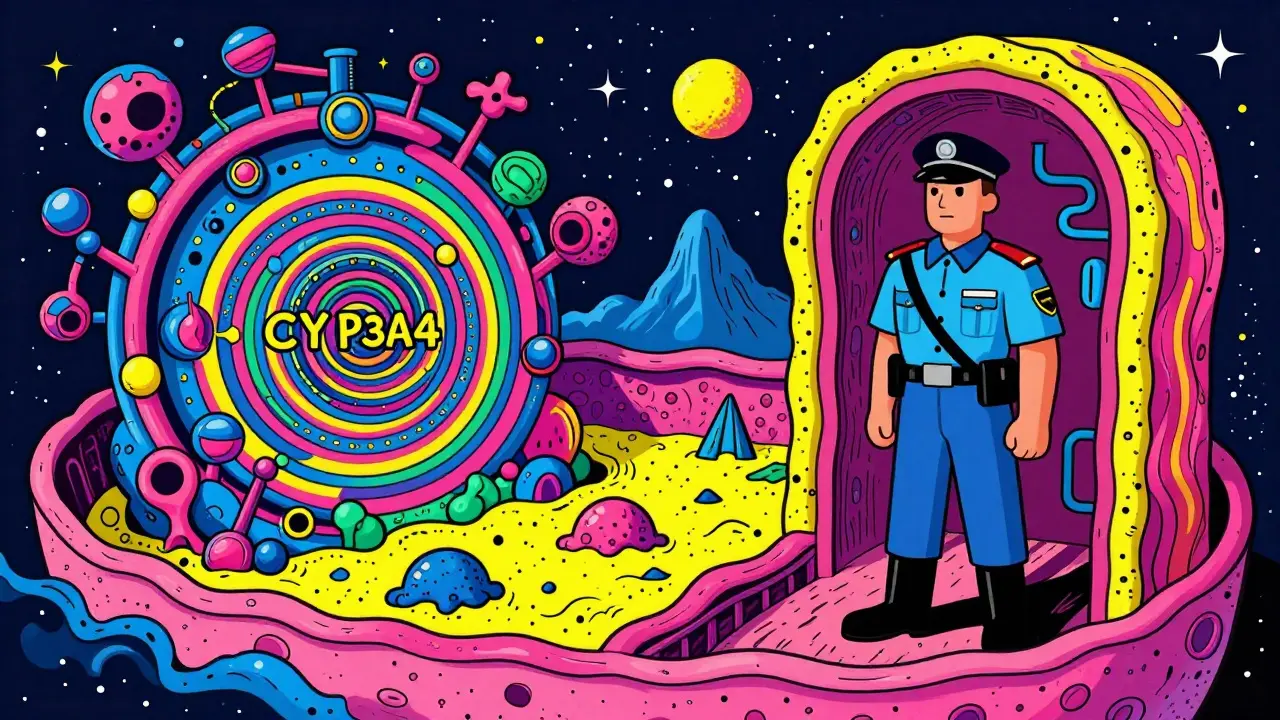
To understand why your doctor is so cautious about your pharmacy list, you first need to know what these systems actually do. CYP3A4 is the most abundant cytochrome P450 enzyme found in the human liver and intestines. It is basically the body's primary chemical processing plant, metabolizing about 50% of all clinically used drugs. If CYP3A4 is inhibited, the drug it usually breaks down stays in your system longer, potentially reaching toxic levels. Then there is P-glycoprotein (also called P-gp), which is an ATP-dependent efflux transporter encoded by the ABCB1 gene. Think of P-gp as a security guard at the border of your cells. Its job is to pump foreign substances, including many antivirals, back out of the cell and into the gut or bile. When a drug inhibits P-gp, the "security guard" falls asleep, and the medication floods into the bloodstream in much higher concentrations than intended.The Ritonavir Effect: From HIV Treatment to "Pharmacokinetic Booster"
One of the most fascinating turns in medical history happened in 1996 with the approval of Ritonavir. Initially designed as an HIV-1 protease inhibitor, researchers noticed something strange: it didn't just fight the virus; it completely shut down CYP3A4. At doses as low as 100 mg daily, ritonavir acts as a type II ligand that binds irreversibly to the enzyme's heme iron. This discovery led to the concept of "boosting." By adding a small amount of ritonavir to other protease inhibitors like lopinavir, doctors could keep the primary drug in the body longer, allowing for lower doses and less frequent pill-taking. However, this is a double-edged sword. While it boosts the antiviral, it also boosts everything else that uses the same pathway. For example, a 2022 study showed that ritonavir can increase the plasma concentrations of certain CYP3A4 substrates by 300-500%. If you are taking a medication with a narrow therapeutic window, like certain anticoagulants, this spike can be deadly.Complexity in Direct-Acting Antivirals (DAAs)
It isn't just HIV meds you have to worry about. Modern treatments for Hepatitis C, known as Direct-Acting Antivirals (DAAs), have their own set of rules. Many DAAs, such as grazoprevir and paritaprevir, are substrates for P-gp. In lab tests using Caco-2 cells, these drugs show efflux ratios exceeding 3.5, meaning they are heavily pushed out by P-gp. When these DAAs meet other inhibitors, things get messy. Take Cyclosporine, for instance. It is a strong inhibitor of the OATP1B1/3 transporters. When combined with grazoprevir, the resulting increase in drug exposure (AUC) can be a staggering 17.3-fold. This is why certain combinations are strictly contraindicated; the risk of severe side effects outweighs the benefit of the therapy.
The Paradox of Induction vs. Inhibition
Most people think of drug interactions as a simple "on/off" switch, but it is more like a dimmer switch that can move in two directions. Ritonavir is a prime example of this complexity because it is a dual-action agent. While it inhibits CYP3A4, it actually induces CYP1A2. This creates a paradoxical effect. If you are taking alprazolam (a CYP3A4 substrate), your levels will skyrocket by about 305%. But if you are taking olanzapine (a CYP1A2 substrate), your levels might actually drop by 29% because the body is now processing the drug *faster* than normal. This is why some patients report feeling like their antidepressants or antipsychotics stop working the moment they start a boosted antiviral regimen.Real-World Risks and Clinical Consequences
These aren't just theoretical numbers in a lab; they have real consequences for patients. A case report from the Journal of Acquired Immune Deficiency Syndromes detailed a 68-year-old patient taking apixaban. After starting a darunavir/cobicistat regimen, the patient suffered life-threatening gastrointestinal bleeding. The reason? The antiviral inhibited the metabolism of the anticoagulant, pushing anti-Xa levels well beyond the therapeutic range. Similarly, the interaction with herbal supplements is a common pitfall. Many people assume "natural" means "safe," but St. John's Wort is a potent inducer. Its hyperforin content can decrease ritonavir levels by 57%, potentially leading to viral breakthrough and drug resistance. On the flip side, grapefruit juice contains bergamottin, which inhibits CYP3A4 and can bump up antiviral levels by 23%, increasing the risk of toxicity.
How to Manage Interactions Safely
Managing these interactions requires a systematic approach. You cannot rely on memory alone given the number of variables involved. The gold standard currently used by many clinics is the University of Liverpool HIV Drug Interactions guide. This tool provides color-coded risk assessments that help clinicians decide whether to avoid a drug, adjust the dose, or simply monitor the patient more closely. For those managing their own care, the best approach is "strategic sequencing." This involves delaying the start of certain CYP3A4-dependent medications until the antiviral regimen has reached a steady state, avoiding the dangerous peaks that occur during the first few weeks of treatment. Always ensure your prescribing doctor and your pharmacist are communicating. A 2021 study showed that integrating automated interaction alerts into electronic health records reduced severe adverse events by 31%.What happens if I stop my "booster" medication?
If you stop a booster like ritonavir or cobicistat, the levels of your primary antiviral medication will drop significantly. This can lead to sub-therapeutic levels in your blood, giving the virus a chance to mutate and develop drug resistance. Never change your dosing without a doctor's supervision.
Why does my doctor care about grapefruit juice?
Grapefruit juice contains compounds that block the CYP3A4 enzyme in your gut. Since many antivirals rely on this enzyme for metabolism, blocking it can cause the drug to build up in your system, increasing the risk of side effects.
Is cobicistat safer than ritonavir?
Cobicistat is often preferred because it does not have the same induction properties as ritonavir (it doesn't speed up other enzymes), and it generally has a better side-effect profile. However, it can still cause significant drug interactions and may lead to higher creatinine levels due to its effect on OCT2 transporters.
Can herbal teas cause these interactions?
Yes, specifically those containing St. John's Wort. It induces the CYP3A4 enzyme, which means your body clears the antiviral medication much faster than normal, potentially making your treatment fail.
How long does it take for these interactions to start?
Inhibition (blocking the enzyme) usually happens very quickly, often within hours of the first dose. Induction (increasing enzyme production), however, takes longer, often several days or weeks, as the body needs to physically synthesize more enzyme proteins.
Randy Ryder
April 13, 2026 AT 23:48The pharmacokinetic profile of cobicistat is definitely a game-changer for mitigating the induction-related flux seen with ritonavir, though the OCT2 interaction still creates a tricky situation for renal clearance monitoring.
Jasmin Stowers
April 15, 2026 AT 03:27so true regarding the liverpool guide it really helps
Ikram Khan
April 15, 2026 AT 19:45Omg this is such a wake-up call! 😱 I had no idea that a simple glass of grapefruit juice could basically mess with your whole treatment plan! Stay safe everyone!! 🌟✨
S.A. Reid
April 16, 2026 AT 12:36It is quite quaint that we are told to trust these 'automated alerts' in electronic records, as if the pharmaceutical conglomerates aren't the ones designing the algorithms to ensure we remain perpetually dependent on their specific chemical cocktails. One must wonder if these 'interactions' are merely a convenient narrative to explain away the systemic failures of synthetic pharmacology.
mimi clouet
April 17, 2026 AT 05:59Actually, it's worth mentioning that some people have genetic polymorphisms in their CYP3A4 alleles which means they might react totally differently to these boosters than the average person! 🧬✨ Just something to keep in mind when talking to your doc! 😊
Scott Lofquist
April 17, 2026 AT 20:12The sheer negligence of patients who take St. John's Wort without checking a database is honestly appalling 🙄. We live in an era of instant information and yet people still treat their bodies like a chemistry set experiment 🧪. It is morally irresponsible to gamble with drug resistance just because some 'natural' tea feels more holistic 🤡.
Kenzie Evans
April 18, 2026 AT 20:50This post is way too basic. Anyone with a pharmacy degree knows this. The section on DAAs barely scratches the surface of the AUC increases and it's almost insulting to the intelligence of the reader. Just a shallow summary for people who can't read a real medical journal.
Brooke Mowat
April 19, 2026 AT 02:05It is just wild how our bodies are like these tiny litte cities with their own customs agents and waste management systems lol. The way the ritonavir 'boosts' other meds is almost poetic in a weird way, like a little chemical wingman helping the main drug get into the club. I think we just gotta ride the wave of science and keep our vibez high while the meds do their thing, even if the spelling of some of these enzymes is a total nightmare to remember haha!
Anurag Moitra
April 19, 2026 AT 07:48The distinction between inhibition and induction is critical for patient safety and the temporal difference in their onset is often overlooked in clinical practice
David Snyder
April 20, 2026 AT 18:01It is really great to see these kinds of guides being made available. It gives me a lot of hope that patients can take control of their health and avoid those scary side effects. We're getting better at this every day!
Becca Suttmiller
April 22, 2026 AT 15:54I appreciate the reminder to keep a comprehensive list of supplements. It's a simple step that can prevent a lot of trouble during a doctor's visit.
Sam Dyer
April 24, 2026 AT 04:07Typical government-approved medical nonsense 🙄. They want you on these 'boosters' just to keep you hooked on the system. My grandfather used a different approach and he did just fine without any fancy 'P-gp' security guards. Pure American grit beats a lab-grown pill any day! 🇺🇸
Milo Tolley
April 25, 2026 AT 23:53The hemodynamic implications of an unmonitored AUC spike in a patient on apixaban are absolutely CATASTROPHIC!!! I cannot even begin to fathom the sheer terror of a GI bleed resulting from such a blatant pharmacokinetic oversight!!! It is a clinical tragedy of the highest order!!!
Mark Dueben
April 27, 2026 AT 17:04For anyone feeling overwhelmed by the technical terms, just remember that your pharmacist is your best ally here. They have the tools to check these interactions in seconds and are usually happy to walk you through the risks in plain English.
rupa das
April 28, 2026 AT 20:44who cares about grapefruit juice