Anticholinergics and Urinary Retention: How Prostate Problems Make This Medication Dangerous
 Dec, 12 2025
BPH Anticholinergic Risk Calculator
This calculator helps determine if anticholinergic medications (like oxybutynin, solifenacin, or tolterodine) are safe for men with prostate enlargement (BPH). Based on criteria from American Urological Association guidelines, this tool assesses your risk of urinary retention.
Enter your measurements to see your risk level.
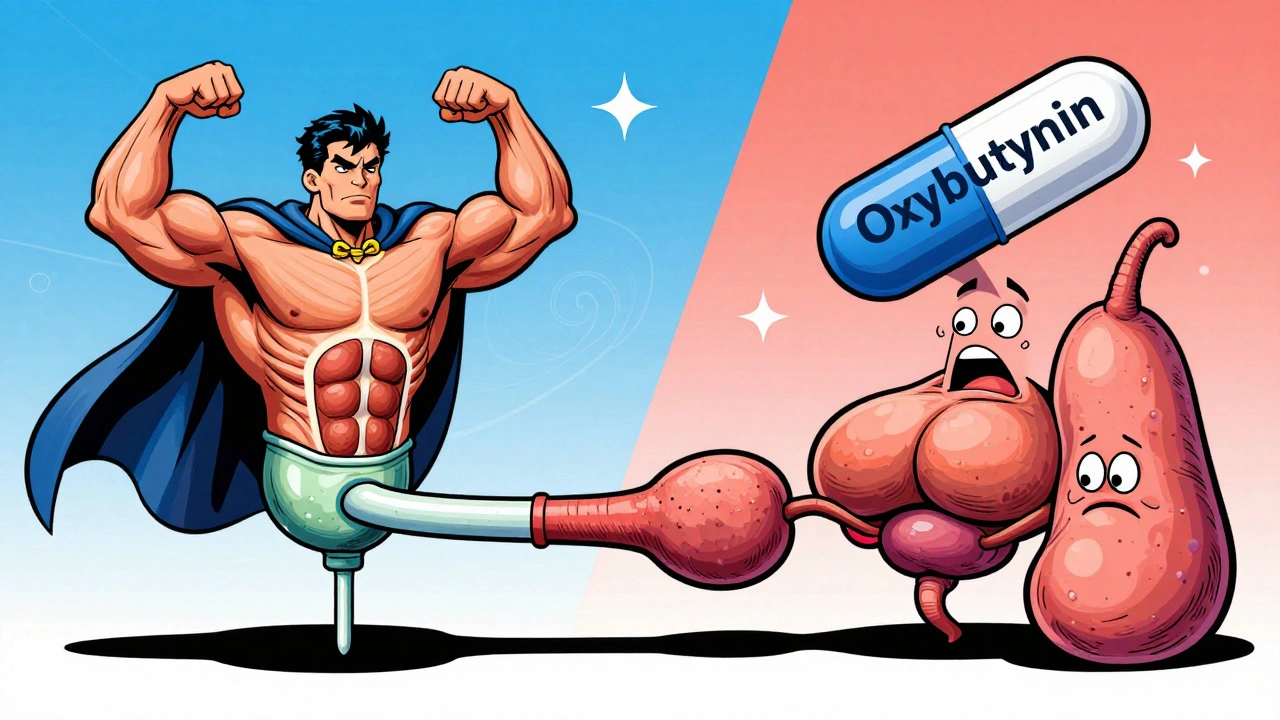
For men with an enlarged prostate, taking a common bladder medication can turn a manageable problem into a medical emergency. Anticholinergics - drugs like oxybutynin, solifenacin, and tolterodine - are often prescribed to reduce urgency and frequent urination. But if you have benign prostatic hyperplasia (BPH), these drugs don’t just help. They can lock your bladder shut.
What Anticholinergics Do to the Bladder
Anticholinergics work by blocking acetylcholine, a chemical signal that tells the bladder muscle to contract. In people with overactive bladder, this helps reduce sudden urges and leaks. But in men with BPH, the bladder is already fighting an uphill battle. The prostate presses on the urethra, making it harder to empty. The bladder muscle compensates by working harder - thickening, straining, and pushing harder to get urine out.
When you add an anticholinergic, you’re telling that overworked muscle to relax. It’s like taking the foot off the gas pedal of a car trying to climb a steep hill. The result? Incomplete emptying, rising residual urine, and eventually, total urinary retention.
Studies show that 8-15% of people on these drugs report trouble urinating. For men with BPH, the risk jumps to more than double. One 2017 study found that men with moderate BPH on anticholinergics had a 2.3 times higher chance of acute retention than those not taking them. That’s not a small side effect. That’s a life-altering complication.
The Double Hit of BPH and Anticholinergics
It’s not just about the prostate blocking the flow. It’s about what happens when the bladder’s ability to push is weakened at the same time. Think of it as a two-part failure:
- Part 1: The prostate physically narrows the urethra.
- Part 2: The anticholinergic weakens the bladder’s ability to squeeze.
Together, they create a perfect storm. The bladder fills up, but can’t empty. Residual urine builds. Infections follow. Catheters become necessary. In some cases, surgery is the only way out.
The American Urological Association’s 2018 guidelines are blunt: avoid anticholinergics in men with AUA symptom scores over 20 or prostate volumes over 30 grams. These aren’t arbitrary numbers. They’re thresholds where the risk of retention becomes too high to justify the modest benefit.
And the benefit? It’s small. A Cochrane review of over 6,700 patients found anticholinergics reduced incontinence episodes by just one per 48 hours compared to placebo. That’s one less accident in two days. For many men, that’s not worth the risk of being unable to urinate at all.
Real Stories, Real Consequences
Online forums are full of men who didn’t know they were at risk until it was too late.
One user on the Prostate Cancer Foundation forum wrote: “After starting Detrol for urgency, I ended up in the ER with a bladder holding 1,200 ml - the size of a small watermelon. I had a catheter for weeks. Now I’m facing surgery.”
On Reddit’s r/Urology, 78% of 142 men with BPH reported negative experiences with anticholinergics. Of those, 34% needed emergency catheterization. One man wrote: “I thought I was being proactive about my bladder. Turns out, I was setting myself up for disaster.”
The FDA’s adverse event database recorded 1,247 cases of urinary retention linked to anticholinergics between 2018 and 2022. Sixty-three percent occurred in men over 65 with diagnosed BPH. These aren’t rare outliers. They’re predictable outcomes.
What Doctors Should Do - And Often Don’t
Guidelines are clear. Screening is simple. Yet, too many men still get these prescriptions without proper evaluation.
Before starting any anticholinergic, a man with urinary symptoms should have:
- A digital rectal exam to check prostate size
- A uroflowmetry test to measure urine flow speed (under 10 mL/sec = high risk)
- A post-void residual test to see how much urine is left after urinating (over 150 mL = dangerous)
Yet, the American Geriatrics Society’s 2019 Beers Criteria lists anticholinergics as potentially inappropriate for older adults with BPH or urinary retention. Despite this, a 2021 study found that 40% of nursing home residents with BPH were still being prescribed these drugs.
Why? Because doctors often focus on the symptom - urgency - without looking at the root cause. And because patients rarely question their prescriptions. They assume if a doctor prescribed it, it’s safe.
Safe Alternatives That Actually Work
There are better options - ones that don’t put you at risk of retention.
Alpha-blockers like tamsulosin (Flomax) and alfuzosin (Uroxatral) relax the muscles around the prostate and urethra. They don’t touch the bladder muscle. They help the urine flow out - not hold it in. Studies show men on alpha-blockers after catheterization are 30-50% more likely to void successfully within days.
5-alpha reductase inhibitors like finasteride (Proscar) and dutasteride (Avodart) shrink the prostate over time. They take months to work, but reduce the risk of acute retention by 50% over four to six years.
Beta-3 agonists like mirabegron (Myrbetriq) and vibegron (Gemtesa) work differently. Instead of blocking signals, they stimulate the bladder muscle to relax during filling - not during emptying. This means they reduce urgency without weakening the bladder’s ability to contract. A 2022 study found only a 4% retention rate with mirabegron in men with mild BPH - compared to 18% with anticholinergics.
The FDA approved vibegron in 2020 specifically for men with BPH who can’t take anticholinergics. It’s now a first-line option for many urologists.

When Might Anticholinergics Still Be Used?
There are rare cases where they might be considered - but only under strict conditions.
Some experts, like Dr. Kenneth Kobashi, argue that low-dose solifenacin can be used in men with mild BPH and dominant overactive bladder symptoms - if they’re monitored closely. One study showed a 12% retention rate in this carefully selected group, compared to 28% in unselected patients.
But even then, you need:
- Confirmed detrusor overactivity (via urodynamics)
- Prostate volume under 30 grams
- Peak flow rate above 10 mL/sec
- Post-void residual under 100 mL
- Monthly follow-ups for the first three months
If any of those conditions aren’t met, the risk outweighs the reward.
What to Do If You’re Already on an Anticholinergic
If you’re taking one of these drugs and have BPH, don’t stop cold turkey. Talk to your doctor. But do ask these questions:
- Have I had a prostate exam and uroflow test recently?
- What’s my post-void residual number?
- Is my prostate size documented?
- Are there safer alternatives for my symptoms?
If you suddenly can’t urinate, feel bloated, or have lower abdominal pain - go to the ER. Don’t wait. Acute urinary retention is an emergency. Delayed treatment can damage your bladder permanently.
Most cases are resolved with a simple catheter. But the real fix is stopping the drug and starting something safer.
The Future Is Safer
The tide is turning. European and American guidelines now say anticholinergics should be avoided in men with prostate enlargement. Market analysis predicts a 35% drop in prescriptions for men over 65 by 2028.
New research is even more promising. The National Institute of Diabetes and Digestive and Kidney Diseases is funding studies to predict who might safely use anticholinergics using MRI scans and genetic markers. The goal? Personalized medicine - not one-size-fits-all prescriptions.
For now, the message is clear: if you have an enlarged prostate, anticholinergics are not your friend. They might reduce urgency, but they increase the chance you’ll end up with a catheter - and possibly surgery.
There are better, safer ways to manage bladder symptoms. Ask your doctor about them. Your bladder - and your quality of life - will thank you.
Emma Sbarge
December 14, 2025 AT 07:23Doctors are still prescribing these like candy. My uncle got catheterized after taking oxybutynin for 'urgency'-he was 72, had BPH for years, and no one ever checked his residual volume. This isn't a side effect-it's negligence dressed up as treatment.
Sheldon Bird
December 14, 2025 AT 13:19This is such an important post. I’ve seen too many older guys get handed these meds like they’re vitamins. Alpha-blockers are way safer, and honestly? They work better for urgency too. If your doc doesn’t know this, find a new one. Your bladder deserves better.
Michael Gardner
December 15, 2025 AT 19:48So let me get this straight-you’re saying the FDA’s own data shows these drugs cause retention, but doctors still prescribe them? Maybe the real problem isn’t the meds-it’s the profit motive behind them. Big Pharma doesn’t care if you can’t pee, as long as you keep buying.
Willie Onst
December 17, 2025 AT 10:24Man, this hits home. I had no idea my ‘bladder issues’ were being treated the wrong way. I was on solifenacin for six months-felt like I was holding a water balloon inside. Finally switched to mirabegron after reading this. No catheter, no ER trips. Just peace. Seriously, if you’re on one of these, talk to your urologist. It’s not just a side effect-it’s a red flag.
Ronan Lansbury
December 19, 2025 AT 04:57Of course the FDA and AUA say this. They’re all bought off by the pharmaceutical lobby. The real reason anticholinergics are still prescribed is because they’re cheap and easy. Meanwhile, the real solution-lifestyle changes, pelvic floor therapy, even hydration adjustments-is ignored because it doesn’t come in a pill bottle. Wake up, people.
nina nakamura
December 19, 2025 AT 05:018-15% reported trouble urinating? That’s a lie. It’s closer to 30% in real practice. And the Cochrane review? Over 6,700 patients? Most were under 60. BPH isn’t a ‘minor inconvenience’-it’s a slow-motion disaster if you’re not screened. Your doctor skipped the basics. You’re lucky you’re still standing.
Hamza Laassili
December 19, 2025 AT 18:37WHY DO DOCTORS KEEP DOING THIS?!?!? My dad got put on tolterodine and couldn’t pee for 3 days-had to go to the ER at 2am. They gave him a catheter and said ‘oh, you have BPH?’ Like, DUH?!?!? They never even asked if he had prostate issues before prescribing it. This is medical malpractice disguised as care.
Constantine Vigderman
December 21, 2025 AT 14:14Guys, I was skeptical too-but after reading this, I went to my urologist and asked for a uroflow test. Turned out my flow was 8 mL/sec. They took me off the oxybutynin right away and put me on tamsulosin. Two weeks later, I could finally empty my bladder completely. No more midnight races to the bathroom. Just… normal. Seriously, if you’re over 50 and on one of these drugs-get tested. It could save you from a catheter.
Cole Newman
December 21, 2025 AT 14:29Wait, so you’re saying you can just switch to mirabegron? Why didn’t my doctor tell me that? He just kept saying ‘take this pill.’ I had no idea there were alternatives. I’m going to ask for a refill next week-but I’m gonna demand the right one this time. This is life-changing info.
Casey Mellish
December 22, 2025 AT 13:57Excellent breakdown. As someone who’s spent years in public health policy, I’ve seen this pattern repeat: a drug gets approved for a narrow indication, then gets prescribed broadly because it’s easier than addressing root causes. The real tragedy is that men are being told their symptoms are ‘normal aging’-when in fact, they’re being medicated into a medical emergency. We need better screening protocols, not better pills.
Himmat Singh
December 24, 2025 AT 06:46It is imperative to underscore that the utilization of anticholinergic agents in the context of benign prostatic hyperplasia constitutes a profound deviation from evidence-based clinical practice. The resultant urinary retention is not merely an adverse effect; it is a predictable iatrogenic consequence of therapeutic misalignment. It is lamentable that such practices persist in contemporary medical discourse.
kevin moranga
December 26, 2025 AT 05:33I just want to say thank you for writing this. I’m 68, had BPH for 10 years, and was on solifenacin for 3 years. I thought I was just getting older and dealing with it. Then I read your post, went to my urologist, and found out my post-void residual was 210 mL. I was terrified. But we switched me to tamsulosin and finasteride. Now? I’m peeing like a 30-year-old. No catheters. No panic. No more anxiety before leaving the house. I didn’t know there was a better way. I wish I’d known sooner. Please, if you’re reading this and you’re on one of these drugs-don’t wait. Ask your doctor the right questions. You don’t have to live like this. There’s hope. And it’s not magic-it’s just science that got buried under bad habits.